
A car arrives at the auction with a tidy MOT record, no obvious finance marker and a price that leaves room for preparation. The latest mileage looks plausible, the V5C appears consistent and the standard vehicle history check returns no serious warning. That's often where the work starts, not where it ends.
For a UK dealer, a car vehicle check is only useful when the underlying records are read in context. A clean result can confirm that certain databases contain no recorded adverse event. It can't, by itself, prove that the vehicle has an honest identity, a credible mileage progression or a straightforward ownership history.
The distinction matters because mileage fraud is a recurring market risk. HPI reported that one in 11 vehicles undergoing an HPI check was identified with a mileage discrepancy, compared with one in 14 in 2018 and one in 20 in 2014. It also reported 836,214 confirmed mileage discrepancies in 2019, with an estimated annual cost to motorists of more than £800 million (HPI's mileage fraud analysis). A dealer buying on a headline result alone is accepting a risk that a deeper reading may have exposed.
Table of Contents
- The Trade Reality Behind a Clean-Looking History Check
- What a Car Vehicle Check Covers
- The main checks and their purpose
- The Core UK Data Sources Every Dealer Should Understand
- Why a Standard Check Is Rarely the Full Answer
- A clean result has a narrow meaning
- Reading Mileage as a Sequence Rather Than a Number
- Provenance Signals Hidden in Ownership and Resale Patterns
- Registration changes need context
- A Practical Point-of-Purchase Workflow for Trade Buyers
- Start with identity and documents
- Apply decision gates
- Turning Vehicle Intelligence Into a Trade Edge
The Trade Reality Behind a Clean-Looking History Check
A familiar example starts with a small hatchback bought at a regional auction. The MOT history is green, the recorded mileage rises in a broadly believable pattern and the usual finance and stolen-vehicle checks show nothing adverse. Two providers return an HPI-clear style result, so the car is prepared and advertised with confidence.
Two weeks after delivery, the customer reports an intermittent ABS warning. Diagnosis traces the fault to damage around the front end, consistent with an earlier shunt. There's no corresponding insurance marker in the report and no obvious entry in the MOT record. The problem isn't that the check failed to list a recorded event. The problem is that the absence of an entry was treated as evidence that the event never happened.
That distinction causes expensive comebacks. A history report records data held by its sources. It doesn't inspect the vehicle, validate every repair or explain every gap between recorded events. A car can have a clean-looking used car history report while carrying unresolved mechanical, identity or provenance risk.
Practical rule: A clean standard check should move a vehicle into the next stage of assessment. It shouldn't move it straight into retail preparation.
The same issue appears with mileage. A final reading can look reasonable for the vehicle's age, yet the sequence may contain a drop, a flat period or a long undocumented interval. A plate change can also make a quick search appear less connected than the underlying V5C and MOT trail is.
The free car history check guidance from AutoProv is useful for understanding why a basic report is best treated as an initial filter. In practice, the dealer's question isn't, “Is this car clear?” It's, “Does the complete pattern make sense for the vehicle I'm about to own?”
What a Car Vehicle Check Covers
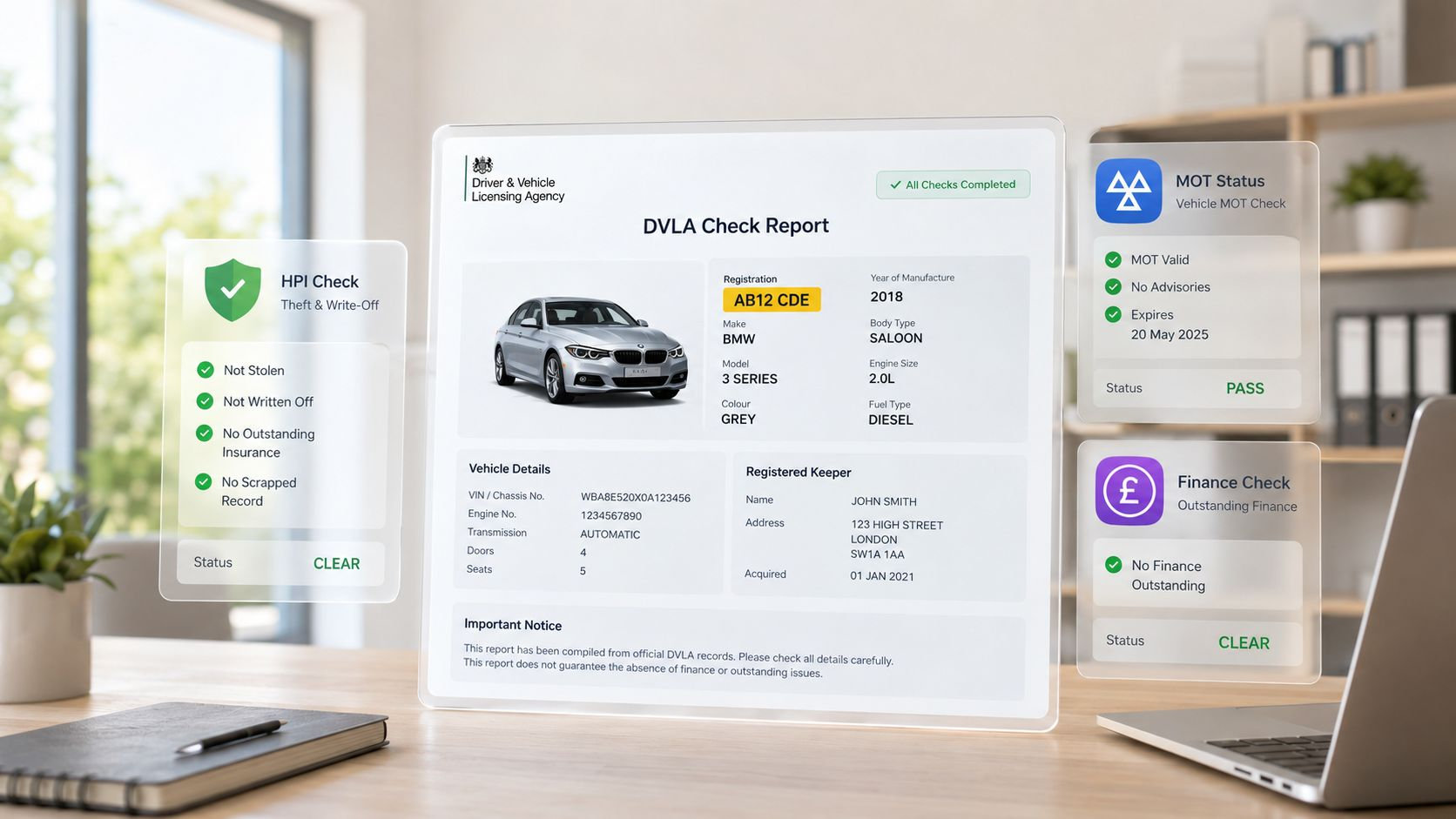
Most dealer checks stop at the headline result. The layers beneath that result are where risk lives. A car vehicle check in the UK brings together legal, recorded, mechanical and commercial evidence, but each layer answers a different question. The useful work is comparing them rather than accepting a single pass-or-fail conclusion.
The main checks and their purpose
- DVLA information: Confirm first registration, the last V5C issue date, vehicle status and other administrative details available through official services. GOV.UK vehicle information provides public access to vehicle and driver information, including MOT and DVLA-held vehicle details.
- MOT history: Review test dates, pass or fail outcomes, recorded mileage, advisories and warnings. The official GOV.UK MOT history service shows the recorded test sequence.
- Mileage verification: Compare MOT readings with service documents, invoices, diagnostic evidence and other contemporaneous records. The dashboard figure is only one point in that chain.
- Finance and security status: Establish whether an outstanding agreement or security interest could affect the transaction. This addresses commercial ownership, not mechanical condition.
- Stolen vehicle records: Check for a theft report or an identity concern connected with stolen-vehicle records.
- Insurance and write-off information: Look for recorded insurance damage and classification details. A missing marker does not prove the vehicle has never been damaged, particularly after a private repair or an incident handled outside the relevant reporting route.
A resource such as the DreamBid vehicle history check helps buyers understand the elements commonly included in a report. The trade decision depends on how those elements fit together and whether the physical car supports the digital record.
A clean result in one area confirms only what the available data records. It cannot confirm repair quality, seller honesty or an event that was never reported. Dealer checks therefore need physical corroboration and a written decision before retail preparation begins.
The Core UK Data Sources Every Dealer Should Understand
Three sources form the foundation of most UK vehicle provenance work: DVLA records, MOT history and mileage evidence. They overlap, but they don't answer the same questions.
DVLA information is primarily administrative. It can help establish first registration, the timing of V5C issuance, registration details and certain vehicle-status information. It can support an ownership timeline, but keeper identity is not generally available as a simple commercial profile, so the data won't always explain why a vehicle changed hands or whether the same business repeatedly supplied problematic stock.
MOT history is more useful for behavioural analysis. The record includes test dates, outcomes, mileage and advisories. RAC's explanation of what an MOT history record contains confirms why dealers should read it as a sequence rather than a single pass result. The limitation is that readings are captured at tests, not continuously. A vehicle can travel, change hands or undergo work between those points without creating a complete digital trail.
Mileage evidence from servicing, repairs and diagnostic activity can fill some gaps. It can also introduce contradictions. Missing invoices, an undated service stamp or a reading that appears only after a long period of use may not prove wrongdoing, but each weakens confidence in the declared history.
Source What It Confirms Known Limitations DVLA Registration timing, vehicle status and V5C-related administrative details Keeper anonymity limits motive and relationship analysis MOT history Test outcomes, advisories, failures and mileage recorded at tests Readings exist at test points, leaving intervals between records Service and repair records Mileage and maintenance evidence linked to specific work Records may be incomplete, inconsistent or unavailable The AutoProv data sources overview provides useful context for how multiple records can be brought together. The practical principle is simple: use DVLA to anchor identity and registration, MOT to establish the tested timeline, and supporting documents to challenge anything that doesn't fit.
Why a Standard Check Is Rarely the Full Answer
A mainstream report is good at answering narrow questions. Is there a recorded finance interest? Is the vehicle listed as stolen? Is there a recorded insurance write-off? Those checks matter, but they cover only part of the risk a dealer carries.
They often don't explain the relationship between ownership timing, plate changes and MOT mileage. They may not identify a plausible-looking sequence where the odometer has been altered in small increments. They also can't reliably expose every privately repaired collision, identity manipulation or misuse that never entered the relevant database.
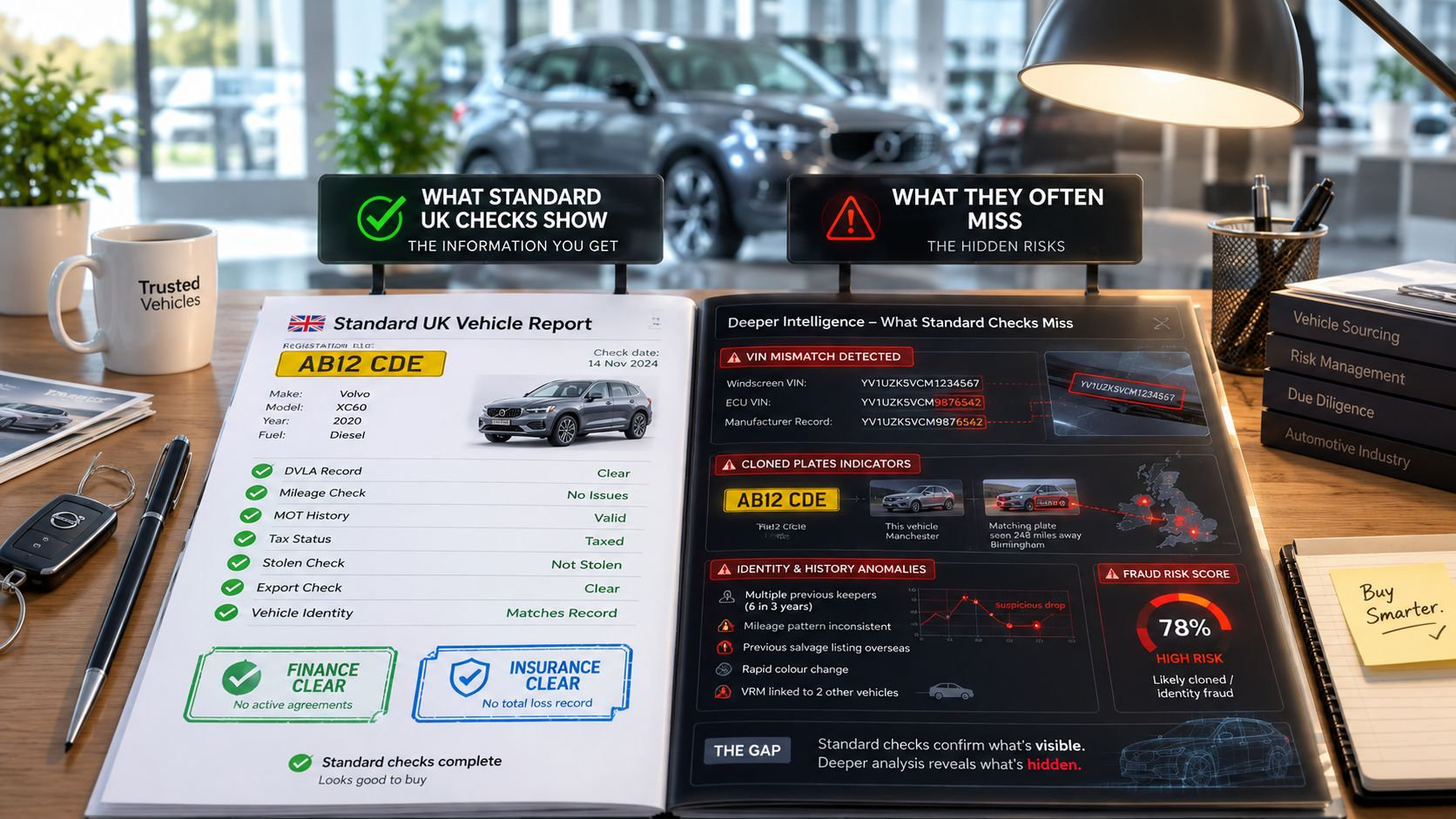
A clean result has a narrow meaning
The phrase “HPI clear” is often used as shorthand for safety. It isn't a mechanical warranty, an identity certificate or proof of honest mileage. It means the relevant search has not returned a recorded marker within the scope of that service.
That gap is visible in wider UK reporting. Diagnostic-based checks reported that 16.25% of 2.5 million checks showed mileage and/or VIN discrepancies, described in the same coverage as roughly one in seven used cars showing signs of fraud-related issues (Auto Express reporting). The important point for a dealer isn't to treat that figure as a universal probability for every purchase. It's to recognise that mileage and identity problems can appear together, while a basic administrative result may not explain the connection.
The official government checker is also deliberately limited. It returns administrative details such as tax, MOT expiry, first registration, type approval, emissions and vehicle status. It doesn't synthesise ownership behaviour, mileage progression or identity anomalies into one commercial risk view.
A report tells you what has been recorded. Provenance analysis asks what the recorded pattern means.
That's why a vehicle history check UK workflow should separate recorded absence from positive evidence. A clear result may support a purchase. It shouldn't close the investigation.
Reading Mileage as a Sequence Rather Than a Number
The latest odometer figure is easy to read and easy to overvalue. A proper mileage check UK process plots each available reading against its date, the vehicle's age and its declared use.
Start with monotonicity. Recorded mileage should generally move forwards. DVSA only permits correction of an MOT mileage error where evidence shows the correct odometer reading within one day of the test, supported by details such as the MOT test number and documents including an invoice, emissions printout, service receipt or job card (DVSA MOT correction guidance). That correction process shows why an unexplained downward step deserves attention rather than casual acceptance.
Next, assess the slope. A flat sequence across several tests may be credible for a lightly used private car, but it needs more scrutiny on a vehicle described as heavily used. A sharp increase may reflect a change in use, a missing earlier reading or a genuine high-mileage period. A decrease is more serious because it conflicts with the expected direction of travel.
Independent analysis of a 2.5 million-car sample reported 160,430 vehicles failing MOT-related mileage checks, with 93% of those inconsistent cases showing a decrease between tests (Driving.co.uk analysis). The same analysis suggested up to 2.48 million clocked cars and vans, around 6.4% of vehicles on the road. Those figures underline why regression should be a decision event, not a footnote.
Pattern Observed What It Usually Means Trade Risk Level Steady increase matching use A broadly coherent record Lower, subject to document and physical checks Flat readings across tests Low use, missing work records or possible manipulation Medium Implausibly low growth for declared use The usage story may be incomplete Medium to high Reading decreases Possible clocking or a documented entry error High Long gap followed by a sharp change Missing evidence or altered sequence High until verified A reading of 2,000 miles a year may be entirely credible for a second car. It deserves a different interpretation if the vehicle was previously presented as a private hire car. The number has no meaning without the usage context.
The AutoProv mileage history guidance is relevant here because mileage should be treated as behavioural evidence. Flag negative deltas, unexplained gaps and readings that don't match wear, servicing or the vehicle's declared role.
Provenance Signals Hidden in Ownership and Resale Patterns
Provenance is the story created by the relationship between records. A vehicle with individually clean entries can still present an uncomfortable pattern when its ownership, registration and resale history are viewed together.
Ownership churn is one such signal. A high number of keepers relative to a vehicle's age can reflect ordinary retail movement, lease returns or genuine changes in circumstance. It can also indicate that several owners discovered faults, attempted to move the vehicle quickly or passed it through the trade without resolving a known problem. Keeper count isn't proof of misconduct, but it changes the questions a buyer should ask.
Rapid resale needs the same treatment. A vehicle that moves through several hands in a short period may have a reasonable explanation, yet repeated short holding periods can align with undisclosed faults, finance complications or attempts to change the commercial story before the next sale.
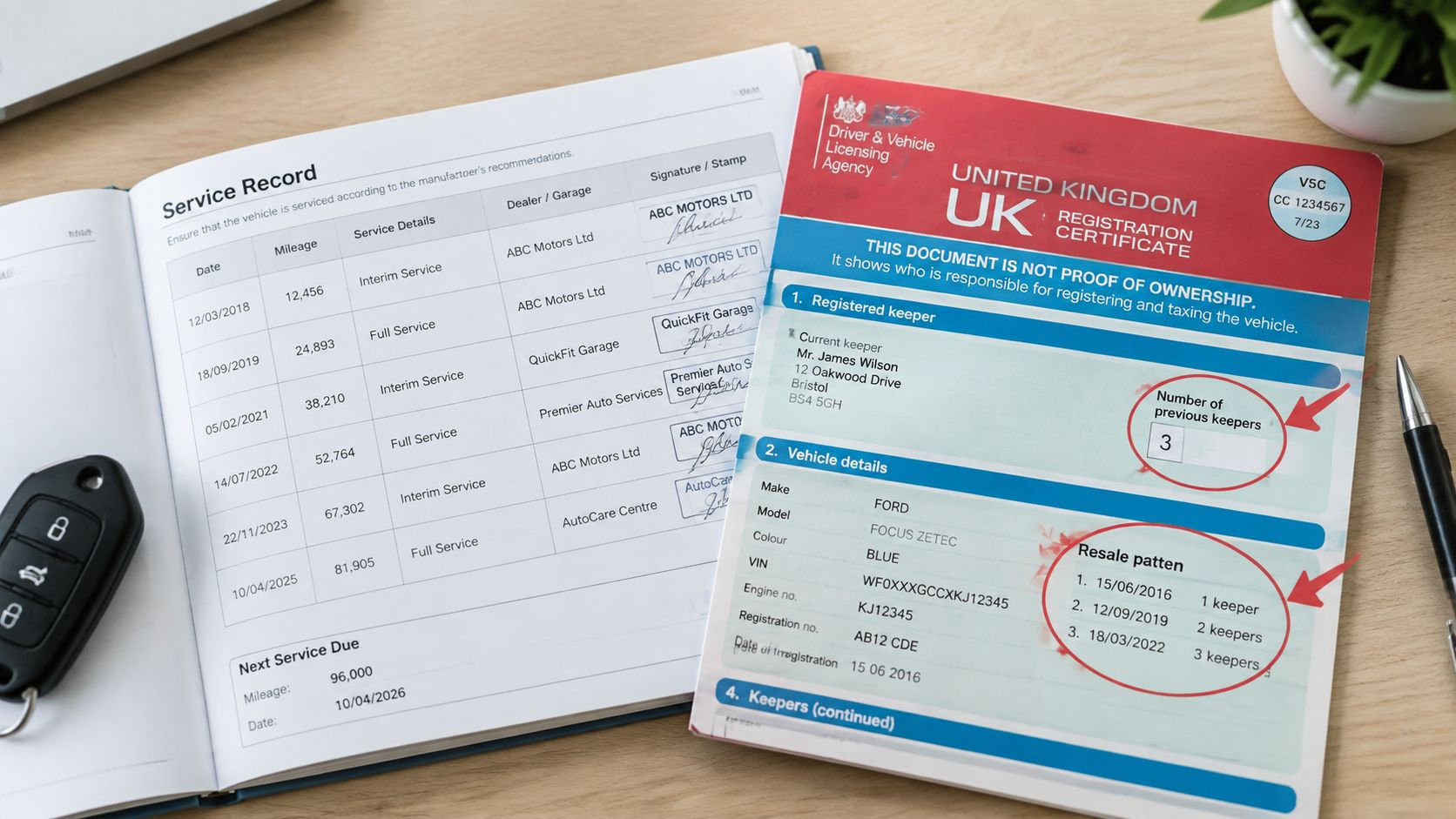
Registration changes need context
Plate changes deserve particular attention because they can interrupt a casual search trail. A private registration applied shortly before sale isn't automatically suspicious, but the buyer should reconnect the underlying vehicle identity, V5C history and MOT records rather than rely on the visible plate alone.
Import registration can create similar confusion. A mileage jump after registration may reflect missing pre-import records, a genuine reading difference or an identity problem. The right response is not an automatic rejection. It's a request for evidence that explains the transition.
Use the following signals as prompts for deeper verification:
- Frequent ownership changes: Ask whether the holding periods fit the vehicle's age, price and market role.
- Rapid resale: Look for preparation invoices, diagnostic records and evidence that the seller had enough time to identify defects.
- Plate changes: Reconcile the current registration with the VIN, V5C and historical MOT entries.
- Missing service periods: Treat absent documentation as reduced confidence, not as proof of a clean period.
A 2024 UK report stated that 2.1% of checked second-hand cars showed mileage rollback, equating to around 160,000 vehicles annually, with affected buyers overpaying an average of £4,758 (Top Car Check coverage). The commercial lesson is broader than the numbers. The car's history needs to be normal for its age and usage, not merely free of an obvious marker.
A Practical Point-of-Purchase Workflow for Trade Buyers
The strongest workflow begins before the bid, part-exchange acceptance or private purchase. Capture the available documents first, then test whether the vehicle in front of you matches them.
Start with identity and documents
Record the VIN from the vehicle, compare it with the V5C and check that the dashboard, body plates and windscreen markings are consistent. Capture the current mileage, registration, engine details, service book, invoices, MOT certificates and any warranty paperwork supplied with the car.
A mismatch at this stage is a stop signal until resolved. Don't allow a seller's explanation to replace documentary evidence. If the engine number is available and relevant to the vehicle, record that too, but remember that VIN consistency remains central to identity verification.
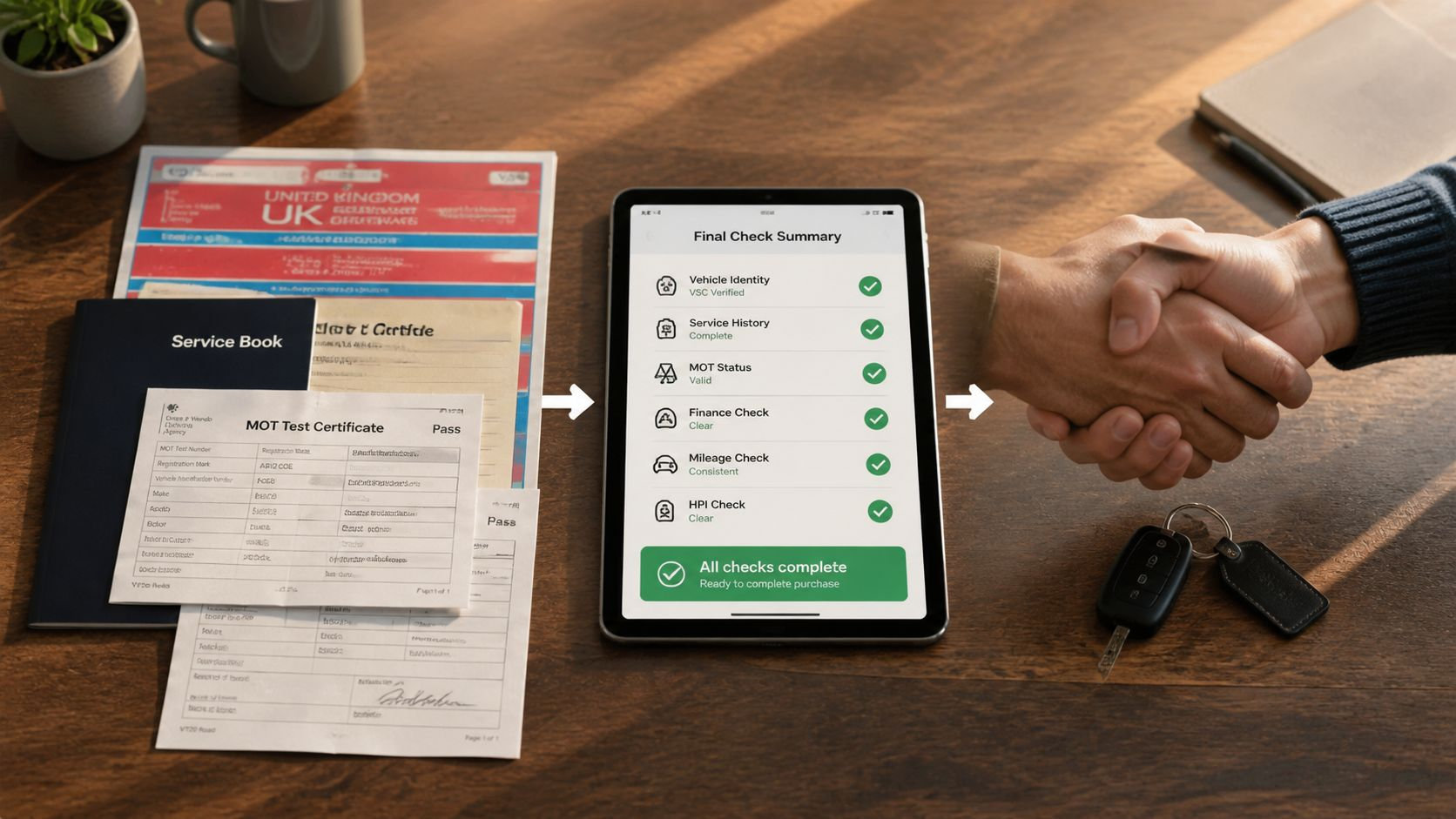
Apply decision gates
Run the checks in a fixed order so urgency doesn't remove a control:
- Administrative gate: Confirm DVLA details, registration status and V5C continuity. Walk away or pause if the identity cannot be reconciled.
- Recorded-condition gate: Review MOT outcomes, advisories, failures and mileage points. Escalate anything that breaks the expected sequence.
- Commercial-risk gate: Check finance, theft and insurance-related markers. If a marker appears, don't proceed on verbal reassurance.
- Provenance gate: Assess ownership churn, resale timing, plate changes and gaps. Renegotiate only when the remaining risk is understood and priced.
- Physical gate: Compare the dashboard mileage with records, inspect VIN markings and test the areas suggested by the history.
A layered workflow doesn't mean every anomaly requires rejection. It means the decision is deliberate. A documented MOT correction may be manageable; an unexplained mileage regression combined with identity inconsistency usually isn't.
The complete vehicle appraisal checklists for trade buyers can support a more consistent internal process. Keep the final check, documents, photographs, inspection notes and decision rationale together. That record supports stock control and gives the business a defensible trail when a complaint or warranty dispute arises.
Turning Vehicle Intelligence Into a Trade Edge
A car vehicle check becomes more valuable when it feeds the next purchase. Dealers that record source, auction location, seller, mileage pattern, ownership behaviour and final outcome can identify recurring risk in their own buying activity.
That doesn't require a complicated forecasting model. A stock controller can log whether a vehicle had a plate change, whether the mileage required documentary clarification, whether a short ownership cycle was present and whether post-purchase faults emerged. Over time, those entries improve judgement around particular sellers, supply routes and vehicle types.
The alternative is transactional checking. The trader runs a report, sees no headline marker, buys the stock and forgets the reasoning. When a similar vehicle appears later, the same blind spot remains. The business pays repeatedly for the same missing context.
The report is an input. The advantage comes from the judgement built around it.
This approach also improves valuation. A car with coherent mileage, traceable servicing, stable ownership and a consistent identity can be priced with greater confidence than one carrying unexplained gaps. That doesn't make the vehicle risk-free. It gives the buyer better grounds for deciding what to pay, what to inspect and when to walk away.
AutoProv's real-time vehicle intelligence reflects this point-of-decision approach by bringing together vehicle history, provenance, mileage progression, ownership patterns and risk indicators for trade assessment. Used properly, tools like this support a process. They don't replace inspection, documentation or professional judgement.
For the UK motor trade, the durable edge isn't owning another report. It's building a repeatable method that turns raw data into buying discipline, protects margin and reduces avoidable post-sale disputes.
AutoProv brings together UK vehicle history, provenance and risk indicators to help dealers assess mileage progression, ownership patterns, finance, theft, write-off and identity signals before committing capital. Visit AutoProv to see how its trade-focused vehicle intelligence can support your point-of-purchase workflow.
Frequently Asked Questions
AI-Generated Content Notice
This article was created with the assistance of artificial intelligence technology. While we strive for accuracy, the information provided should be considered for general informational purposes only and should not be relied upon as professional automotive, legal, or financial advice. We recommend verifying any information with qualified professionals or official sources before making important decisions. AutoProv accepts no liability for any consequences resulting from the use of this information.
From our AI insights
- Navigating UK Grey Imports: A Trader's Guide
Understand the complexities and opportunities of UK grey imports for savvy motor traders.
- Navigating Private Plate Challenges in UK Vehicle Checks
Learn how private plates affect UK vehicle checks and how traders verify provenance and spot cloning risks.
- Navigating VIN Checks Post-Brexit: What UK Traders Need to Know
Discover how Brexit impacts VIN checks for UK traders and the crucial data to review.
Related Articles

Essential Vehicle Checks Before Buying a Used Car
Learn essential checks to ensure your used car purchase is safe and sound in the UK market.

Why a Provenance Check is Essential for Used Car Buyers
Ensure your used car is a smart investment by understanding the importance of a provenance check and how AutoProv can help.
A Guide to Vehicle Check with VIN Number
A vehicle check with vin number is easily the most important thing you can do before buying a used car. Think of it as your first line of defence—a quick, simple step that pulls back the curtain on a vehicle's past, protecting you from expensive mistakes, legal headaches, and downright dangerous cars.
Published by AutoProv
Your trusted source for vehicle intelligence