

You're on the buying desk, the car looks clean, the mileage lines up at first glance, and the seller says all the right things. Then the paperwork starts to wobble. The company name on the invoice doesn't quite match the person at the end of the phone, the ownership story feels thin, and the standard vehicle history check UK result only tells you part of what you need to know.
That's where the know your customer process matters in the motor trade. In practice, it's not just about confirming who you're dealing with, it's about understanding the vehicle provenance, the counterparty behind the stock, and the risk signals that sit between the two. Dealers who treat KYC as a buying control, not just a compliance chore, tend to spot issues earlier and negotiate with more confidence.
Table of Contents
- Why the Know Your Customer Process Matters in the Motor Trade
- The practical buying-desk reality
- UK Regulatory Foundations of Customer Due Diligence
- Ongoing control, not a one-off check
- What the rules force you to document
- Step-by-Step KYC Workflow for Motor Trade Onboarding
- Build the file in the right order
- Keep exception handling explicit
- Retain evidence like you expect a challenge
- Risk-Based Due Diligence Paths for Dealers and Wholesalers
- How the levels differ in practice
- Vehicle Provenance Red Flags and Fraud Indicators
- What tends to look suspicious
- Why point-in-time checks miss real risk
- Compliance Checklists and Practical Templates
- A practical dealer checklist
- Make reviews event-driven, not decorative
- Use tools to support, not replace, judgement
- Moving from Point-in-Time Checks to Continuous Monitoring
- What continuous monitoring looks like in a dealership
Why the Know Your Customer Process Matters in the Motor Trade
A used car can look straightforward and still carry hidden risk. The logbook may be in order, the odometer may not raise an obvious alarm, and the walkaround may feel routine. The problem is that a clean presentation doesn't tell you whether the person selling the car can support the story behind it.
In a trade context, the know your customer process has to do more than confirm a name and address. It needs to help you assess whether the counterparty is credible, whether the vehicle's background makes commercial sense, and whether anything in the chain of ownership feels incomplete. A standard used car history report is useful, but it won't always tell you whether the seller, the stock pattern, or the provenance trail deserves more scrutiny.
The practical buying-desk reality
The sharpest risks usually show up as small mismatches. A dealer account opened quickly, a stock list that changes hands fast, or a seller who can't give a clear explanation of how they acquired the vehicle, all of those are clues worth slowing down for. None of them prove misconduct on their own, but together they can justify a deeper check.
Practical rule: if the vehicle story and the counterparty story don't line up, treat that as a buying risk before it becomes a post-sale dispute.
That mindset matters because the motor trade doesn't buy cars in a vacuum. You're pricing stock, checking margin, and trying to keep turnaround moving, so a weak onboarding process can create friction later when a customer query, warranty issue, or provenance challenge lands on your desk. Good dealer vehicle checks reduce that drag by making the decision more defensible at the point of purchase.
The best operators don't use KYC as a gate that slows everything down. They use it as a filter that separates ordinary stock from the cases that need a second look. That's where motor trade risk and trade vehicle intelligence intersect, because the decision is rarely only about the vehicle, it's about who is selling it and whether the paper trail supports the buy.
UK Regulatory Foundations of Customer Due Diligence
A dealer can have a tidy file and still fail the test if it cannot show who the counterparty really was, who owned or controlled it, and why the car moved through that route. In practice, UK customer due diligence starts with those questions, not with a stack of scanned documents.
The core obligation is to identify the customer, verify identity, identify any beneficial owner where relevant, and assess the purpose and intended nature of the relationship or transaction. The JMLSG keeps that structure central in its guidance, which is why motor traders should treat KYC as formal identification and verification work rather than informal screening (JMLSG guidance for Part I).
That distinction matters on a showroom floor and in the buying office. A company buying stock from another business may sit outside the same regulatory perimeter as a bank, but the practical expectation is similar, you still need a documented way to establish who you dealt with, why the relationship exists, and whether ownership or control raises risk. For a wider view of where regulated activity begins and why some motor trade arrangements need closer attention, see AutoProv's FCA regulated activities guide.
Ongoing control, not a one-off check
UK guidance also treats due diligence as ongoing control. Firms are expected to monitor the relationship after onboarding, because risk changes and activity patterns drift.
That fits the motor trade. Suppliers change, company structures shift, and a counterparty that looked ordinary at first can start behaving differently later. A clean file at point of purchase does not stay clean if the trading pattern changes and nobody rechecks the basis for the relationship.
What the rules force you to document
The rules also push firms towards records that can stand up to challenge. Where beneficial ownership cannot be established satisfactorily, the file needs to show what steps were taken and why the relationship was still accepted. Where a company structure is involved, reasonable measures to understand ownership and control are expected (FCA handbook guidance).
For a motor trader, that becomes very practical. If a limited company bought a part-exchange through a director who could not be traced back to the registered business, and the file still relied on a single invoice and a copy of an ID card, that is weak. A defensible file would show the legal entity, the person acting, the ownership or control checks made, and the route to ownership of the vehicle. If the seller's explanation of how they acquired the car does not match the paperwork, the file should reflect that gap, not smooth it over.
A dealership file is only as strong as the story it can prove.
Step-by-Step KYC Workflow for Motor Trade Onboarding
A workable onboarding flow for the motor trade needs to be simple enough for sales and buying teams to use, but strict enough to survive audit or dispute. Start with the counterparty, then move to the vehicle, then capture the exceptions. If you get the order wrong, you end up verifying a stock item before you know whether the business behind it is credible.
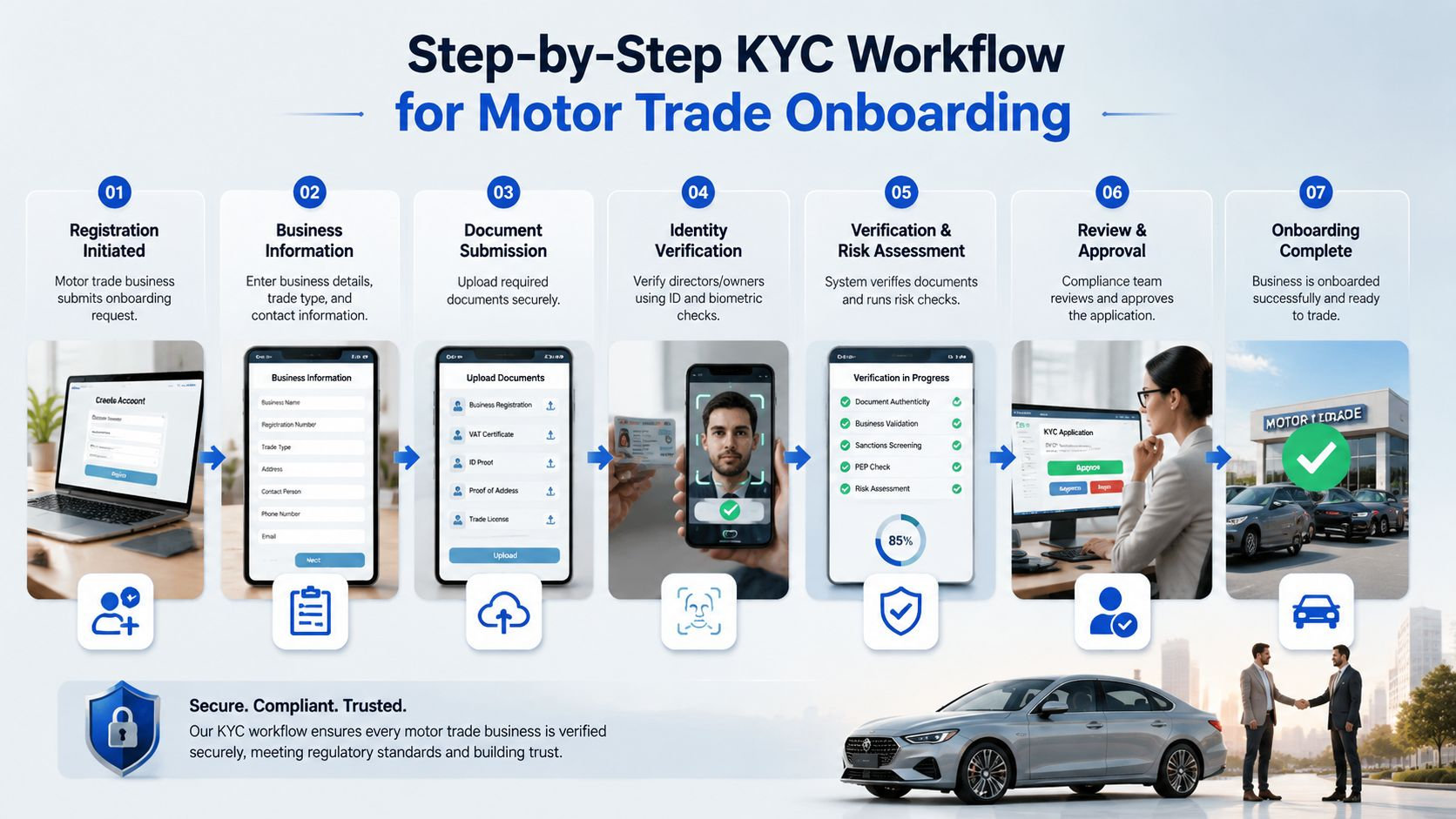
Build the file in the right order
The best process starts with identity capture. For a company counterparty, that means the legal entity, trading name, registered details, and the person you're dealing with. For an individual trader, it means enough identity evidence to link the person to the transaction without leaving gaps that later have to be guessed at.
From there, move into beneficial ownership and control. UK rules expect reasonable measures to understand the ownership structure, and that turns KYC into a graph-tracing exercise rather than a simple document scan (FCA handbook guidance). If the ownership chain is incomplete, the workflow needs a fallback path, because the regulation expects firms to prove what was attempted and why a senior managing person was used instead.
Keep exception handling explicit
Many dealership processes fall apart at this point. Standard ID is easy to verify when the counterparty is organised, but real trade life includes missing documents, partial company data, group structures, and hurried transactions. The file should show what evidence was requested, what came back, what was rejected, and what the next control was.
A practical way to reduce that friction is to use a document review layer before the case reaches final approval. Tools like LegesGPT's AI document review can help teams spot inconsistent information faster, but the compliance decision still needs a human owner.
Retain evidence like you expect a challenge
Once the file is built, keep the record trail clean. Record the relationship purpose, the checks completed, the exceptions raised, and the reason for the decision. The technical value here isn't paperwork for its own sake, it's that a dealer can show the logic behind the onboarding decision if a finance partner, auditor, or buyer questions it later.
For teams trying to tighten this up operationally, process automation benefits are obvious, but automation only works if the underlying workflow is already disciplined. Bad process made faster is still bad process.
Risk-Based Due Diligence Paths for Dealers and Wholesalers
Not every counterparty deserves the same depth of checking. A low-risk trade account with clean trading history doesn't need the same treatment as a newly formed company with an unclear ownership chain and a vehicle story that keeps changing. The UK framework allows different levels of due diligence, but only when the risk basis is real and documented (JMLSG Part II guidance).
How the levels differ in practice
Due Diligence Level When to Apply Evidence Required Motor Trade Example Simplified due diligence Only where risk is demonstrably low Basic identity and relationship checks, with no red flags Long-standing wholesale counterparty with stable trading history Standard due diligence Normal trading where the risk profile is ordinary Identity, ownership, purpose of relationship, and routine verification Retail prep purchase from a regular trade supplier Enhanced due diligence Where risk is higher, evidence is weak, or red flags appear Deeper checks on beneficial owners, ownership chains, reputation, and negative allegations New corporate seller with unclear controller information and unusual vehicle sourcing Simplified due diligence is often misunderstood. It isn't a shortcut you can apply because the file looks tidy. It only works where risk is low, and it must not be used if there are signs of money laundering or doubts about the truth of the information obtained (JMLSG Part II guidance). In the motor trade, that means a clean-looking invoice isn't enough if the trading pattern is odd or the seller can't explain the chain of supply.
Enhanced due diligence is the opposite of guesswork. It needs more evidence, more context, and more challenge. That includes ownership chains, controller roles, reputation checks, and negative allegations where relevant, because the point is to understand whether the risk picture has changed enough to justify a different decision.
Trade discipline matters here. Risk scoring should trigger escalation, not sit in a dashboard as a label nobody acts on.
The operational mistake is to treat risk scoring as a static classification. In practice, it should be a control trigger that sends the case to a reviewer when the evidence quality drops or the transaction feels off. For broader context on adverse signals, see AutoProv's adverse media screening guide.
Vehicle Provenance Red Flags and Fraud Indicators
A vehicle can pass a basic check and still deserve extra scrutiny. Mileage consistency, ownership pattern, and source documentation all matter, because provenance problems rarely announce themselves with one dramatic signal. More often, they show up as small mismatches that become obvious only when you compare data sets side by side.
The GOV.UK MOT history service exposes the mileage recorded at each test, so a dealer can see whether an odometer reading is consistent across the inspection record (GOV.UK MOT history). If a mileage entry is wrong, the correcting evidence has to show the correct mileage and a date within one day of the MOT test, which is a useful reminder that mileage data can be corrected but only with tight supporting proof. DVSA guidance also distinguishes simple data errors from later corrections, so MOT mileage history is an indicator, not a standalone proof of true mileage (DVSA correcting MOT certificate mistakes).
What tends to look suspicious
The strongest provenance red flags usually sit in patterns rather than single facts.
- Mileage gaps or jumps: When the MOT trail doesn't line up neatly, the history needs a closer look.
- Short-term ownership: Fast turnover can be perfectly legitimate, but it can also hide risk if the paper trail is thin.
- Incomplete handover evidence: Missing invoices, weak sourcing notes, or unclear seller identity make the file harder to defend.
- Post-sale story changes: If the explanation changes after the vehicle has already moved through the channel, treat that as a warning sign.
The open-data release of anonymised MOT tests and results goes back to 2005, including odometer readings and failure reasons, which gives the trade a long-run view of anomalies rather than a single snapshot (MOT open data). That's important because a vehicle provenance review should look for gaps, reversals, and improbable sequences, not just one clean result.
Why point-in-time checks miss real risk
Point-in-time checks are useful, but they're also limited. A vehicle can look fine on the day of purchase and then reveal a different ownership story later, especially where the source chain moved quickly or the seller was only a temporary holder. That's why counterparty due diligence and vehicle intelligence need to sit together.
For practical ownership-pattern analysis, a trade-focused tool can add context that a basic report misses. The useful question isn't only whether the car exists, it's whether the story around it makes commercial sense. That's where plate change history insights help buyers connect identity changes to provenance risk without overreacting to normal admin changes.
Compliance Checklists and Practical Templates
A KYC file only works on the showroom floor if a buyer can complete it without slowing the deal to a crawl, and a compliance lead can still defend it when stock, counterparties, or ownership change. That means the template has to track the vehicle story as closely as the counterparty file, because in the motor trade those two records rise and fall together.
A practical dealer checklist
Use a checklist that matches how used stock is sourced, valued, and released.
- Confirm the legal counterparty: Match the entity name, trading style, and the person controlling the deal.
- Check ownership and control: Record who owns or controls the business, or note why that could not be established.
- Capture the vehicle story: Note where the stock came from, how long it was held, and whether the timeline makes commercial sense.
- Record the risk call: Log why the case is standard, low risk, or escalated.
- Keep the evidence trail: Save what you asked for, what you received, and what you rejected.
That last point is where weak files usually fall apart. If a supplier gives partial paperwork, the record should show what was chased, what was accepted, and what still needs clarification. The same discipline helps when a buyer later questions valuation or provenance.
Make reviews event-driven, not decorative
A calendar reminder is not enough. A new director, a new trading address, a change in stock profile, or an unexplained gap in activity should reopen the file and prompt a fresh judgment.
The template should say who reviews the case, what evidence they need, and what closes it. If those fields are vague, the process turns into box-ticking and the buying office starts treating compliance as paperwork instead of a control.
For teams that need a cleaner way to keep records tied to the live deal, streamline documentation with OnRoute is a useful reference point. The practical lesson is simple, keep the fields specific, keep the ownership clear, and do not rely on memory when a file is challenged later.
Use tools to support, not replace, judgement
Internal templates work better when they sit beside vehicle intelligence that flags anomalies early. That gives the buyer a cleaner handoff into valuation, negotiation, and stock approval, without pretending the software can make the final call.
For ready-made support, AutoProv's free compliance tools can sit alongside your own file structure. They help standardise the paperwork, but the trade team still owns the decision on risk, source, and whether the deal makes sense.
Moving from Point-in-Time Checks to Continuous Monitoring
A one-time KYC check feels tidy, but it ages quickly. UK guidance frames customer due diligence as an ongoing process, with monitoring used to detect changes in risk or activity patterns over time, and that logic fits the motor trade better than many realise. A supplier who looked ordinary at onboarding can become a different risk once ownership, trading behaviour, or vehicle source patterns change.
Recent UK regulatory updates have also pushed harder on audit trails, better documentation of the nature and purpose of relationships, and stronger re-KYC after inactivity, while poor practice examples have included periodic review backlogs and screening only after onboarding (Stephenson Harwood summary of updated FCA guidance). For dealers and wholesalers, that means the file can't sit still. It has to move with the relationship.
What continuous monitoring looks like in a dealership
Monitoring doesn't need to be complicated to be effective.
- Track relationship changes: New owners, new directors, or new trading names should reopen the file.
- Watch vehicle-source patterns: Rapid changes in how stock is acquired can justify a fresh review.
- Revisit inactive accounts: A dormant counterparty returning after a gap shouldn't be treated as a clean continuation by default.
- Preserve the audit trail: Record why the case stayed open, was escalated, or was rechecked.
That approach is particularly important for trade-counterparty due diligence because vehicle sourcing can move quickly. A point-in-time file might not capture short-term holding patterns, rapid ownership shifts, or post-sale disputes unless the process keeps looking after the initial buy.
Continuous monitoring is cheaper than explaining a bad buy after the event.
The practical value is not only compliance. It's better buying discipline, cleaner negotiation, and fewer avoidable surprises in the prep bay or after the handover. Dealers that build KYC into ongoing stock control usually find they make sharper decisions because the risk picture stays current instead of stale.
If you want a clearer way to connect counterparty checks, vehicle provenance, and ongoing risk review, visit AutoProv and see how trade-focused vehicle intelligence can support your buying office. It's a practical way to strengthen the know your customer process without slowing down the stock that deserves to move.
Frequently Asked Questions
AI-Generated Content Notice
This article was created with the assistance of artificial intelligence technology. While we strive for accuracy, the information provided should be considered for general informational purposes only and should not be relied upon as professional automotive, legal, or financial advice. We recommend verifying any information with qualified professionals or official sources before making important decisions. AutoProv accepts no liability for any consequences resulting from the use of this information.
From our AI insights
- Navigating DVLA Conviction Checks: Dealer Compliance
Understand DVLA conviction checks and lawful access for UK dealers.
- Streamlining Compliance: Automated Checks for Dealers
Discover how UK car dealers can automate compliance checks, reduce risk, and build trust with AutoProv.
- Avoiding Towing Missteps: Legal Checks for Dealers
Protect your dealership by ensuring vehicle weight and towing capacity compliance before listing stock.
Related Articles

Understanding the Consumer Rights Act 2015 in the UK Motor Trade
Explore the Consumer Rights Act 2015 and its impact on UK car buyers and sellers, offering essential protections and insights.

Understanding UK Automotive Regulations
Explore the complexities of automotive regulations in the UK, covering DVLA, FCA, MOT, and more.
What is a V5C Document: A Quick UK Log Book Guide
If you've ever bought or sold a car in the UK, you've definitely come across the V5C. It's often just called the 'log book', and it’s the official Vehicle Registration Certificate issued by the DVLA.
Published by AutoProv
Your trusted source for vehicle intelligence
