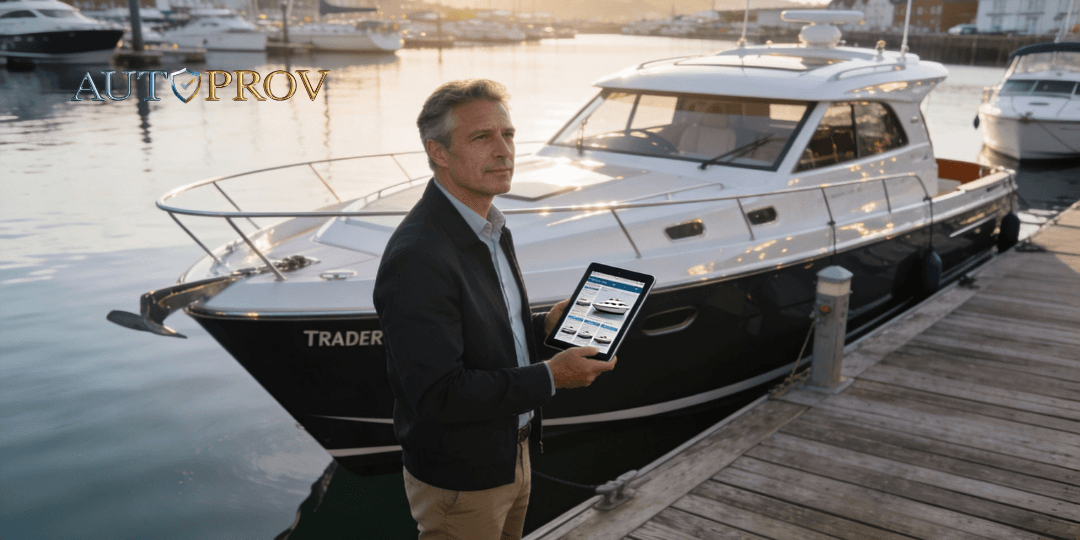
A Trader looks clean on the listing, the photography is competent, the broker sounds organised, and the paperwork appears to stack up at first glance. Then funds move, delivery is arranged, and a title defect surfaces late. It might be an unresolved ownership break, an incomplete chain of sale documents, or a finance-related issue that should have been identified before anyone paid a deposit. At that point, the problem isn’t aesthetic. It’s capital exposure.
That pattern is familiar to anyone in the UK motor trade. A used car can present well and still carry hidden risk. A yacht is no different. The only real difference is that marine buyers too often approach a six-figure asset as a lifestyle purchase first and a provenance exercise second. That order is backwards.
A Trader acquisition should be handled with the same discipline as specialist stock buying. If you'd insist on a proper vehicle history check UK, mileage context, ownership pattern analysis, and a clear proof-of-title path before buying a performance car, you should expect the marine equivalent before buying a motor yacht.
Beyond the Brochure A Trader's Approach to Yacht Acquisition
A common failure point is assuming that “brokered sale” means “risk managed”. It doesn’t. Brokers market and facilitate. They don't remove your obligation to verify title, ownership continuity, or document integrity.
I’ve seen buyers focus heavily on cosmetics, domestic fit-out, and whether the engine room looks tidy. Those things matter, but they don’t rescue a weak file. If the seller can’t evidence an unbroken ownership trail, or if key papers arrive late and in fragments, that vessel is already telling you something.
Why marine buying needs a trade mindset
Motor traders already understand this logic. A standard used car history report can return clean, yet a deeper review of usage pattern, prior disposal route, or inconsistent paperwork can still alter the buy decision. The same thinking applies here. Boat provenance is not a luxury check. It’s the basis of the transaction.
That’s why I’d treat a Trader file like any other high-value used asset file:
- Start with identity certainty: Hull identity, registration detail, builder information, and sale documents must align.
- Test the paper trail before viewing: If ownership evidence is fragmented at desk stage, don’t assume it will improve later.
- Separate seller confidence from seller proof: A persuasive explanation isn't evidence.
- Price follows risk: A cheaper yacht with unclear title can become the most expensive option in the yard.
Practical rule: If the paperwork makes you work too hard before survey, walk away or pause the file.
Borrow discipline from adjacent markets
The most useful crossover from the motor trade isn’t a specific database. It’s the mindset of point-of-decision intelligence. That’s the same principle behind analysing provenance before buying niche car stock, as discussed in this guide to the Parker car buying process.
For marine buyers who want a simple sense-check before the detail work starts, Better Boat’s 10 tips for boat buyers is a useful prompt list. It won’t replace a serious due diligence workflow, but it does reinforce the basic truth that pre-purchase discipline beats post-purchase regret.
Sourcing and Vetting Trader Yachts Like a Professional
The first filter happens before anyone books travel, survey lift, or sea trial. This is desk work. Done properly, it removes weak opportunities early and keeps your time for boats that justify a closer look.

Trader motor yachts are primarily found in the UK, with pre-owned models from 1974 to 2008, ranging from 43 to 68 feet, and UK pricing starts around £104,000 and can exceed £800,000 according to YachtWorld’s current Trader listings. That tells you two things straight away. First, this is a used-asset market. Second, age spread is wide enough that generic assumptions are dangerous.
Filter listings before you inspect anything
When reviewing trader motor yachts for sale, I’d sort listings into three categories. Proceed, pause, and reject.
Proceed if the listing gives a coherent story. Model, year, location, ownership context, specification, and documentation references should line up without strain.
Pause if the listing looks polished but avoids specifics. Missing engine detail, vague ownership wording, soft language around maintenance, or phrases such as “believed to be” around important facts all deserve follow-up.
Reject when the seller or broker can’t answer basic file questions promptly. Delay at this stage usually gets worse, not better.
A practical starting framework:
- Check listing consistency: Compare the written description with visible equipment, layout photos, and any stated registration references.
- Request document headlines early: Ask whether the vessel has builder paperwork, bills of sale, registration material, VAT evidence, and maintenance history before discussing price in depth.
- Confirm who is selling: A central agent with authority is different from an intermediary relaying messages.
- Interrogate location: A boat’s berth can affect logistics, access for survey, and how quickly you can verify facts.
Assess the broker as well as the boat
A lot of buyers vet the yacht and forget to vet the transaction pathway. That’s a mistake. A credible selling broker should be able to explain who instructs them, what documents are already held, how deposits are handled, and what conditions govern offer acceptance.
A weak broker file often reveals itself through evasive sequencing. They want the offer first and the documents later.
That doesn’t automatically mean dishonesty. Sometimes the seller is disorganised. Commercially, the distinction matters less than people think. A disorganised seller can create the same delay, uncertainty, and abort cost as a problematic one.
Spot outliers without becoming emotional
An asking price outside the obvious range can indicate opportunity, but it can also indicate compromise. The car trade knows this well. Cheap stock is often only cheap on day one. The same discipline behind buying a used car properly applies here. Filter first, verify second, inspect third. Don’t reverse that order because the teak looks good in the photographs.
Mastering Marine Provenance and Documentation
The hardest losses usually come from paper, not paintwork. Engines can be repaired. Upholstery can be replaced. A defective ownership trail is different because it strikes at the buyer’s legal and commercial position from the outset.

In the motor trade, vehicle provenance means more than “it has a logbook”. It means understanding whether the ownership history, identity markers, usage pattern, and supporting records form a believable whole. Marine buying requires the same standard. A pile of documents is not the same thing as a clean chain of title.
The ownership trail must be continuous
The first document group to review is the sale chain. In practice, that usually means every available Bill of Sale linking one owner to the next.
You’re looking for continuity, not volume. Names, dates, vessel description, and identifying details should align logically from one transfer to the next. A gap doesn’t always kill the deal, but it must be explained and supported. If one transfer is missing and everyone involved tells you “it was all dealt with years ago”, treat that as unresolved until proved otherwise.
This is the marine equivalent of checking whether a seller can properly evidence ownership of a vehicle. The same principle sits behind clear guidance on proof of ownership in vehicle transactions. Possession is not proof. A seller holding keys and papers doesn't automatically equal clean title.
VAT status needs direct evidence
VAT is one of the most misunderstood marine risk areas because buyers often rely on informal assurances. They hear that the boat has “always been in the UK” or “has been around for years” and assume that settles the matter. It doesn’t.
Look for documentary support. That may include original purchase material, import evidence, or other paperwork that gives you a defensible position on tax status. If the file depends on verbal history and scattered copies, push for clarity before exchange.
A practical point from trade buying applies here. If a risk can’t be quantified cleanly, it usually gets ignored in negotiation and reappears as a post-deal problem.
Registration matters because traceability matters
Registration is useful because it adds structure to the identity file. If the yacht is on the UK register, review the details carefully and match them against the vessel itself and against the sale documents.
What matters most is consistency:
Document area What to verify Why it matters Ownership records Seller name matches authority to sell Reduces title dispute risk Vessel identity Hull details align across documents Helps prevent misdescription Registration papers Current details and history make sense Supports traceability Builder information Original specification and identity cues align Strengthens authenticity review The point isn’t bureaucracy for its own sake. The point is that every document either strengthens the identity story or weakens it.
If the ownership chain, registration file, and vessel markings don't agree, the boat has not passed due diligence. It has only reached the next question.
Builder records and original specification still matter
The Builder’s Certificate or equivalent original construction paperwork can be important because it anchors the yacht’s original identity. It helps when later modifications, relabelling, or broker descriptions have blurred the facts.
This is especially relevant with older Trader stock, where years of refit, equipment changes, and changing sales language can obscure the original build specification. A buyer should know what the yacht started as, not just what it’s currently being called.
Maintenance records are context, not title
Service files, invoices, manuals, and refit records are valuable, but they don’t replace ownership evidence. They help you understand care, technical decision-making, and whether the vessel has been maintained with discipline. They can also expose contradictions.
Examples of useful signals include:
- Dates that make sense: Service chronology should follow ownership chronology.
- Named suppliers: Recognisable marine specialists often add confidence, even where records are incomplete.
- Recurring unresolved faults: Repeated references to the same issue may tell you more than a polished broker description.
- Modification paperwork: Major equipment changes should have some documentary footprint.
A proper used car history report can reveal pattern and anomaly rather than a pass or fail. Marine documents should be read in exactly that way. You are not collecting papers. You are testing whether the whole file tells one coherent story.
The Essential Survey and Sea Trial Checklist
Paperwork answers who owns the yacht and how the file holds together. Survey and sea trial answer what the asset is today. Those are different questions, and both matter.
A proper pre-purchase process needs independent technical eyes. It also needs a buyer who pays attention on the day. Too many purchasers outsource all observation to the surveyor, then skim the report later. That’s poor practice.

Know what each survey is for
Not every survey answers the same commercial question. Buyers should be clear on scope before instruction.
A pre-purchase condition survey focuses on the vessel’s structure, systems, and visible condition. That’s the broad technical snapshot.
An engine survey goes deeper into propulsion and associated machinery. On an older motor yacht, that extra scrutiny is often worth having.
A valuation survey is a separate exercise. It may satisfy lender or insurer requirements, but it shouldn’t be mistaken for a substitute for detailed condition work.
What the buyer should observe directly
Even with a good surveyor onboard, I’d want the buyer or their representative to make their own disciplined observations. Not because they’re replacing the surveyor, but because negotiation and acceptance decisions are commercial as well as technical.
During inspection, focus on what can be verified by operation and by consistency.
- Hull and deck condition: Look for signs of repair, stress, poor cosmetic masking, soft feel underfoot, or areas where presentation looks fresher than surrounding structure.
- Engine room discipline: Cleanliness matters less than honesty. Fresh paint, wiped surfaces, and staged presentation can hide weeping joints or neglected components.
- Electrical behaviour: Power up systems methodically. Random failures, improvised labelling, and non-functioning equipment matter because they speak to maintenance culture.
- Domestic systems: Water, heads, pumps, refrigeration, heating, and galley equipment should be operated, not merely described.
- Navigation electronics: Switch everything on and test what can be tested in a realistic way.
Buyer’s note: A non-functioning accessory may be minor. A seller who says “I’ve never used that” about half the boat is not.
Use the sea trial as evidence, not theatre
The sea trial should not become a social outing. It is a controlled opportunity to verify operation under load and to correlate what the boat does with what the listing, seller, and survey suggest.
Watch how the yacht starts, idles, responds astern, comes onto load, and behaves across the rev range. Listen for hesitation, imbalance, vibration, smoke pattern changes, steering inconsistency, and system alarms. Observe whether temperatures, pressures, and instrumentation remain credible.
A simple working format helps:
Trial area What to do What to watch for Start-up Cold start where possible Reluctance, excessive smoke, uneven running Helm response Manoeuvre at low speed and in turns Delay, stiffness, poor tracking Engine loading Run through operating range Vibration, heat, alarm behaviour Systems under way Test electronics and onboard functions Dropouts, intermittent faults, unexplained non-use The same mentality behind a disciplined used car inspection checklist applies here. You’re verifying claimed condition against real-world behaviour under operating conditions.
Choose independent people and read reports commercially
Surveyors need to be independent of the sale. That sounds obvious, but buyers still drift toward convenience. If the easiest option is also the one most embedded in the deal, pause and reconsider.
When the report lands, don’t just scan for headline defects. Read for pattern. A long list of small issues can indicate a neglected ownership regime. A short list of serious findings may still be commercially acceptable if title is clean and pricing is adjusted properly. The report is not the decision. It is evidence for the decision.
Negotiation Strategy and Financial Due Diligence
Weak negotiation starts with opinion. Strong negotiation starts with file quality, market position, and verified defects. A Trader purchase is no place for theatrical haggling.

In the UK used boat market, the average listing price for a Trader yacht is approximately £169,000, with a broad range from £35,000 to £319,000, according to TheYachtMarket’s Trader listings. That range is useful because it reminds buyers that “Trader” is not a price point on its own. Model, age, condition, paperwork quality, and technical burden all change the number.
Build your offer from evidence
A buyer should separate negotiable findings into categories. Title and documentation risk. Technical defects. Deferred maintenance. Cosmetic or preference items.
The first two categories affect deal confidence most. Cosmetic dislike doesn’t justify much. Unclear title, machinery concerns, or system faults do.
A practical negotiation file usually includes:
- Document exceptions: Missing ownership links, unclear authority to sell, unresolved registration issues, incomplete tax evidence.
- Survey findings: Material defects, urgent safety items, machinery concerns, or significant remedial work.
- Operational inconsistencies: Faults observed during sea trial or discrepancies between description and reality.
- Comparable positioning: Not a broad market slogan, but a reasoned view of where this yacht sits relative to other Trader stock.
Protect the money movement
A surprising number of marine problems arise not from the asset but from how funds are handled. Deposits should move through an appropriate client account arrangement under clear written terms. If the route for holding money is informal, opaque, or rushed, stop the process until it isn’t.
The same caution applies to the transaction paperwork. Read the Memorandum of Agreement carefully. Conditions around deposit release, survey rights, sea trial rights, inventory, default, and completion mechanics need to be understood before signature, not argued after a problem emerges.
Price negotiation is only half the deal. Transaction structure is the other half.
Get finance and insurance questions settled early
If finance or insurance will be involved, don’t leave those conversations until after offer acceptance. The lender or insurer may react to age, survey findings, valuation position, or condition in ways that materially affect the transaction.
That’s not unique to yachts. It mirrors what experienced dealers already know from vehicle buying. The strongest acquisitions are supported by early funding discipline and proper finance check procedures before purchase.
Don’t confuse asking price with deal value
The asking figure is an invitation to examine the file. It is not proof of worth. If survey, provenance, and financial structure all come back strong, paying close to the ask may be sensible. If the file is weak, the right move may be to walk, not negotiate harder.
Good traders preserve capital by declining avoidable risk. Marine buyers should do the same.
Finalising the Purchase and Securing the Handover
Once price and conditions are agreed, discipline matters even more. This is the stage where people relax too early because the “hard part” feels finished. It isn’t. Completion is where the paper trail becomes final.
Completion needs clean sequencing
Funds should move only when the agreed conditions have been satisfied and the transfer documents are ready for execution. The final Bill of Sale should be complete, accurate, and consistent with the rest of the ownership file.
Check names, addresses, vessel description, and authority to sign. If a company is selling, confirm that the signatory has proper authority. If the transaction has inventory attached, make sure that inventory is specifically referenced where appropriate.
A sensible completion file should include:
- Executed transfer paperwork: Final sale documents signed correctly.
- Identity support: Registration material, builder records, and any supporting ownership evidence being handed over.
- Financial record: Clear evidence of payment route and receipt.
- Inventory confirmation: Tender, electronics, loose gear, manuals, and any listed equipment confirmed as present.
Handover is operational as well as legal
A proper handover isn’t just key collection. On a yacht, that means receiving every service file, manual, spare, code, and piece of operational knowledge that was part of the sale expectation.
I’d also want a live walkthrough with the seller or broker where possible. Not because it replaces familiarisation, but because it exposes what the current custodian knows and what may have been left unresolved. If they can’t demonstrate systems they claimed were operational, that’s useful information even at the final stage.
A clean handover leaves no ambiguity about what was bought, what was delivered, and what documents support the transfer.
Record the acceptance properly
If the yacht is being accepted on an “as is, where is” basis, make sure that position is understood in writing and reconciled with any express promises made earlier in the deal. Avoid casual side assurances. If something matters, it belongs in the documented transaction.
The best completions are uneventful because every uncertainty was dealt with earlier. That’s the same standard good buyers apply in any high-value used asset class. The handover should close risk, not carry it forward.
If your business already relies on disciplined buying decisions in the used vehicle market, that same approach works across other high-value assets. AutoProv helps the UK motor trade move beyond basic checks with deeper vehicle provenance, mileage context, ownership analysis, and risk intelligence at the point of purchase. For dealers, wholesalers, and buying teams, it’s a practical way to reduce exposure before capital is committed.
Frequently Asked Questions
AI-Generated Content Notice
This article was created with the assistance of artificial intelligence technology. While we strive for accuracy, the information provided should be considered for general informational purposes only and should not be relied upon as professional automotive, legal, or financial advice. We recommend verifying any information with qualified professionals or official sources before making important decisions. AutoProv accepts no liability for any consequences resulting from the use of this information.
From our AI insights
- Auction Pitfalls: Avoiding Costly Mistakes
Navigate UK car auctions with confidence by avoiding finance, write-off, and mileage risks.
- Mastering Paint Code Checks: Detecting Hidden Car Repairs
Discover how to use paint code verification to identify hidden car repairs and ensure a smarter purchase.
- UK Part-Exchange Checks: Protecting Dealer Margins
Explore essential part-exchange checks for UK dealers to safeguard profit margins, including provenance and finance verification.
Related Articles

Your Ultimate Guide to Buying a Used Car in the UK
Navigate the UK used car market with confidence using our comprehensive buying guide. Tips, checks, and AutoProv Provenance insights included.

Difference Between MOT and Service: What You Need to Know
An MOT is a mandatory legal inspection that every car on UK roads needs to pass.Think of it as the government's way of ensuring your vehicle meets the absolute minimum safety and environmental standards to be considered roadworthy. A service, on the other hand, is a completely different beast. It's the proactive maintenance routine recommended by the people who built your car, designed to keep it running smoothly and catch problems before they start. In short, an MOT is a pass-or-fail exam required by law. A service is a comprehensive health plan for your car.

Your Ultimate Used Car Inspection Checklist
A solid used car inspection checklist is the single most powerful tool you have to avoid buying a lemon. It gives you a methodical way to look past the shiny paint and assess a car's real condition, helping you spot hidden problems and get a fair price before you shake hands on the deal.
Published by AutoProv
Your trusted source for vehicle intelligence