
You've bought the tidy car, checked the MOT status, seen the service stamps and accepted the seller's mileage. The vehicle looks straightforward, the margin looks workable, and the pressure to make a quick decision is familiar to every UK trade buyer. The problem is that a UK vehicle history check isn't automatically a risk assessment. A report can confirm isolated facts while missing the relationship between them.
For dealers, vehicle provenance is about sequence, context and commercial exposure. The right question isn't whether a car is recorded as clear. It's whether the available evidence supports the mileage, ownership story, condition, valuation and resale plan. That's the difference between a report bought for reassurance and trade vehicle intelligence used before capital is committed.
Table of Contents
- A Trade Floor Scenario That Shows Why Checks Fail
- What a UK Vehicle History Check Covers
- Start with identity and registration
- Treat each result as a separate question
- Consumer Reports Versus Trade-Grade Provenance
- The report should change the buying decision
- Reading Mileage as a Time Series, Not a Snapshot
- Weight the sequence, then verify the gaps
- Ownership Patterns and Short-Term Resale Signals
- Read duration, not just the total
- Insurance Events and Write-Off Categories in Context
- Roadworthy isn't the same as structurally sound
- Building a Point-of-Decision Provenance Workflow
- Run the checks in a fixed order
- Make the decision auditable
- Where Vehicle Risk Intelligence Fits in the Trade
A Trade Floor Scenario That Shows Why Checks Fail
It's Tuesday morning at an auction house. A tidy BMW 320d catches your eye. The car is presented with two former keepers, a full service stamp history and an MOT due in four months. The seller says the mileage is 64,000, the basic check comes back clear, and the bidding stays within your expected range.
You win it for £9,800 and drive it back to the yard. Two weeks later, a customer takes the car out and the engine management light appears. Diagnostics point towards a tampered diesel particulate filter system. You inspect the history again, this time against the full MOT sequence. The cluster shows 64,000 miles, but two previous MOT records against the same registration number show 71,000 and 89,000.
The original check didn't prove the car was sound. It repeated the seller's disclosed position without connecting the seller's statement to the chronological MOT record. Nobody compared the readings, questioned the reversal or checked whether a formal correction had been issued. The result is a vehicle that may be £3,000 underwater before preparation, with a customer dispute, repair uncertainty and a weakened retail proposition attached.
The buying mistake: treating “clear” as a conclusion instead of treating the report as evidence.
That scenario is realistic because trade losses rarely arrive as one dramatic warning. They build from small gaps: a mileage figure that isn't tested against earlier readings, a keeper count that isn't matched to keeper duration, or an insurance event viewed without checking the repair story. A dealer who only reads the headline status is buying the seller's narrative, not independently assessing the vehicle.
Use the same discipline during the appraisal as you would during a forecourt inspection. A practical forecourt appraisal workflow should connect the physical car, supplied documents and digital history before you bid or agree a purchase price. If the evidence conflicts, pause the deal. Reprice it, require supporting documentation or walk away.
What a UK Vehicle History Check Covers
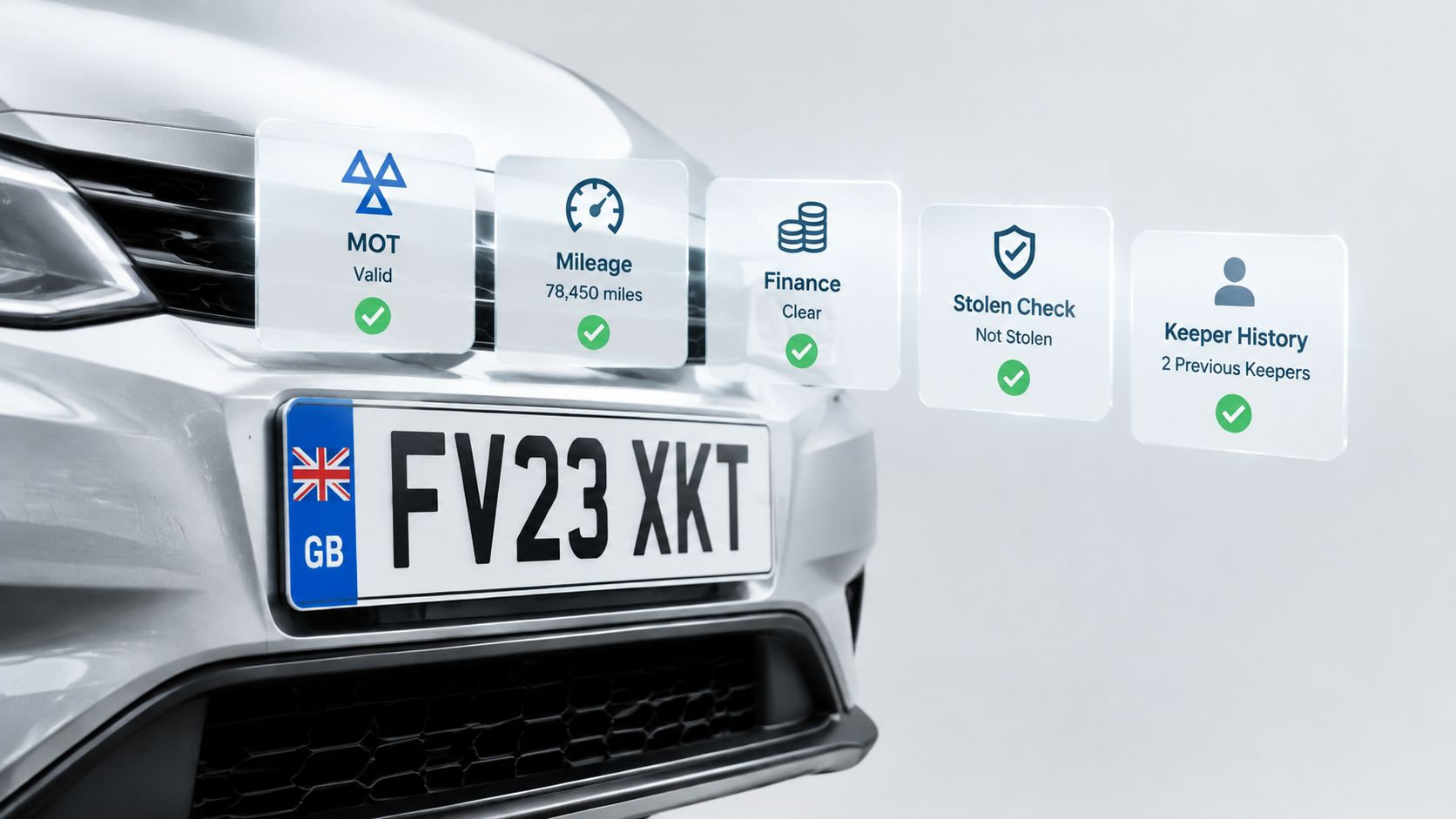
A UK vehicle history check combines separate data layers, each answering a different question. Treat the report as a forensic workflow, not a pass-or-fail label. A credible used car history report should help you compare the records, identify conflicts and decide which evidence matters most for the deal in front of you.
Start with identity and registration
The DVLA layer checks whether the registration, VIN, vehicle description and supplied documents refer to the same car. Compare the registration details with the V5C, physical VIN and vehicle in front of you. A mismatch is a buying signal, not minor administration. It can point to a document problem, an identity concern or a vehicle requiring further verification before purchase.
MOT history records test outcomes, advisories and mileage. Use the official MOT history service to verify pass and failure results and review the mileage recorded at each test. The publicly available record provides a useful baseline for checking mileage progression, changes in condition and patterns of use.
Record the query date and retain the report used for the purchase decision. Different systems can update at different times, so the timing of a result matters when you are assessing a live deal.
Treat each result as a separate question
A stolen-vehicle result indicates whether the car appears on the relevant register when searched. It does not authenticate every document or prove that the vehicle has never been involved in an undisclosed event. Finance data addresses whether an outstanding agreement may affect ownership and sale. A V5C held by the seller does not settle that point.
Insurance-event data, mileage records, keeper changes, plate changes and import or export indicators come from separate sources. Weight them against the transaction. A finance marker can stop a purchase; a plate change may require explanation; an insurance event demands repair evidence, inspection and a revised valuation.
A basic check returns headline answers. A trade-grade process tests whether those answers agree with the physical car, seller documents, inspection findings and purchase terms. Review the data layers a dealer vehicle check should include according to the risk you are pricing, then reprice, request evidence or walk away when the records do not reconcile.
Consumer Reports Versus Trade-Grade Provenance
Consumer reports are usually designed to answer a simple question: does the available record show an obvious problem? That can be useful for a private buyer, but a dealer needs a different output. A trader is pricing stock, estimating preparation, managing warranty exposure and deciding how much capital can remain tied up in a vehicle.
The structural gap is context. A consumer report may show a keeper count, MOT history or write-off marker as separate facts. Trade-grade provenance asks how those facts interact. A short keeper period may be routine for a fleet vehicle, but more concerning when combined with repeated resale activity, unexplained document gaps and a weak inspection result.
Dimension Consumer Report Trade-Grade Provenance Primary question Does the car appear clear on the available record? What does the combined evidence imply for purchase and resale risk? Mileage Displays recorded readings Reviews the sequence for progression, gaps and reversals Ownership Shows keeper information Considers duration, transaction timing and vehicle use MOT Lists results and advisories Identifies changes in condition and patterns over time Insurance events Shows a category or marker Places the event beside repair evidence, inspection and valuation Commercial use Often limited context Assesses whether use affects preparation, pricing or warranty exposure Decision output Reassurance or caution Proceed, renegotiate, inspect further or reject
The report should change the buying decision
A dealer doesn't need more raw fields for their own sake. They need a defensible view of the downside. If a vehicle has a strong mileage trail, coherent keeper history and no conflicting event data, the buyer may be able to bid with greater confidence. If the report shows a conflict, the right response may be a lower purchase price, a hold pending evidence or no purchase at all.
A consumer report records facts. Provenance analysis gives those facts weight.
That weighting matters because not every signal carries the same commercial consequence. A minor advisory may be manageable on a low-value car with clear maintenance evidence. A mileage reversal can affect valuation, customer disclosure and the credibility of every supplied service record. A dealer should decide which signals move risk on the specific deal, rather than apply the same pass or fail rule to every vehicle.
Reading Mileage as a Time Series, Not a Snapshot
A mileage figure can look clean in a report and still fail scrutiny once you plot the vehicle's history. Treat the MOT record as a chronological dataset. Each reading belongs beside its test date, so you can see whether use progresses, stalls or reverses. The government's guidance on correcting MOT certificate mistakes explains that an MOT centre can correct a recording error within 28 days. After that, the issue must be reported to DVSA with documentary proof, such as an invoice, emissions printout, service receipt or job card.
Calculate the change between consecutive tests and compare it with the vehicle's likely work. A diesel van used commercially may build mileage very differently from a small petrol hatchback used for short local journeys. The question is whether the sequence is plausible and supported by records, not whether it matches a universal annual-mileage assumption.
A steady progression followed by a downward step is a high-risk pattern. A sudden reset after consistent readings deserves the same response. A large increase may reflect genuine heavy use, delayed testing or an entry error. Review the surrounding evidence before treating it as proof of manipulation.
Weight the sequence, then verify the gaps
MOT data is not a complete odometer history. Records may be missing, and a mileage change made after the latest MOT will not appear until a later test. Some vehicles also have limited early data because they have not yet entered the testing cycle. A proper mileage check UK workflow therefore compares the MOT trail with service invoices, V5C information, previous reports and physical evidence inside the vehicle.
Pattern in MOT Readings What It Suggests Risk Signal Level Consistent upward progression Mileage broadly aligns with recorded use Lower, subject to document and inspection support Downward step between tests Possible clocking, recording error or identity issue High until resolved Sudden reset after stable readings Possible odometer manipulation or replacement cluster High Large increase between tests Heavy use, delayed testing or data-entry error Medium until evidenced Long gap with no supporting records Unverified period in the vehicle's use Medium to high, depending on the deal Missing mileage data Incomplete reporting rather than proof of clean history Unresolved Use this trade-focused mileage analysis approach when reviewing the trail. The reading is one point in a trajectory, not a number to copy into an advert. If the seller cannot support an anomaly with credible records, price the uncertainty into the deal, hold the vehicle for inspection or reject the stock.
Ownership Patterns and Short-Term Resale Signals
A low keeper count doesn't prove a low-risk car. It tells you how many recorded keeper changes exist, not how long each keeper held the vehicle or what happened during each period. A car can have a modest owner count and still move rapidly between traders, leasing structures or fleet operators.
Read duration, not just the total
Look at the timing of each keeper change alongside the vehicle's age and use. A vehicle re-registered within twelve months of the previous change deserves a closer review, particularly if the seller presents it as a straightforward private-owner car. Multiple plate changes in quick succession can also create gaps between the identity the seller describes and the identity shown in earlier records.
Rapid movement between dealers in the same region inside a quarter may have an innocent explanation, such as stock balancing or a failed retail preparation. It can also indicate that several buyers identified a problem and passed the vehicle on. The record doesn't prove which explanation applies. It tells you to ask for the transaction history and inspect the car with that possibility in mind.
Buyer's discipline: keeper count is an index. Keeper duration provides the context.
Ex-fleet and ex-leasing vehicles require a different lens. Shorter registered keeper periods may reflect an organised operating model rather than poor ownership. The question becomes whether the mileage, service evidence, condition and disposal route fit that model. A fleet vehicle with consistent records can be easier to understand than a supposedly privately cherished car whose paperwork is incomplete and whose ownership timeline is compressed.
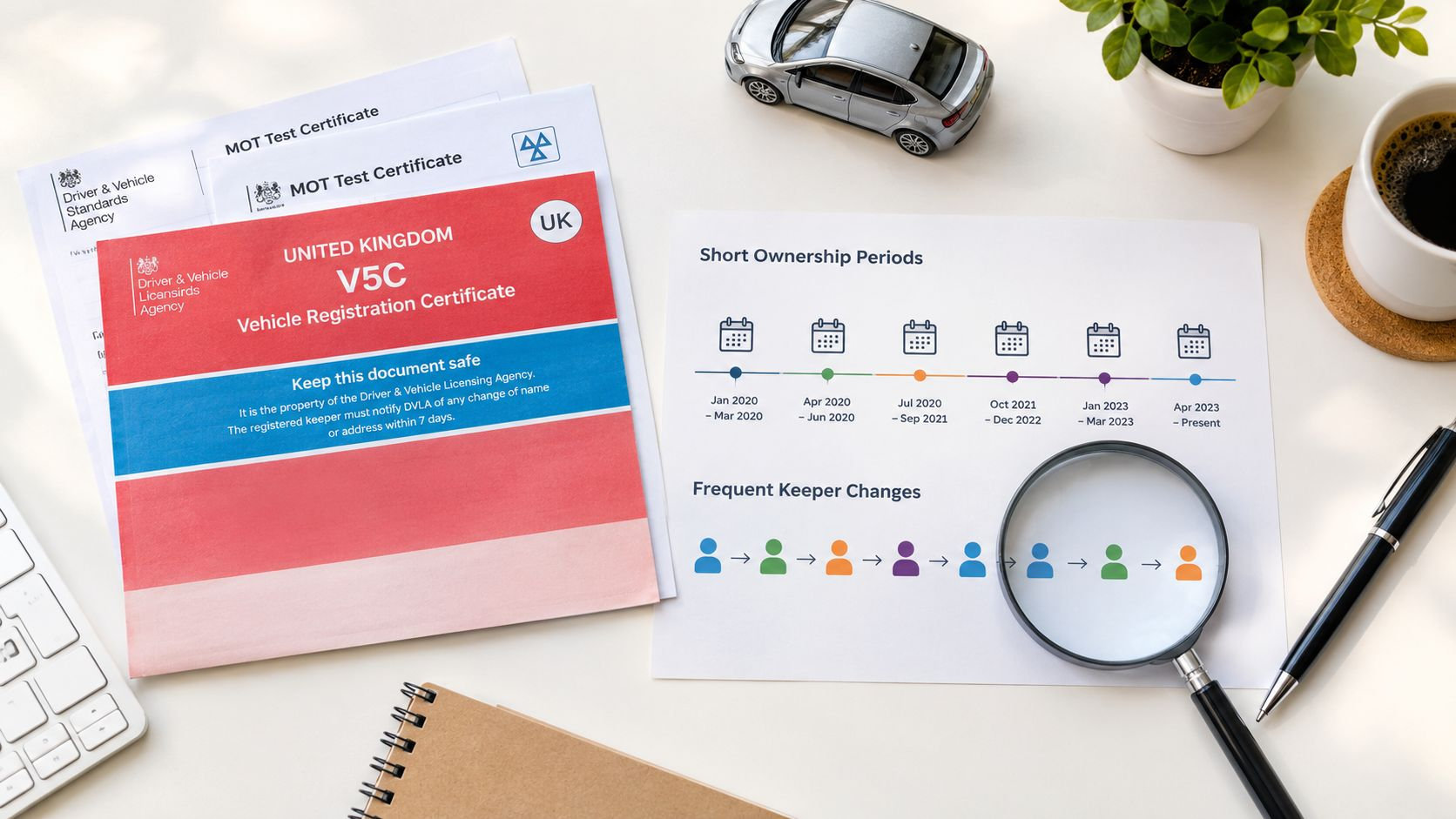
The practical test is simple. Can you explain who appears to have controlled the vehicle, for how long, and why it changed hands? If the answer depends on assumptions, classify the ownership story as unresolved. Don't let an attractive keeper count override short-term resale signals or missing supporting evidence.
Insurance Events and Write-Off Categories in Context
An insurance event changes the provenance conversation permanently. It doesn't automatically make a vehicle unfit for use, but it does require the trader to distinguish between a car that can legally return to the road and one whose repair quality and structural condition support its intended resale.
The ABI and GOV.UK framework divides damaged vehicles into four categories:
Category Damage Type Returned to Road? Trade Implication A Non-roadworthy end state, scrap only No The vehicle should not return to the road B Non-roadworthy end state, parts only No The shell should not return to the road, although parts may be recoverable S Structural damage Yes, if repaired and roadworthy Structural repair quality, disclosure and market acceptance require close review N Non-structural damage Yes, if repaired and roadworthy Electrical, mechanical, airbag and hidden secondary damage still need investigation The ABI guidance on written-off and total-loss vehicles confirms that Categories A and B are non-roadworthy end states, while Categories S and N are repairable and can return to the road once made roadworthy. An MOT pass doesn't remove the insurance marker or confirm that repairs followed manufacturer-approved methods.
Roadworthy isn't the same as structurally sound
Category S means the frame or chassis was affected. The vehicle may be repaired properly, but the dealer still needs evidence of the repair method, structural alignment and replacement parts. Category N means the damage wasn't classified as structural, yet that doesn't make it cosmetic. Electrical systems, mechanical components and airbags can create significant post-sale exposure.
A trader should verify the registration and VIN against the event record and inspect for signs of identity alteration. The category is a starting point, not a repair certificate. Finance and warranty providers may also assess repaired vehicles differently, so confirm the intended retail and funding route before committing.
The insurance write-off checking process should sit beside physical inspection, repair invoices and provenance evidence. If the event is unexplained, the repair trail is thin or the current identity doesn't align, don't rely on subsequent MOT passes to close the risk.
Building a Point-of-Decision Provenance Workflow
A history check belongs at the start of the buying decision, not after the hammer falls. Before reviewing the data, write down the commercial assumptions: source, asking or bid price, expected preparation, target margin, financing position and how quickly you need to retail the vehicle. Those assumptions determine how much unresolved risk the deal can carry.
Run the checks in a fixed order
Collect the V5C, service records, invoices, previous-sale paperwork and seller identity before you accept a clean headline. Then work through the evidence in a consistent sequence:
- Confirm identity: Match the registration, VIN, vehicle description, colour and documents to the physical vehicle.
- Build the MOT sequence: Review every available pass, failure, advisory and recorded mileage point.
- Test the mileage: Look for progression, reversals, resets and unsupported gaps.
- Review ownership timing: Compare keeper changes with duration, vehicle use and seller claims.
- Place insurance events in context: Assess category, damage type, repair evidence and current structural condition.
- Classify the evidence: Mark each point as confirmed, unresolved or contradictory.
- Calculate downside: Add likely preparation, delay, resale restriction and dispute exposure to the purchase decision.
Make the decision auditable
A late registration, unexplained mileage gap or expensive safety defect doesn't always mean automatic rejection. It may justify renegotiation, a hold on funds or an inspection condition. The important point is that the decision follows recorded evidence rather than the buyer's memory or auction pressure.
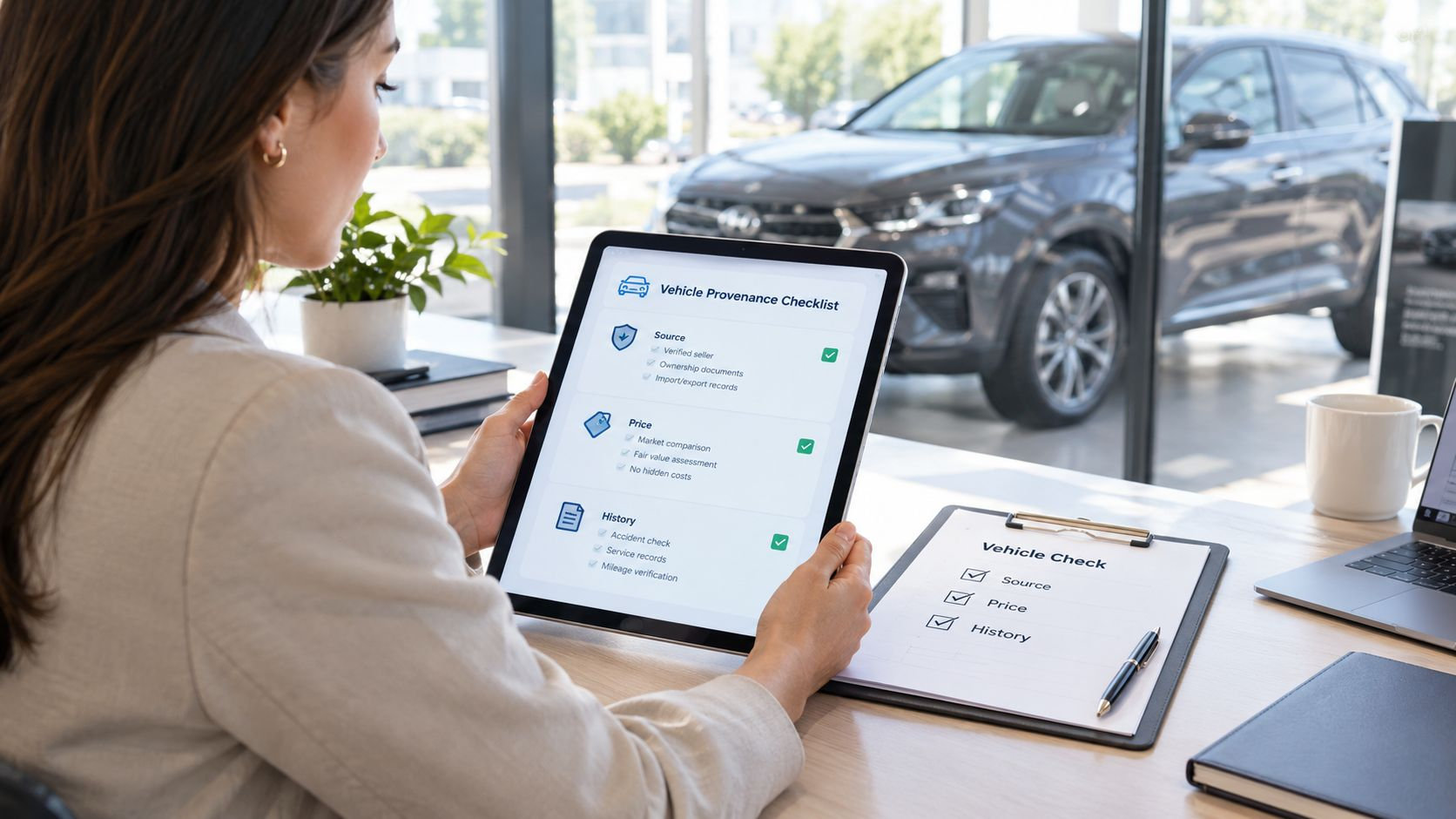
Use a repeatable vehicle appraisal checklist for trade buyers, and store the report with the purchase file. When the same standard applies to every vehicle, managers can review why stock was bought, why a price was accepted and whether the risk allowance matched the eventual outcome.
Where Vehicle Risk Intelligence Fits in the Trade
Vehicle risk intelligence should influence the whole acquisition process. Before purchase, it can help rank suppliers, compare asking prices and identify vehicles that warrant a deeper inspection. At the bidding point, it focuses attention on mileage discontinuities, ownership timing, insurance events and mismatched records.
After acquisition, the same evidence supports preparation and disclosure decisions. A dealer can use the identified risks to target diagnostic work, verify repairs, organise documents and set a defensible retail position. That doesn't replace a physical inspection, document authentication or professional judgement. It makes those activities more focused.
AutoProv connects records into a vehicle provenance view and highlights relationships between events, including mileage patterns, ownership timelines, plate changes, finance, theft and insurance-related records. It's designed for dealers, wholesalers and other UK motor-trade professionals who need structured decision support before committing capital. Use it as one part of a controlled workflow, not as a substitute for inspecting the vehicle or challenging incomplete evidence.
The operating principle: buy the evidence you can explain, price the risk you can measure and walk away from the risk you can't resolve.
A strong dealer vehicle check doesn't produce false certainty. It creates a repeatable standard for deciding whether to proceed, renegotiate, hold or reject. That standard protects margin, improves stock selection and gives the business a clearer record when a customer, funder or warranty provider asks how the vehicle was assessed.
Use AutoProv to review UK vehicle provenance, mileage patterns, ownership timelines and risk indicators before you commit to trade stock. Build the report into your point-of-decision workflow, then combine it with physical inspection and document verification to make clearer buying and valuation decisions.
Frequently Asked Questions
AI-Generated Content Notice
This article was created with the assistance of artificial intelligence technology. While we strive for accuracy, the information provided should be considered for general informational purposes only and should not be relied upon as professional automotive, legal, or financial advice. We recommend verifying any information with qualified professionals or official sources before making important decisions. AutoProv accepts no liability for any consequences resulting from the use of this information.
From our AI insights
- Navigating UK Grey Imports: A Trader's Guide
Understand the complexities and opportunities of UK grey imports for savvy motor traders.
- DVLA Keeper Changes: Insight for UK Motor Traders
Understand DVLA keeper change patterns to assess vehicle history and risk factors for UK motor traders.
- Navigating Private Plate Challenges in UK Vehicle Checks
Learn how private plates affect UK vehicle checks and how traders verify provenance and spot cloning risks.
Related Articles

Essential Vehicle Checks Before Buying a Used Car
Learn essential checks to ensure your used car purchase is safe and sound in the UK market.

Why a Provenance Check is Essential for Used Car Buyers
Ensure your used car is a smart investment by understanding the importance of a provenance check and how AutoProv can help.
A Guide to Vehicle Check with VIN Number
A vehicle check with vin number is easily the most important thing you can do before buying a used car. Think of it as your first line of defence—a quick, simple step that pulls back the curtain on a vehicle's past, protecting you from expensive mistakes, legal headaches, and downright dangerous cars.
Published by AutoProv
Your trusted source for vehicle intelligence