
A car lands in appraisal looking right. Clean enough bodywork, a believable cabin, sensible spec, tidy paperwork, and an odometer reading that doesn't immediately jar with the age. In the lane or on the auction screen, that's often enough to keep the conversation moving.
The trouble starts when a vehicle looks clean in the obvious places but carries background risk that only shows up when you read its history as a timeline rather than a snapshot. That's where used car checks stop being an admin step and become a buying decision.
Table of Contents
- Why Used Car Checks Matter More Than Ever for UK Dealers
- The cost shows up in appraisal accuracy
- Provenance risk is a stock decision, not an admin task
- What Basic Vehicle History Checks Miss in the Motor Trade
- Basic checks confirm records. They do not test the story.
- The gap is context, not just data
- Point-of-purchase decisions need layered evidence
- False reassurance is the expensive mistake
- How to Validate Mileage and MOT History With Confidence
- Build the mileage sequence before you price the car
- Then test the MOT trail against other evidence
- Plausibility beats a simple pass
- Common trade mistakes
- Reading Ownership Timelines and Provenance Risk Signals
- The timeline often matters more than the count
- Read the signals together, not one by one
- Why this still feeds disputes
- Making Smarter Valuation and Stock Decisions at Point of Purchase
- Provenance Risk to Buying Decision Matrix
- A Repeatable Checklist for Safer Used Car Checks
- The checklist that holds up under pressure
- Consistency beats memory
- Better discipline creates better stock
Why Used Car Checks Matter More Than Ever for UK Dealers

A car can look right in the lane and still be wrong for stock.
That matters more now because margins are tighter, retail customers ask better questions, and weak provenance is harder to hide once a vehicle is advertised. A dealer who buys on appearance and a basic clear report can end up holding a car that is harder to price, slower to retail, and more exposed to comeback when a buyer starts reading the history properly.
The trade issue is not merely whether a vehicle passes an HPI-style check. The issue is whether the background supports the deal at the number being discussed. Good used car checks give decision support at point of purchase. They help a buyer judge whether the mileage story stands up, whether the ownership timeline is coherent, and whether any risk signals are small enough to absorb in the margin.
The cost shows up in appraisal accuracy
Mileage is the clearest example because it shifts both desirability and book position. A UK analysis of half a billion MOT records found that 3.42 million of 62.7 million vehicles, or 5.45%, showed a reduction in mileage between MOT tests, although 1.43 million of those cases appeared to be data-entry errors rather than deliberate clocking. The same analysis also cited checked-vehicle discrepancy rates in the 6.32% to 6.5% range, with one study identifying 60,501 mileage reductions in one million vehicles checked and an average reduction of 70,000 miles where a discrepancy existed, according to UK mileage fraud statistics analysis.
For a dealer, the takeaway is practical. Even if a fair share of anomalies come from bad entries rather than fraud, the appraisal problem remains the same at buying time. Someone still has to explain the sequence, price the doubt, and decide whether the car remains workable stock.
Practical rule: If the mileage record needs a story to make sense, buy it on the risk, not on the pitch.
Provenance risk is a stock decision, not an admin task
Independent reporting has stated that 160,000 used cars may be sold each year with fraudulent mileage, costing buyers at least £750 million to £800 million per year, while a separate market summary reported 2.1% of secondhand cars had been clocked, implying roughly 160,000 affected transactions annually, according to Bodyshop Magazine's mileage fraud coverage.
Those figures matter because they show how often dealers are asked to price uncertainty. A green tick on a history report may remove one obvious concern, but it does not tell you how easy the vehicle will be to defend on the forecourt. Two cars can both come back clear on the headline checks and still deserve very different bids once you look at ownership timing, MOT cadence, periods off the road, plate changes, specification consistency, and whether the mileage pattern fits the age and use case.
Used car checks earn their keep when they answer three buying questions:
- Can the mileage story be defended at retail?
- Does the ownership timeline make commercial sense?
- Are the risk signals small enough to carry in the margin, or large enough to walk away?
That is why these checks matter more than ever. For UK dealers, they are provenance intelligence first and a pass or fail filter second.
What Basic Vehicle History Checks Miss in the Motor Trade
A car can come up clean on a basic history check at 10:15 and still be the wrong buy at 10:20.
That happens when the report confirms a few headline facts but leaves out the sequence behind them. Trade buyers do not just need recorded events. They need a version of the car's past that stands up when the vehicle is appraised, prepared, retailed, and questioned by the next customer.
Basic checks confirm records. They do not test the story.
A standard vehicle history report is useful for obvious deal-breakers. It can flag stolen status, insurance loss markers, finance, registration details, and other headline risks. That saves time and stops some bad purchases early.
What it does not do well is judge whether the full background is commercially coherent. A car may be clear on the major markers and still carry enough friction to weaken margin or slow the retail exit. In the trade, that matters more than whether a report looks tidy at first glance.
The usual misses are not dramatic. They are timing problems, pattern problems, and gaps between records that should support each other but do not.
The gap is context, not just data
A buyer looking at a basic check can miss issues such as:
- Keeper changes that cluster too tightly for the age and type of vehicle
- Long periods with little supporting activity followed by a sudden return to market
- Registration or plate changes that are explainable but still worth pricing for
- Service paperwork that does not match the usage pattern
- Spec or derivative inconsistencies between the car in front of you and the recorded identity
None of those points proves dishonesty on its own. All of them affect confidence.
That is the difference between a consumer lookup and trade buying. Dealers are not just asking, "Is there a marker?" They are asking, "Can I defend this car at retail, and how much risk am I carrying if I cannot?"
A basic check records what has happened. A trade check tests whether the history makes sense as a whole.
Point-of-purchase decisions need layered evidence
At the block or on a part-exchange appraisal, the job is to build enough confidence to bid properly. That means using several sources together and weighing the gaps, not treating one report as a final answer.
A practical review usually includes:
- Identity checks, including registration, VIN alignment, derivative, and date consistency
- Title and risk markers, such as finance, theft, and insurance loss history
- Usage evidence, including MOT chronology and service timestamps
- Ownership timeline, especially short holding periods or repeated resale patterns
- Presentation against provenance, checking whether the physical car fits the paper trail
That layered approach is what turns a history check into buying support. For a wider view of the inputs worth pulling together, AutoProv's guide to data sources a trade vehicle check should include is a useful reference.
False reassurance is the expensive mistake
The risk with a basic pass is not that it is wrong. The risk is that it feels complete when it is only partial.
The Office for National Statistics has said it does not hold figures specific to vehicle clocking as a standalone aggregate category, according to the ONS response on reports of vehicle clocking in the UK. That absence of a single official measure is one reason experienced buyers avoid treating any one check as definitive.
In practice, the car earns confidence by holding together across time. If the ownership cadence is odd, the use pattern is hard to reconcile, or the paperwork only explains part of the timeline, the decision is no longer about pass or fail. It is about whether the risk fits the margin, or whether the cleanest move is to leave it alone.
How to Validate Mileage and MOT History With Confidence
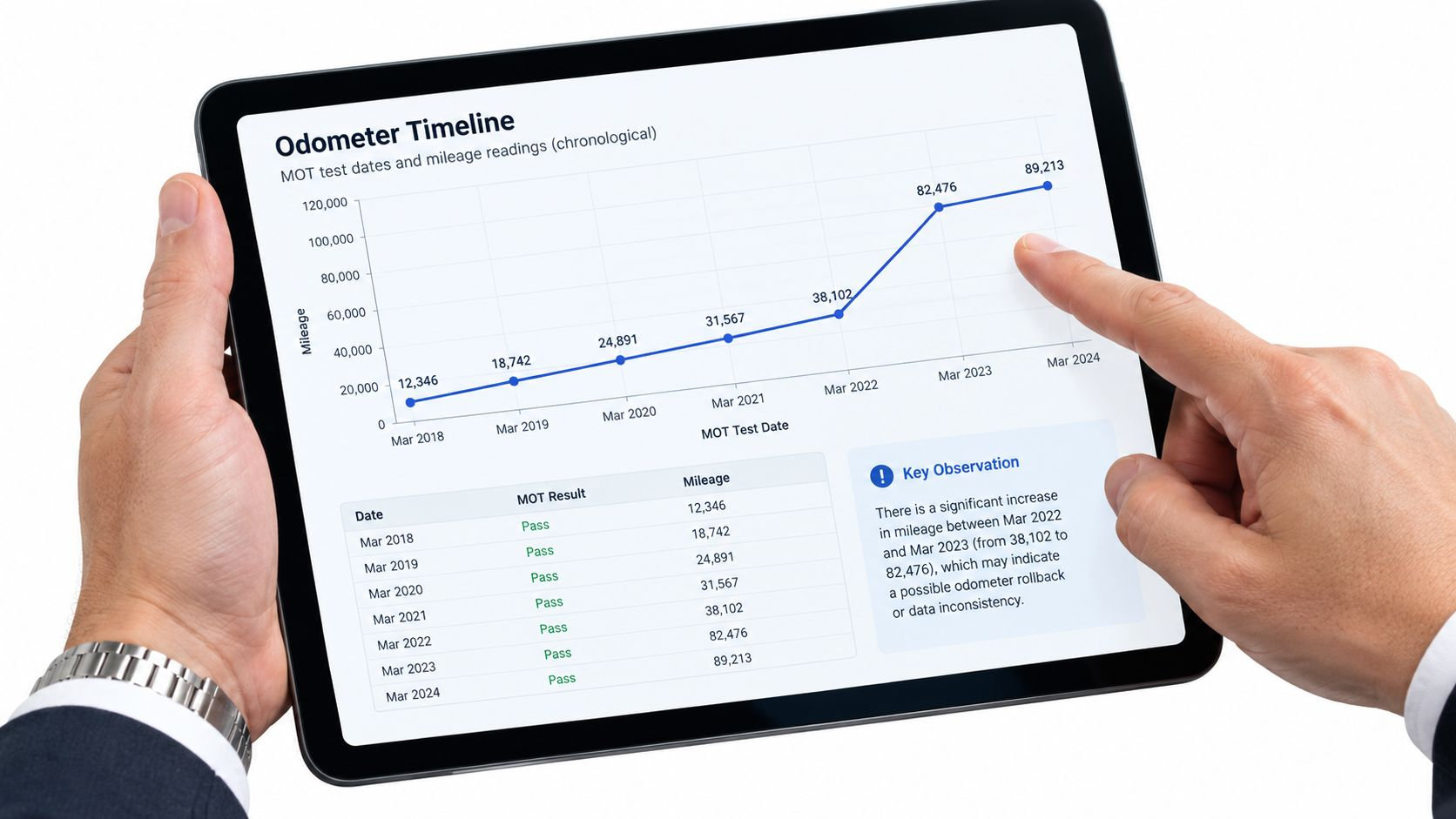
A car turns up with strong spec, clean paint, and mileage low enough to make the CAP look tempting. Ten minutes later, the decision is usually sitting in the timeline, not on the dashboard. If the mileage story is thin, valuation discipline matters more than presentation.
Good mileage validation is a buying process, not a box-tick. The job is to build a usable chronology at point of purchase and decide whether the recorded use fits the age, condition, paperwork, and route to market. A car does not need a dramatic rollback to become poor stock. It only needs enough uncertainty to put your retail confidence, prep spend, or exit route under pressure.
Build the mileage sequence before you price the car
Start with the MOT record and write out every test date with the recorded mileage in order. That sounds basic, but plenty of buyers still glance at the latest entry, see that it broadly matches the dash, and move on too quickly.
The better habit is to examine each step in the sequence.
- Drops in mileage: These need an explanation straight away.
- Very low annual use: Often genuine on second cars, retirees' cars, or niche vehicles, but it should fit the rest of the file.
- Flat periods followed by normal use: Sometimes admin error, sometimes more than that.
- Big swings in annual accumulation: Fleet use, change of owner circumstances, or a weak history. The pattern matters.
MOT data is useful because it gives dated mileage points alongside failures and advisories. Read those together in plain English. A car showing light annual use while picking up wear that suggests heavier use deserves a harder look.
Then test the MOT trail against other evidence
An MOT sequence on its own is only one stream of evidence. It is annual, and annual data leaves gaps.
In trade practice, the safer method is to reconcile three sources where possible: the MOT chronology, service or invoice mileages, and any third-party odometer records available through finance, warranty, inspection, or previous sales channels. That three-source check does two jobs. It catches obvious inconsistencies, and it exposes cars that are technically progressive on paper but still do not stack up as a believable usage history.
A practical workflow looks like this:
- Record the displayed mileage exactly. No rounding.
- List every MOT reading in date order. Check the progression line by line.
- Pull service evidence. Use invoices and dated entries, not just stamp presence.
- Check outside records where available. Finance and inspection data can fill gaps between MOTs.
- Compare the numbers with the car itself. Pedal wear, seat bolster wear, steering wheel finish, stone chipping, and general cabin fatigue should broadly fit the claimed use.
- Decide whether the history is coherent enough to underwrite. If not, price the uncertainty or leave it.
For a trade-focused process, this guide on how to check MOT and mileage is a useful companion.
If low mileage is doing the heavy lifting in the valuation, the supporting evidence needs to be stronger, not lighter.
Plausibility beats a simple pass
The expensive mistake is treating an increasing sequence as proof. A clocked car does not always present with a crude reversal. Some histories are tidied up just enough to avoid a headline red flag, while still leaving timing gaps, weak service support, or usage patterns that do not make commercial sense.
That is why context matters. A ten-year-old hatchback showing unusually low use with patchy invoices is a different proposition from a specialist car with long-term keeper history, marque servicing, and consistent condition. Both may show no obvious MOT anomaly. Only one may deserve retail confidence.
Common trade mistakes
The same errors come up repeatedly on the buy sheet:
- Letting the dashboard reading anchor the bid too early
- Checking only the latest MOT entry instead of the full sequence
- Accepting stamped history without matching dates and mileages
- Ignoring condition clues that conflict with the recorded use
- Treating “no discrepancy found” as the same thing as proven provenance
Mileage validation works best as decision support. The aim is not to prove every car perfect. The aim is to know when the history is strong enough to support the price, when the risk belongs in the margin, and when the cleanest trade decision is to walk away.
Reading Ownership Timelines and Provenance Risk Signals
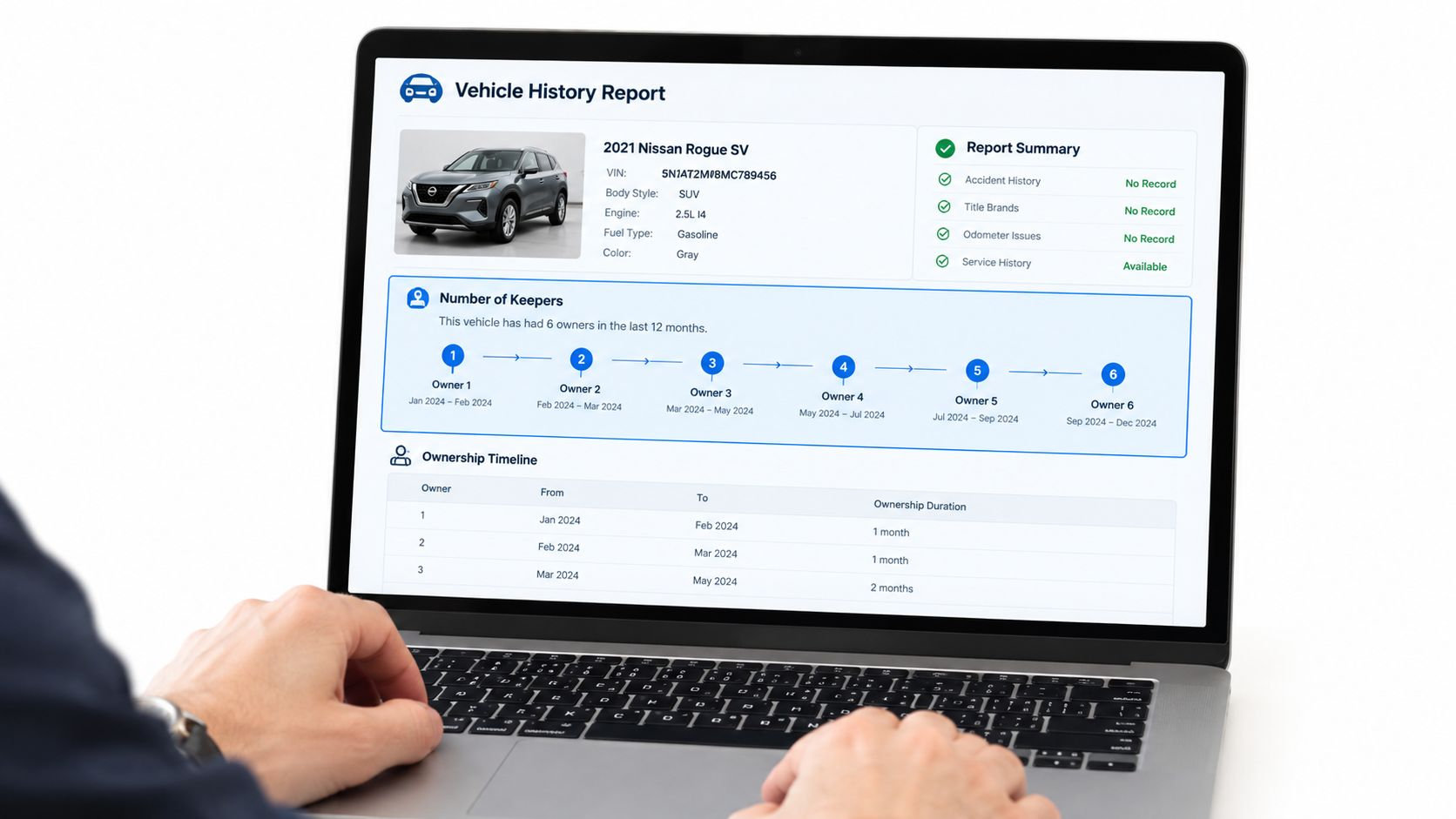
Mileage gets most of the attention, but ownership timing often tells you just as much about stock risk. Two cars with similar condition and similar mileage can sit in very different risk categories once you study how they've moved between keepers, sellers, and sale windows.
That matters because provenance isn't just about what happened. It's about whether the pattern is normal for the vehicle type, age, and route to market.
The timeline often matters more than the count
A buyer can be misled by a simple keeper total. A car with several keepers over a long, logical life may be perfectly straightforward. Another car with fewer keepers may still be awkward if those changes are compressed into short periods or cluster around resale activity.
Signals worth weighing include:
- Short-term ownership: A vehicle moving on quickly can be innocent, but it can also mean dissatisfaction, unresolved faults, or speculative flipping.
- Rapid resale activity: Repeated movement through trade channels often weakens confidence, even where no single event is disqualifying.
- Clusters of keeper changes: Timing matters more than the headline number.
- Mismatch with vehicle type: A practical family car, city hatchback, or specialist performance vehicle can each have different “normal” patterns.
Read the signals together, not one by one
A common trade mistake is isolating each point. A quick owner change on its own may not concern you. A slightly odd mileage plateau on its own may still be explainable. An incomplete service trail on its own may be manageable.
Together, those signals can tell a different story.
Buying discipline: Risk rarely arrives as one dramatic flag. It usually arrives as several small inconsistencies that line up.
That's why vehicle provenance work is about context. Ownership cadence, sale timing, record gaps, and mileage behaviour should be read as a package.
If you want a deeper look at how prior ownership affects buying confidence, this piece on checking all previous keepers is relevant to appraisal decisions.
Why this still feeds disputes
The market still shows plenty of post-sale friction around used vehicles. The Motor Ombudsman reported that used-car disputes rose 14% to 18,570 cases in 2025, according to The Motor Ombudsman press release on used-car disputes. That figure doesn't prove every dispute is a provenance issue, but it does underline a live trade problem. A vehicle can pass basic checks and still become hard work after sale if its history doesn't stand up to scrutiny.
In day-to-day buying, ownership analysis is where experience often beats automation. The strongest systems can surface the pattern, but the buyer still has to judge what it means for valuation, preparation, retailability, and fallback risk.
Making Smarter Valuation and Stock Decisions at Point of Purchase
You are standing with a fresh appraisal. The car is clean, the pitch is tidy, and the seller wants a quick decision. This is the point where history checks stop being admin and start shaping margin, prep risk, and whether the car belongs in stock at all.
The job is to convert provenance signals into a buying decision while the deal is still live. In practice, that usually means one of four outcomes. Buy at the agreed figure, rework the number, hold the deal until better evidence turns up, or leave it alone. Good buyers do not treat every anomaly as a write-off, but they do price uncertainty properly.
A car with a coherent mileage trail, believable ownership timing, and paperwork that supports how it has been used can be appraised with confidence. A car with open questions may still suit the business, but only if the margin, prep allowance, and exit route cover the risk. That matters because mileage manipulation still moves real money. Analysis cited by Honest John reported that falsely lowering a used car's mileage can add nearly 30% to its sale price, with an average overpayment of £4,758 per buyer and an annual cumulative impact of £762 million, according to Honest John's report on the cost of clocked cars.
Mileage fraud is not common enough to assume on every appraisal, but it is common enough to affect buying discipline. Independent reporting found that 2.1% of the 7.6 million cars checked on one platform over a 12-month period had odometer readings that did not match recorded mileage history, with the market impact estimated at about 160,000 vehicles changing hands in a year with potential mileage-fraud risk, according to Auto Express reporting on mileage fraud data.
The useful question is not whether a report looks clean. It is whether the full record gives enough confidence to back your valuation.
Provenance Risk to Buying Decision Matrix
Risk Profile Typical Signals Recommended Trade Action Low Coherent MOT and mileage progression, service entries support use pattern, ownership timing looks stable Proceed at normal appraisal level and document the evidence retained Medium One or two explainable anomalies, incomplete supporting paperwork, ownership timing slightly compressed Price-adjust, request more evidence, and tighten retail notes before commitment High Unresolved mileage inconsistency, conflicting records, rushed keeper pattern, weak provenance narrative Decline, or proceed only if the risk is fully understood and reflected in the buy price Experienced buyers make their money here. A weak provenance story does not only create comeback risk after sale. It also affects how hard the car is to retail, how much prep confidence you really have, and how exposed you are if the market softens and the unit has to be traded out quickly.
For dealer groups and multi-site teams, the challenge is consistency. One buyer will tolerate compressed keeper changes on the right metal. Another will ignore them until the car hits prep or gets questioned by a retail customer. Shared appraisal standards reduce that drift. AutoProv supports that process by combining vehicle history, mileage behaviour, ownership timelines, and related risk indicators into a decision layer built for trade buying rather than a simple pass or fail screen.
If you are refining appraisal rules across buyers or sites, this guide to stock selection criteria for used car dealers is a useful next step.
A Repeatable Checklist for Safer Used Car Checks
Good buyers usually aren't saved by one brilliant decision. They're protected by a repeatable process applied every time, especially when the car looks easy.
The most effective used car checks are disciplined enough to slow the transaction down at the right moment. Not to create friction for its own sake, but to stop valuation from running ahead of evidence.
The checklist that holds up under pressure
A practical trade checklist should be short enough to use in real buying conditions and strong enough to catch hidden risk.
- Confirm identity first. Registration, VIN-linked records and core vehicle details should align before anything else is trusted.
- Build the mileage sequence. Read the MOT trail in order and challenge anything that drops, plateaus oddly, or accumulates implausibly.
- Reconcile external history. Finance-related records, service paperwork and workshop timestamps should support the vehicle's story.
- Read ownership timing. Focus on sequence, clustering and resale speed, not just keeper count.
- Decide commercially. Proceed, reprice, request evidence, or walk away. Don't leave the vehicle in a grey area.
Consistency beats memory
This matters even more across multiple buyers or sites. Informal appraisal habits drift. One buyer is cautious with ownership churn. Another notices only mileage. A third assumes a clean basic report settles the question.
A stronger buying standard is to require the same evidence chain every time:
- MOT chronology reviewed
- Mileage plausibility assessed
- Supporting records checked
- Ownership timeline considered
- Decision and rationale recorded
That turns provenance from background admin into point-of-decision vehicle intelligence.
The aim isn't to eliminate all risk. It's to spot the vehicles where the risk is hidden, poorly explained, or badly priced.
Better discipline creates better stock
The trade doesn't need more noise around used car checks. It needs sharper judgement about what a clean-looking car might still be hiding, and a buying process that can separate acceptable imperfection from real exposure.
For teams formalising that process, a practical reference is this guide to complete vehicle appraisal checklists for trade buyers. The value isn't in adding paperwork. It's in making sure every buyer asks the same hard questions before capital is committed.
The best used car history report is the one that helps the buyer decide with context. The best vehicle history check UK workflow is the one that combines records, timing, and commercial judgement into a clear action at the moment the stock is being bought.
AutoProv gives UK dealers a trade-focused way to read vehicle history as provenance intelligence, not just a pass or fail report. It brings together mileage progression, ownership timelines, finance and other risk signals to support valuation and buying decisions at the point of purchase. To see how that fits into your used car checks workflow, visit AutoProv.
Frequently Asked Questions
AI-Generated Content Notice
This article was created with the assistance of artificial intelligence technology. While we strive for accuracy, the information provided should be considered for general informational purposes only and should not be relied upon as professional automotive, legal, or financial advice. We recommend verifying any information with qualified professionals or official sources before making important decisions. AutoProv accepts no liability for any consequences resulting from the use of this information.
From our AI insights
- Navigating UK Grey Imports: A Trader's Guide
Understand the complexities and opportunities of UK grey imports for savvy motor traders.
- Trade Secrets: Identifying Clocked Cars in the UK
Discover how UK traders can spot clocked cars using innovative tools and detailed checks.
- Identifying Ex-Driving School Cars Using MOT Patterns
Learn how to spot ex-driving school vehicles with MOT patterns and history checks.
Related Articles

Essential Vehicle Checks Before Buying a Used Car
Learn essential checks to ensure your used car purchase is safe and sound in the UK market.

Why a Provenance Check is Essential for Used Car Buyers
Ensure your used car is a smart investment by understanding the importance of a provenance check and how AutoProv can help.

A Guide to Vehicle Check with VIN Number
A vehicle check with vin number is easily the most important thing you can do before buying a used car. Think of it as your first line of defence—a quick, simple step that pulls back the curtain on a vehicle's past, protecting you from expensive mistakes, legal headaches, and downright dangerous cars.
Published by AutoProv
Your trusted source for vehicle intelligence