
A clean MOT timeline is not the same thing as a clean vehicle. That's the mistake most buyers still make, and it's a costly one for dealers who think a vehicle history check can be reduced to a pass or fail screen. In the trade, the question isn't whether a car has an MOT record. It's whether the record, the keeper pattern, and the mileage trail make sense together. If they don't, you're not looking at reassurance, you're looking at motor trade risk dressed up as a tidy report.
Table of Contents
- Why a Clean MOT Timeline Is Not a Clean Vehicle
- What a pass certificate actually proves
- The Core Data Layers Behind a Trade-Grade Check
- The four pillars that matter
- Reading Mileage Discrepancies That Matter
- Small gaps are not the same as rollback patterns
- What should trigger physical scrutiny
- Ownership Cadence and Rapid Resale Signals
- How to read keeper timing against the record
- The commercial meaning of short tenure
- Where Basic Vehicle History Checks Fall Short
- Why a verdict-style report can mislead
- Why that matters for margin
- Consumer Checks Versus Trade Provenance Intelligence
- Side by side, the difference is obvious
- What better intelligence actually adds
- How a Trade Buyer Interprets Conflicting Signals
- Reading the file like a buyer, not a browser
- What a trade file needs to show
- Turning Vehicle Intelligence Into Buying Decisions
- Use a three-way response, not a single verdict
- What to record before you buy
Why a Clean MOT Timeline Is Not a Clean Vehicle
An unbroken MOT history tells you the car was roadworthy on test day. It does not tell you the car was healthy in the months between tests, or that it hasn't been carrying expensive wear for years. That's why dealers who treat MOT pass certificates as a proxy for overall condition get caught out on stock that looks tidy on paper and expensive in the workshop.
The official MOT history service publishes the past test outcomes and mileage recorded at each test, and that's why it became the backbone of mileage verification in the UK used-car market. It's useful, but only as one layer inside a wider vehicle provenance picture, not as the verdict itself. The GOV.UK MOT system has also been available for cars, motorcycles and vans in Great Britain since 2005, with Northern Ireland coverage added in 2017, and the DVLA vehicle data service adds fields like first registration date, V5C issue date, tax status, MOT expiry, fuel type, emissions and export status, which is enough to anchor identity and compliance in a modern vehicle history check UK workflow. GOV.UK MOT history service
What a pass certificate actually proves
A pass certificate only proves the vehicle met minimum standards at that exact inspection. It doesn't clear the engine, gearbox, suspension, cooling system, or the sort of wear that builds between test dates. On the trade side, that distinction matters more than it does for a private punter, because you're not buying a story, you're buying reconditioning liability.
A car can move through a clean MOT chain and still need serious money. Timing chain stretch, turbo wear, dual-mass flywheel fatigue, coolant losses, and electrical gremlins often show up after the test date, not before it. That's why a “clean MOT” should be treated as a compliance receipt, not a substitute for inspection, provenance work, or valuation discipline.
Practical rule: if the MOT history looks neat but the car is being priced like a low-risk stock unit, slow down and make the seller earn the margin.
The Core Data Layers Behind a Trade-Grade Check
A proper trade check is built on overlapping records, not one database. If you only pull one layer, you'll miss context. If you pull several and compare them properly, you can separate ordinary data noise from genuine trade vehicle intelligence.
The four pillars that matter
The first pillar is DVLA keeper data. It helps establish legal identity, keeper sequence, and plate-to-VIN consistency. It doesn't update in real time during a private sale, so there can be lag between the actual handover and the record catching up. That's why a keeper count alone never tells the full story.
The second pillar is MOT mileage and advisory history. It gives you timestamped readings, test outcomes and advisories, which makes it the most practical line of defence against odometer inconsistency. But it only captures what was recorded on test day, so it can't see what happened between tests.
The third pillar is insurance and finance markers. Those are the shadows that can sit behind a car even when the surface looks clean. A trade buyer needs to know whether a vehicle is carrying active financial exposure, a prior total loss marker, or a history event that changes how it should be priced and inspected.
The fourth pillar is ownership cadence. Keeper duration tells you whether the car has been retained, flipped, parked, traded through, or repeatedly released. That cadence is often more revealing than the headline keeper count because it shows how the vehicle has moved through the market.
Data Layer What It Confirms What It Misses DVLA records Legal identity, keeper sequence, plate and provenance fields Real-time transfer timing, why the car changed hands MOT history Recorded mileage, test outcomes, advisories, fail items Non-MOT tampering, sparse history, between-test degradation Insurance and finance markers Financial and total-loss exposure Cleared history, underlying repair quality, current condition Ownership cadence Keeper tenure patterns and rapid-resale signals Mechanical health, the reason behind each disposal A useful internal reference for building that kind of stack is this guide to the data sources a trade vehicle check should include. It's the overlap that creates confidence, not any single field on its own.
Reading Mileage Discrepancies That Matter
Mileage anomalies are where weak checks collapse. Dealers who know how to read them properly can separate data-entry noise from a car that needs a hard reset in valuation terms. Dealers who can't usually find out the expensive way.
Small gaps are not the same as rollback patterns
A slight discrepancy between readings isn't automatically fraud. GOV.UK says mileage records are not compulsory, and gaps can appear when garages don't submit data or when an owner leaves the mileage blank on the V5C during a keeper change, so incomplete progression can happen without deliberate wrongdoing. Autotrader guidance on mileage discrepancies
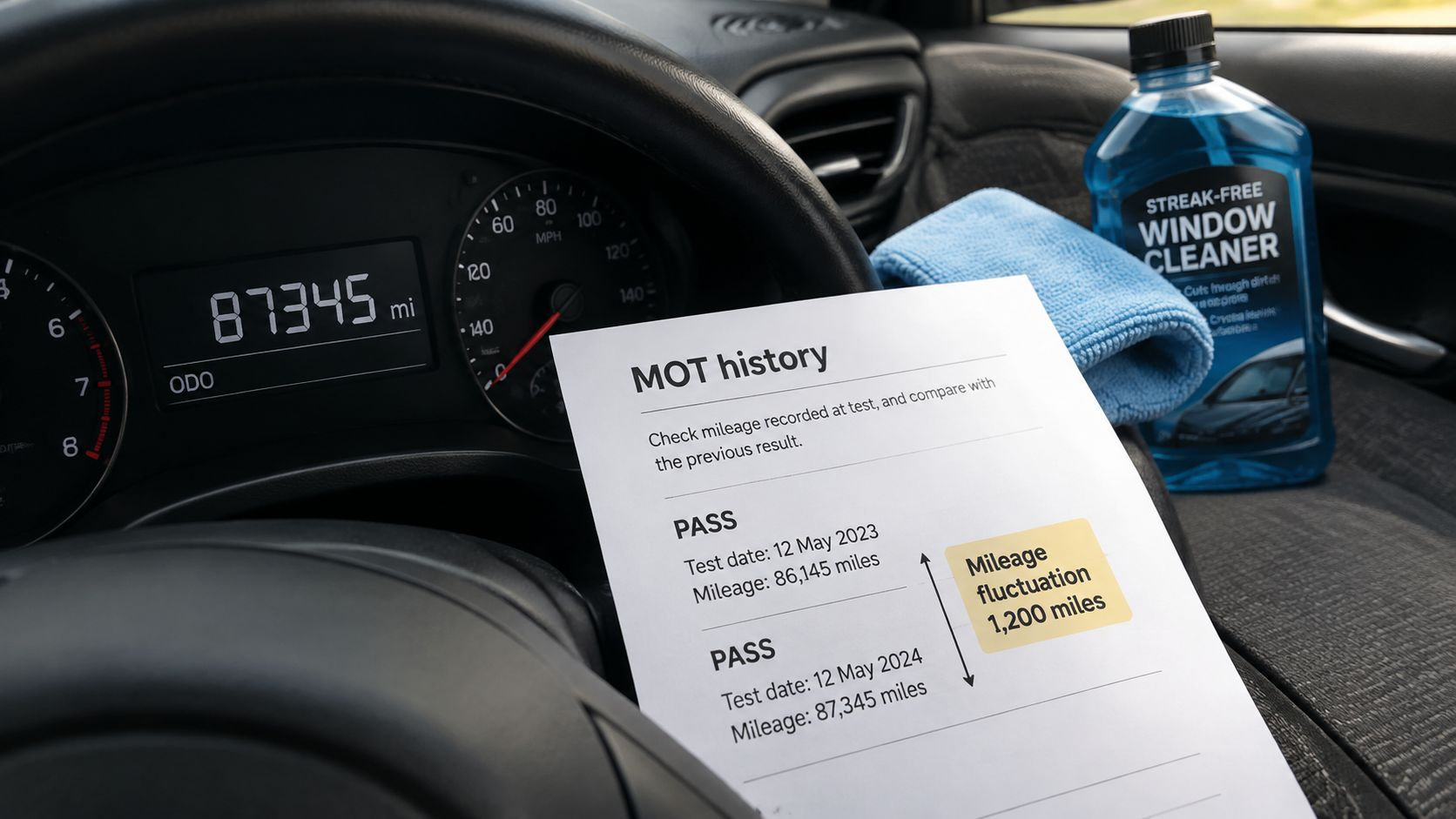
That's why a dealer shouldn't react to every irregularity with the same level of alarm. A modest jump that can be explained by a missed reading, a delayed entry, or a clerical correction deserves a call, not a panic. A pattern that breaks the overall direction of travel is a different matter entirely.
A single odd mileage point doesn't condemn the car. A broken mileage story does.
What should trigger physical scrutiny
The signal that matters is not just a discrepancy, it's the shape of the discrepancy. A reading that drops against a prior upward MOT sequence, or a vehicle that sits suspiciously flat across years when the class of car should have been accumulating miles, needs attention. That's especially true where the car is visibly high-mileage, because the odometer story should align with wear in the cabin, pedals, seat bolsters and engine bay.
The larger UK MOT analysis is worth keeping in mind here. One study of 62.7 million vehicles found that 3.42 million, or 5.45%, about 1 in 18, showed a reduction in mileage between MOT tests after anomalies were removed, with the average reduction estimated at 46,089 miles. A separate extrapolation suggested the number of clocked vehicles could be around 2.48 million, or roughly 6.4% of the fleet, if the findings were projected across 38.7 million vehicles on the road. Analysis of UK MOT records
That's not a fringe problem. For trade buyers, it means a mileage check UK workflow has to do more than display a timeline. It has to judge whether the line makes commercial sense. Understanding mileage anomalies in MOT records
Ownership Cadence and Rapid Resale Signals
A car that keeps changing hands tells you something, even when the paint still looks decent. Read the keeper pattern as a trading signal, not a comfort blanket. Rapid turnover usually means someone had a reason to move it on, and that reason matters more than the sales patter.
How to read keeper timing against the record
Start with the keeper sequence, then line it up against the MOT dates. If a change of keeper lands just before or just after a mileage wobble, that deserves attention. Repeated short tenures point to hesitation in the market, so treat the car with suspicion until the paperwork and condition explain it properly.
Three keepers in three years is a warning pattern in trade terms. It does not prove a fault, but it does show the car has been circulating quickly enough to justify a proper look at provenance, finance history, and the story being sold with it. DVLA keeper history and what it reveals
The commercial meaning of short tenure
Price short-tenure stock as risk stock unless the evidence says otherwise. Challenge the seller, inspect harder, and reduce the bid if the paper trail is thin. A car flipping every six to twelve months often points to clocked mileage, finance pressure, warranty disputes, or category history that did not sit well with the last buyer.
A tidy exterior can hide repeated disposal. That is where dealers lose margin, because the car looks retail-ready while the provenance still looks messy.
Keepers in 3 Years Likely Signal Trade Response 1 to 2 Stable ownership, lower obvious churn Buy on evidence, normal diligence 3 High turnover, needs context Investigate provenance further and price carefully 4 or more High churn, strong risk signal Treat as a deeper inspection candidate, or walk away
Where Basic Vehicle History Checks Fall Short
Basic consumer checks answer simple questions. Is it stolen. Is it financed. Has it been written off. Useful, yes. Enough for a dealer buying stock at speed and carrying resale exposure, no.
Why a verdict-style report can mislead
Context is where these reports go thin. Under DVSA rules, if an MOT mileage error is spotted within 28 days, the test centre can correct the record and issue a replacement certificate. After that, DVSA requires a formal correction request plus evidence dated within one day of the test, such as an invoice, emissions printout, service receipt or MOT-centre job card. DVSA MOT correction rules
That matters because a consumer platform can flag a mileage mismatch without saying whether it came from a valid correction window, a data lag, or a suspicious rollback pattern. Dealers who buy on the flag alone end up working from incomplete records presented as a verdict.
Keeper data can be delayed or incomplete as well. V5C transfers do not always line up neatly with the actual handover date, so a logbook trail can look untidy even when the deal itself was normal. Finance markers create another blind spot. They show what is active today, but they do not show what has already been cleared.
If the report only shows the present state, it gives an incomplete picture. It is a snapshot with gaps.
Why that matters for margin
The trade needs decision support. A basic screen tells you whether to keep reading. It does not tell you whether the car should be discounted, re-inspected, or rejected. A serious used car history report has to work as a risk filter, not a comfort blanket.
A plain-English view of those limits is in this note on free car history checks. The dealer takeaway is blunt. Free or low-cost checks are starting points, and nothing more.
Consumer Checks Versus Trade Provenance Intelligence
Consumer checks and trade provenance workflows serve different buyers. One is built to reassure a retail shopper. The other helps a dealer decide whether the stock justifies the capital, the recon, and the exposure.
Side by side, the difference is obvious
Capability Consumer Check Trade Provenance Stolen and finance status Binary result, usually yes or no Status plus context on how it affects the buy Mileage history Timeline display Pattern analysis and anomaly interpretation Keeper history Count and dates Cadence, tenure, and resale pressure Write-off history Marker shown Marker assessed alongside other risk signals Decision support Limited Buy, discount, inspect, or walk away That's the practical divide. A consumer report gives you facts. A trade provenance workflow tells you how those facts affect stock policy and margin.
What better intelligence actually adds
A trade-grade process layers corroboration across sources. If keeper change timing, mileage movement and inspection history all pull in the same direction, you have a coherent file. If they don't, the vehicle needs a deeper review before money changes hands.
That is why dealers should use Sendvo automotive solutions as a reference point for organising vehicle data into operational decisions. The principle stays the same. When data shapes the decision, it earns its place in the workflow.
How a Trade Buyer Interprets Conflicting Signals
Take a 2018 Volkswagen Golf. It shows five previous keepers, an unbroken MOT chain, and one mileage entry that dips slightly between 2019 and 2021. On paper, that mix is awkward. In the yard, it is exactly the sort of car that demands judgement before the money goes out.
Reading the file like a buyer, not a browser
A trade buyer does not give one field the final say. Five previous keepers does not kill the deal, but it does tell you the car has moved more than a steady retail unit usually should. An unbroken MOT chain adds continuity. It does not give you confidence on its own.
The mileage blip is the point to slow down. If the dip sits near a keeper change, check whether it looks like a corrected entry, a missing record, or a clerical mismatch. If the timing does not explain it, move to physical checks. Ask for an under-bonnet inspection, then compare wear with the displayed odometer. How trade buyers should read conflicting vehicle signals
What a trade file needs to show
A trade-grade process layers corroboration across sources. If keeper timing, mileage movement, and inspection history all point the same way, the file is coherent. If they pull apart, the vehicle needs a deeper review before any money changes hands.
A consumer report aims to reassure a retail buyer. A trade provenance workflow helps a dealer evaluate capital exposure. It tells you how to act on those facts when setting stock policy and buying margin.
A single weak signal rarely settles the question. A mileage wobble on a long-held car is one thing. A mileage wobble plus keeper churn is another. The second pattern deserves a harder look, a firmer discount, or a clear walk-away decision. Corroboration turns partial records into a buying decision.
Turning Vehicle Intelligence Into Buying Decisions
A good vehicle history check should change the number you're willing to pay, the questions you ask, or the cars you refuse to touch. If it doesn't do one of those three things, it's decoration.
Use a three-way response, not a single verdict
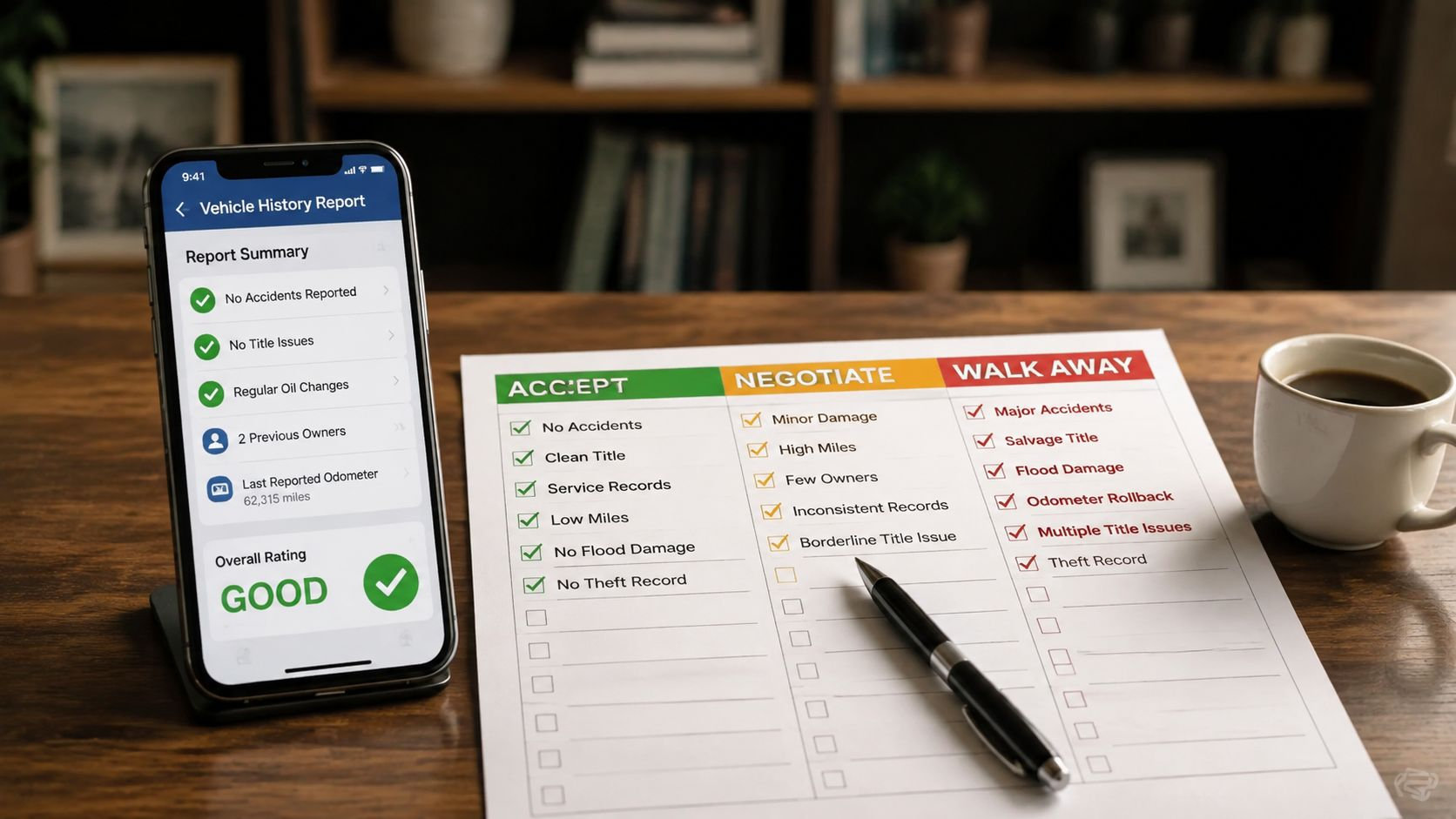
If the record is coherent, the MOT trail makes sense, and the keeper cadence is steady, you can buy at asking price with normal inspection discipline. If the history throws up an anomaly that can be explained, negotiate a discount and document why. If the signals stack against the car, walk away.
Mileage anomalies should translate into valuation discipline. In trade terms, that usually means a 5 to 15 percent haircut depending on how serious the discrepancy looks and how much supporting evidence is missing. That isn't a hard rule, it's a working response to uncertainty, and uncertainty is always priced into stock one way or another.
The right question isn't whether the report is clean. It's whether the report is coherent enough to trust your margin to it.
What to record before you buy
- Decision basis: note which signals supported the purchase and which ones raised concern.
- Inspection priority: send short-tenure or inconsistent-history cars for deeper physical checks before retail prep.
- Disclosure trail: keep the reasoning visible for retail queries and any later internal review.
- Pricing action: tie any discount to a named risk, not a vague feeling.
That approach is exactly where a tool like AutoProv fits. It's a trade-focused provenance layer that helps dealers interpret DVLA data, MOT mileage patterns, keeper cadence and other risk signals together rather than separately.
AutoProv gives UK motor traders a provenance view built for buying decisions, not just consumer reassurance. If you want a sharper way to read vehicle provenance, mileage inconsistency and keeper patterns before you commit stock money, visit AutoProv and see how its trade-focused checks support better acquisition calls.
Frequently Asked Questions
AI-Generated Content Notice
This article was created with the assistance of artificial intelligence technology. While we strive for accuracy, the information provided should be considered for general informational purposes only and should not be relied upon as professional automotive, legal, or financial advice. We recommend verifying any information with qualified professionals or official sources before making important decisions. AutoProv accepts no liability for any consequences resulting from the use of this information.
From our AI insights
- Navigating UK Grey Imports: A Trader's Guide
Understand the complexities and opportunities of UK grey imports for savvy motor traders.
- Navigating Private Plate Challenges in UK Vehicle Checks
Learn how private plates affect UK vehicle checks and how traders verify provenance and spot cloning risks.
- Navigating VIN Checks Post-Brexit: What UK Traders Need to Know
Discover how Brexit impacts VIN checks for UK traders and the crucial data to review.
Related Articles

Essential Vehicle Checks Before Buying a Used Car
Learn essential checks to ensure your used car purchase is safe and sound in the UK market.

Why a Provenance Check is Essential for Used Car Buyers
Ensure your used car is a smart investment by understanding the importance of a provenance check and how AutoProv can help.

A Guide to Vehicle Check with VIN Number
A vehicle check with vin number is easily the most important thing you can do before buying a used car. Think of it as your first line of defence—a quick, simple step that pulls back the curtain on a vehicle's past, protecting you from expensive mistakes, legal headaches, and downright dangerous cars.
Published by AutoProv
Your trusted source for vehicle intelligence