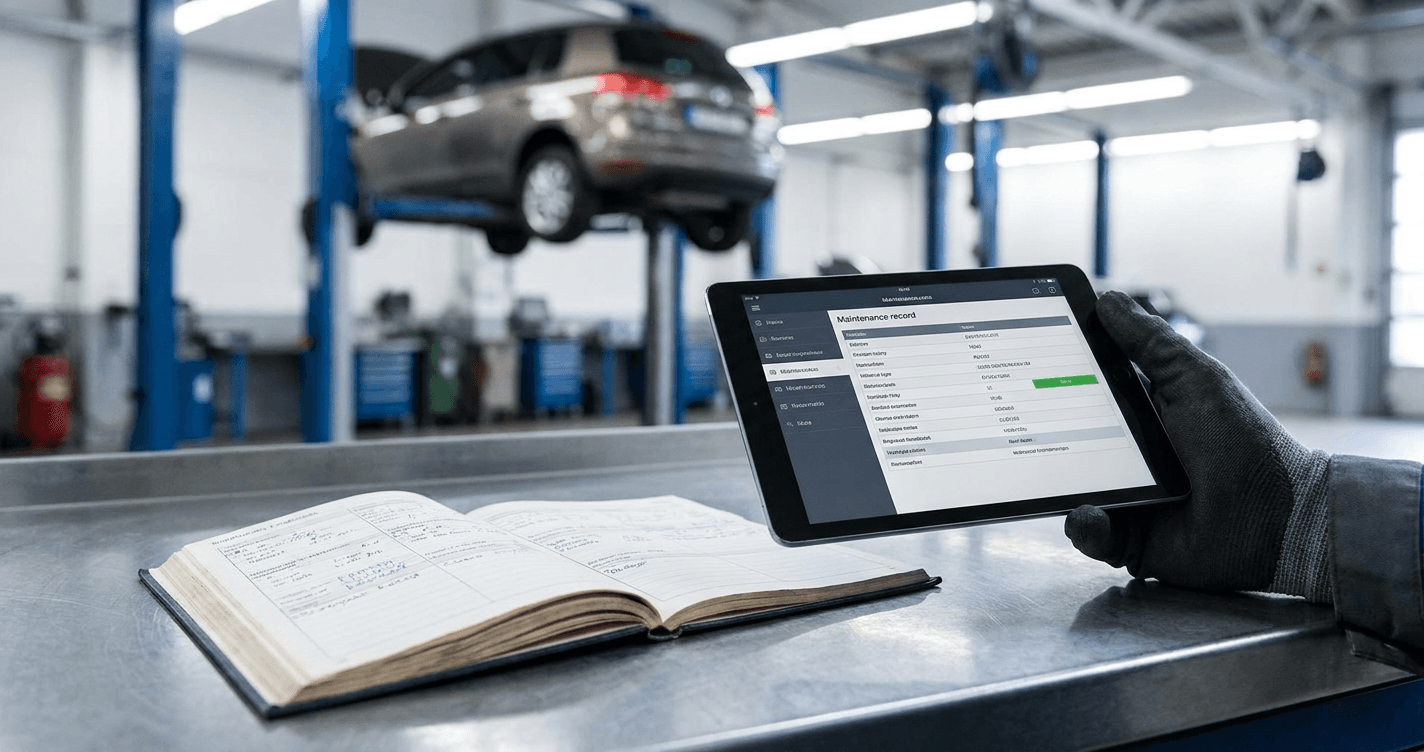
Manufacturer databases hold detailed service records including mileage progression, dealer visits, warranty claims, and recall completion. Learn what trade-grade checks
By CiteFlow
What data manufacturer databases actually hold
Manufacturer databases contain service records logged by franchised dealers during warranty work, scheduled maintenance, and recall campaigns. These records include service dates, mileage readings at each visit, work descriptions, parts fitted, and the specific dealership that performed the work. The data sits in OEM systems (Original Equipment Manufacturer) and is accessible by VIN lookup, creating a digital audit trail independent of paper documentation. What differs from stamped logbooks is that this data cannot be retrospectively altered or forged, as each entry is timestamped and dealer-attributed at the point of service.
Coverage varies significantly between manufacturers. Some brands maintain comprehensive records going back 15-20 years, whilst others only digitised their systems in the mid-2010s. Premium marques typically have more complete historical data because their dealer networks adopted digital service recording earlier. The database only captures work performed at franchised dealers, so independent garage servicing leaves no trace in manufacturer systems.
Mileage progression and clocking detection
Every franchised service visit logs the vehicle's odometer reading alongside the date. This creates a chronological mileage record that reveals inconsistencies impossible to hide. A vehicle showing 78,000 miles at a dealer service in 2022, then 65,000 miles at point of sale in 2024, flags an obvious discrepancy. The manufacturer database provides the evidence trail that stamped books cannot, because each mileage entry is locked to a specific date and cannot be removed.
Mileage progression analysis also identifies unusual patterns. A car averaging 15,000 miles annually for six years, then suddenly showing just 2,000 miles in the following year, warrants investigation. Whilst not definitive proof of clocking, such anomalies inform risk assessment during stock acquisition. Spotting clocked mileage using service history data requires cross-referencing manufacturer records with MOT history, as the two datasets provide independent mileage verification points.
The mileage data becomes particularly valuable when evaluating high-value stock. A premium vehicle with verified low mileage supported by manufacturer records commands better retail prices and reduces dispute risk, because the provenance is demonstrable rather than claimed.
Service intervals and maintenance compliance
Manufacturer databases reveal whether a vehicle followed the prescribed service schedule. Each service entry shows the type of work performed (oil change, inspection, major service) and the mileage or time interval since the previous visit. This allows verification that the manufacturer's recommended maintenance schedule was followed, which directly impacts warranty validity and long-term mechanical reliability.
Missed services become immediately apparent. A vehicle that should have been serviced every 12 months or 10,000 miles, but shows a 30-month gap between dealer visits, raises questions about how it was maintained during that period. For trade buyers, this information influences purchase price negotiations and helps assess the likelihood of deferred maintenance issues.
Some manufacturers' systems also record specific technical campaigns and software updates applied to the vehicle. This data confirms whether known issues were addressed during the vehicle's franchised service life, which can prevent future warranty claims being rejected due to incomplete campaign compliance.
Warranty claims and repair history
Warranty work logged in manufacturer databases provides insight into the vehicle's mechanical history. Repeated claims for the same component (gearbox repairs, turbocharger replacements, electrical faults) indicate potential ongoing issues that may recur after warranty expiry. This intelligence is rarely visible in a stamped service book, which typically shows only routine maintenance.
The repair descriptions vary in detail between manufacturers. Some systems provide comprehensive notes including parts replaced and diagnostic codes, whilst others offer only brief summaries. Even limited information helps assess risk. A vehicle with multiple warranty claims for suspension components, for example, may have been used in demanding conditions or suffered accident damage that wasn't properly repaired.
For vehicles still within manufacturer warranty, the service history verification confirms whether warranty conditions were met. A missed service or use of non-approved parts can void warranty coverage, reducing the vehicle's value and increasing the dealer's exposure to repair costs.
Recall campaign completion status
Manufacturer databases track whether safety recalls and technical campaigns were completed. Each recall is assigned a unique campaign code, and the database records when the work was performed, at which dealer, and at what mileage. Uncompleted recalls represent both a safety concern and a potential liability, as some recalls affect vehicle roadworthiness or insurance validity.
Recall completion data is particularly important for imported vehicles or those with complex ownership histories. A car that spent time outside the UK may have missed recall notifications, leaving safety-critical work undone. The manufacturer database identifies outstanding campaigns that need addressing before retail sale.
Some recalls are time-sensitive or require multiple visits to complete. The database shows the full campaign history, allowing dealers to verify that multi-stage recalls were finished rather than partially completed. This detail protects against selling vehicles with unresolved safety issues.
Dealer network and geographic service patterns
The service history shows which dealers performed work and where those dealerships are located. A vehicle serviced consistently at the same dealer in a specific region suggests stable ownership and local use. Conversely, a car with service records scattered across the country may indicate fleet use, multiple owners, or rental history.
Geographic patterns also help verify mileage claims. A vehicle allegedly used for local commuting, but serviced at dealers 200 miles apart, contradicts the stated use case. Similarly, a car claimed as a single-owner vehicle but showing service history at dealers in different regions raises questions about the ownership narrative.
For premium vehicles, consistent main-dealer servicing at prestigious locations can add value. A luxury car with a complete service history from a flagship London dealer carries more retail appeal than one serviced at multiple locations with gaps in the record. Why manufacturer service history beats stamped logbooks becomes evident when the dealer network data provides this additional context.
Coverage gaps and what databases cannot show
Manufacturer databases only record work performed at franchised dealers. Any servicing at independent garages, specialist workshops, or by the owner leaves no trace in OEM systems. A vehicle with three years of manufacturer history, then a four-year gap, was almost certainly serviced elsewhere during that period. Whether that independent servicing was adequate remains unknown without additional documentation.
Some manufacturers provide better data access than others. Verifying digital service history across manufacturers requires understanding each brand's system limitations. Certain marques only digitised records from 2010 onwards, meaning older vehicles have incomplete or absent database entries despite having full franchised service histories on paper.
The databases also cannot verify the quality of work performed. A logged service confirms that a dealer charged for the work, but doesn't guarantee that all tasks were completed correctly or that genuine parts were used. Fraudulent dealer practices, whilst rare, can result in service entries for work not actually performed.
How manufacturer data integrates with other provenance checks
Manufacturer service history forms one component of comprehensive vehicle intelligence. Cross-referencing this data with MOT records, finance checks, and mileage verification creates a complete provenance picture. A vehicle showing consistent dealer servicing but with MOT failures for neglected maintenance items suggests the servicing may have been minimal or the vehicle poorly maintained between dealer visits.
The combination of manufacturer data and digital service history retrieval methods allows verification that cannot be achieved through visual inspection alone. A stamped book can be forged or selectively filled, but manufacturer database entries are independently verifiable and timestamped.
For trade buyers conducting due diligence, manufacturer service data reduces reliance on seller claims. Rather than accepting a vendor's assertion that the vehicle has full service history, the database provides objective confirmation. This evidence-based approach to stock acquisition reduces the risk of buying mis-described vehicles.
Accessing manufacturer databases for trade use
Access to manufacturer service databases requires either direct relationships with each OEM or use of aggregation services that query multiple manufacturer systems. Individual dealers can request service history directly from manufacturers for their own brand, but cross-brand access requires third-party platforms that have established data-sharing agreements with multiple OEMs.
The retrieval process uses the VIN to query manufacturer systems. Response times vary from near-instant to several hours, depending on the manufacturer's system architecture and data availability. Some brands provide comprehensive PDF reports with full service details, whilst others return basic summaries of service dates and mileage.
Cost structures differ between access methods. Direct manufacturer queries may be free for franchised dealers of that brand but unavailable to independent traders. Aggregated service history check services charge per query but provide multi-brand coverage and standardised report formats, which suits traders handling diverse stock.
Using manufacturer data for CRA 2015 compliance
Manufacturer service history provides documentary evidence for Consumer Rights Act 2015 compliance. When a customer disputes a vehicle's condition or description, manufacturer database records demonstrate the due diligence performed during acquisition. A vehicle sold as having full service history, supported by manufacturer data, is defensible in a way that stamped books alone are not.
The data also helps establish the vehicle's condition at point of sale. If a mechanical fault emerges shortly after purchase, manufacturer records showing recent dealer servicing and no related warranty claims support the dealer's position that the fault was not present or reasonably detectable at sale.
For distance sales, manufacturer service history verification allows dealers to accurately describe vehicles without physical inspection. How digital service history is changing the used car trade includes the ability to confidently market vehicles based on verified digital records rather than seller-provided documentation that may be incomplete or misleading.
Regional variations in manufacturer database access
Manufacturer data availability can vary by region due to different franchised dealer network densities. Vehicles primarily serviced in areas with strong dealer networks typically have more complete records than those from regions with fewer franchised outlets. A car from rural Scotland may have longer gaps between dealer services simply due to geographic access to franchised dealers.
Imported vehicles present additional complexity. A car originally registered in Northern Ireland but later moved to England may have service history split between different dealer networks or even different manufacturer database systems if the vehicle crossed between UK and Republic of Ireland during its life.
For traders operating across multiple regions, understanding these geographic variations helps set realistic expectations for data completeness. A vehicle with patchy manufacturer history may simply reflect the owner's location rather than poor maintenance practices.
FAQ
Can manufacturer databases show service history from independent garages?
No. Manufacturer databases only record work performed at franchised dealers within that brand's network. Independent garage servicing, specialist workshops, and owner maintenance leave no trace in OEM systems. A vehicle serviced exclusively at independent garages will show no manufacturer service history, even if it was maintained to the correct schedule with genuine parts. This limitation means manufacturer data must be considered alongside other evidence when assessing overall maintenance quality.
How far back do manufacturer service records typically go?
Coverage varies significantly between brands. Premium manufacturers often maintain digital records from the early 2000s or even late 1990s, whilst some volume brands only digitised their systems around 2010-2015. The completeness of historical data also depends on when individual dealers within the network adopted digital service recording. Older vehicles may have partial records showing only recent services, with earlier maintenance documented only in paper logbooks.
What happens if a vehicle was serviced at a franchised dealer that has since closed?
The service records typically remain in the manufacturer's central database even after a dealer closes. The entries will show the dealership name and location as they existed at the time of service, but the data itself is preserved. This is one advantage of manufacturer databases over relying on individual dealer records, which may be lost when a business closes or changes ownership.
Do manufacturer databases show mileage at every service visit?
Yes. Each service entry logged by a franchised dealer includes the odometer reading at the time of the visit. This creates a chronological mileage record that can be used to verify mileage progression and identify potential clocking. The mileage data is particularly valuable because it provides independent verification points separate from MOT records, allowing cross-referencing between two different data sources.
Can manufacturer service history be faked or altered?
Manufacturer database entries cannot be retrospectively altered by anyone outside the manufacturer's systems, and even dealer access is typically restricted to adding new entries rather than editing historical data. Each entry is timestamped and attributed to a specific dealer, creating an audit trail. This makes manufacturer data significantly more reliable than stamped service books, which can be forged, backdated, or selectively completed. However, fraudulent entries made by dealers at the time of service (logging work not actually performed) would appear in the database, though such practices are rare due to manufacturer oversight and audit procedures.
Frequently Asked Questions
AI-Generated Content Notice
This article was created with the assistance of artificial intelligence technology. While we strive for accuracy, the information provided should be considered for general informational purposes only and should not be relied upon as professional automotive, legal, or financial advice. We recommend verifying any information with qualified professionals or official sources before making important decisions. AutoProv accepts no liability for any consequences resulting from the use of this information.
From our AI insights
- The Importance of Tyre Verification for UK Motor Traders
Discover why verifying tyre specs is crucial for UK traders to ensure safety and compliance.
- Decoding CO2 Emissions: A Trader's Guide
Learn how traders can verify CO2 data using factory build sheets to prevent disputes.
- Navigating Recall Compliance for UK Car Traders
Ensure compliance with recall regulations: essential steps for UK car traders.
Related Articles

The Importance of Car Maintenance and Provenance Checks
Discover why regular car maintenance and proper provenance checks are essential for vehicle quality and longevity.

Essential Car Maintenance Tips for UK Drivers
Discover vital car maintenance tips to keep your vehicle roadworthy and compliant in the UK.

How Much Is a Car Service? Complete UK Price Guide
Trying to pin down exactly "how much is a car service?" can feel a bit like asking "how long is a piece of string?". Prices vary quite a bit, but to give you a ballpark figure, an interim service will usually set you back around £100 to get started. A more thorough full service often begins at £180, while a major service for many cars can easily top £300.
Published by AutoProv
Your trusted source for vehicle intelligence