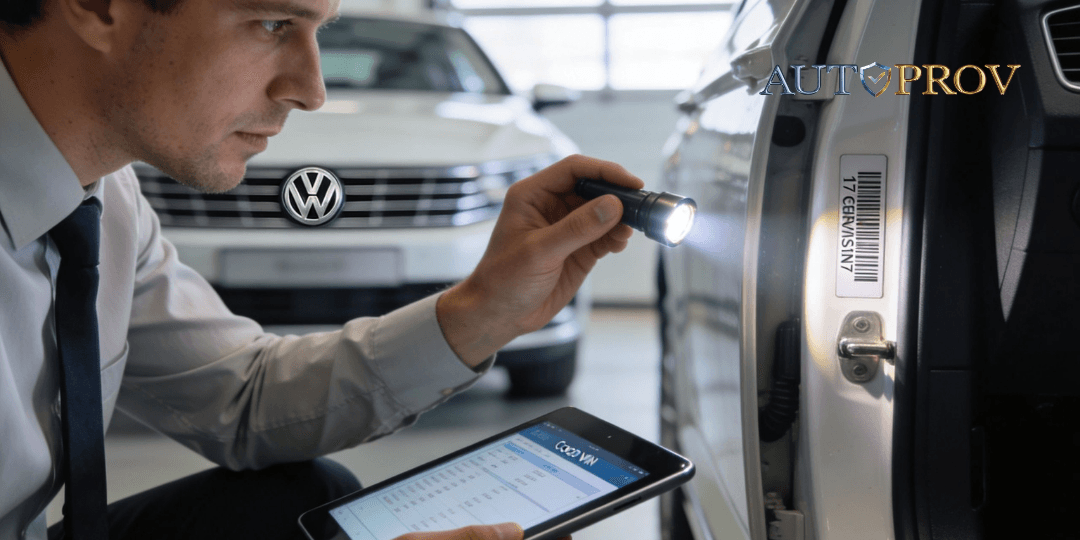
You’re standing in the lane, appraisal sheet in hand, looking at a Volkswagen that seems easy money. Clean enough. Spec looks right. Seller sounds convincing.
That’s exactly when the VIN matters most.
For a trader, decode vin vw isn’t about satisfying curiosity. It’s about deciding whether the stock is genuine, correctly described, and commercially safe to buy. A Volkswagen VIN can confirm build identity, expose inconsistencies, and give you the starting point for a proper vehicle history check UK process. If you treat it as just a serial number, you’ll miss the risk signals that affect margin, prep cost, resale confidence, and post-sale disputes.
Why a VW VIN Is More Than Just a Serial Number
Volkswagen stock moves quickly in the UK trade, and that’s part of the problem. Popular metal attracts rushed appraisals, assumptions about spec, and overreliance on registration-based checks. The VIN cuts through that. It tells you what the vehicle was built as before paperwork, auction wording, or seller narrative starts blurring the picture.
The modern VIN is a 17-character standard, used since 1981, and it gives traders a consistent way to identify manufacturer, model details, year coding, plant information, and serial sequence. In the UK, that matters because Volkswagen has a major used footprint, with over 1.2 million VW passenger cars registered as of 2023 according to VW VIN guidance for UK checks. High volume makes standardisation useful. It also makes shortcuts dangerous.
Where the commercial risk sits
A decoded VW VIN only becomes valuable when you verify it against history records and the physical vehicle. That’s where the money is won or lost.
According to UK VW VIN check data, 14% of used VWs checked had outstanding finance and 8.5% showed mileage discrepancies. Those aren’t theoretical issues. They affect bid strength, disposal route, warranty exposure, and whether the car belongs in your stock profile at all.
Practical rule: A VIN is the opening move in a provenance check, not the conclusion.
If the VIN says one thing and the life story says another, believe the inconsistency until you can explain it. That approach saves more money than trying to “buy cheap enough” to absorb unknowns.
What a trader should take from it
A good trader uses the VIN as the base layer of vehicle provenance. It helps answer basic but profitable questions:
- Is the vehicle what it claims to be? Build identity matters before you value it.
- Does the history fit the build? Year, plant, model and usage should line up.
- Are there risk markers hiding behind a tidy presentation? Finance, mileage and identity problems rarely announce themselves on the forecourt.
If you need a refresher on the physical identifier itself, AutoProv’s guide to what a VIN plate is gives the basic reference point. In trade terms, though, the bigger point is simple. A VW VIN is not admin. It’s your first filter for motor trade risk.
Locating and Verifying the VW VIN on the Vehicle
Before you decode anything, confirm you’re looking at the right identity. Traders get caught when they trust one visible plate, one bit of paperwork, or one auction listing. That’s not enough on a Volkswagen, or on any used stock where provenance matters.

Where to look on the car
On most VW models, the VIN is commonly found in several places. Check more than one.
- Dashboard plate: Look through the lower windscreen on the driver’s side. This is usually the quickest visible point.
- Driver’s door jamb sticker: Open the door and inspect the manufacturer label carefully.
- Engine bay stamping or label: Some vehicles will have an additional VIN reference under the bonnet.
- Vehicle documents: Compare the car to the V5C, not just to a stock sheet or screen print.
If you want a practical reference for typical VIN locations, AutoProv’s guide to finding VIN numbers is a useful checklist.
How to verify it properly
Traders either protect themselves or create future problems at this stage. Don’t just confirm that a VIN exists. Confirm that it matches everywhere it should.
Use a simple verification routine:
- Read the full 17 characters slowly. Don’t rely on a photo if you have the car in front of you.
- Compare every physical VIN point on the vehicle. Dashboard, door label, and any stamped location should agree.
- Match the VIN to the V5C exactly. One wrong character is not “close enough”.
- Check condition around the plate or label. Fixings, surrounding trim, and signs of disturbance matter.
- Question any inconsistency before you value the car. Identity issues should stop the appraisal process, not sit as a note for later.
According to UK AA Vehicle Check data referenced in this VIN decoding guide, mismatches between VIN plates and documentation occur in approximately 12% of fraud cases. That’s why multi-point physical verification isn’t admin theatre. It’s basic stock protection.
If the dashboard VIN matches the V5C but the door sticker doesn’t, you don’t have a minor clerical issue. You have a provenance problem.
What mismatches usually mean in practice
A mismatch doesn’t automatically prove cloning or serious fraud, but it does tell you the file is no longer clean. It can point to poor repair history, documentation errors, plate replacement, identity manipulation, or something worse. Any one of those changes the deal.
For dealer vehicle checks, physical VIN verification should happen before you spend time discussing prep, retail profile, or reserve strategy. There’s no point negotiating hard on price if the car’s identity is already in doubt.
Breaking Down the 17-Character Volkswagen VIN
Once the physical VIN is verified, the code starts doing useful work. Volkswagen VINs follow the standard 17-character format, but traders need to read them with VW-specific context. That’s especially important with common European-format strings where filler characters can confuse people into thinking part of the code is missing.

The three sections that matter
The VIN breaks into three broad parts:
- WMI, positions 1 to 3 identify the manufacturer and origin.
- VDS, positions 4 to 9 describe core vehicle attributes and include the check digit.
- VIS, positions 10 to 17 identify model year, plant, and serial sequence.
For Volkswagen, you’ll often see WVW at the start on European-built passenger vehicles. You’ll also see VINs with ZZZ in parts of the descriptor section. In VW use, those Z characters are often fillers rather than a meaningful trim or feature code on their own. Traders who misunderstand that can overread the VIN and make bad assumptions about exact specification.
Volkswagen 17-Character VIN Breakdown
Position(s) Section What It Decodes VW Example 1-3 WMI Manufacturer and region of origin WVW 4-8 VDS Model, engine, body type and related descriptors May include VW-specific coding and Z fillers 9 VDS Check digit used to validate VIN authenticity Mathematical validation character 10 VIS Model year code Example year code such as M for 2021 11 VIS Assembly plant code Example E for Emden 12-17 VIS Unique production serial Vehicle-specific sequence AutoProv’s explainer on what VIN means is useful if you want the terminology in one place, but in the trade the priority is interpretation, not vocabulary.
What works and what doesn’t
What works is using the VIN as a controlled build reference. It helps you sense-check auction descriptions, seller claims, and registration-derived assumptions. If the car is advertised one way but the VIN points to a different base identity, stop and resolve that first.
What doesn’t work is treating a generic free decoder as a final answer. Volkswagen coding can be nuanced, especially where market-specific spec, imported stock, and filler characters are involved. A generic decoder might return a broad model family and leave traders thinking the car is verified when the detail still needs proving against the vehicle and its records.
A VW VIN should narrow uncertainty. If your decoding process creates false confidence, it’s doing the opposite of what a dealer vehicle check should do.
The positions traders use most
In day-to-day buying, these are usually the most commercially useful points:
- Positions 1 to 3: Confirms whether the manufacturer identity makes sense for the vehicle in front of you.
- Positions 4 to 8: Helps assess whether body, engine and vehicle type fit the car’s presentation and paperwork.
- Position 9: Useful as an authenticity check when there’s any concern about tampering.
- Position 10: Helps align the vehicle’s model year with registration timing and MOT age profile.
- Position 11: Important when assessing imported stock or unusual market history.
- Positions 12 to 17: Essential for precise record matching and theft or history lookups.
That’s the practical value of decode vin vw. It gives you a structured way to move from identity to scrutiny. The code itself won’t tell you whether to buy the car. It will tell you what questions the car now has to answer.
Connecting VIN Data to UK Vehicle History Records
A decoded VIN on its own is only half the job. It tells you how the car was built. Your margin depends on whether the build identity lines up with the vehicle’s UK paper trail.

Use the year code and plant code properly
The two most useful parts for a used car history report are usually the 10th character and 11th character.
The 10th character gives the model year coding. That matters when registration timing looks odd, when a personalised plate obscures age at a glance, or when the seller is describing the car by registration year rather than build year. The 11th character identifies the assembly plant, which is useful when the vehicle may be imported or when the paperwork and market profile don’t match the build story.
That’s where a proper vehicle history check UK process becomes more intelligent than a simple reg lookup. You’re not just asking whether there’s a record. You’re asking whether the record fits the vehicle.
What to compare against DVLA and MOT records
When you decode vin vw for trade purposes, compare the VIN-derived identity against the following:
- MOT mileage progression: Look for a believable progression over time, not just whether the latest figure looks acceptable.
- Vehicle age profile: The year coding should make sense against first registration and test history.
- Import clues: Plant information and build identity can raise useful questions where the V5C history suggests a different market story.
- Spec consistency: If the VIN points to one vehicle type and the paperwork or auction listing implies another, dig deeper.
According to a 2025 Auto Trader report referenced in UK VW auction VIN analysis, 22% of used VWs in UK auctions had inconsistent MOT mileage when cross-checked against their VIN-derived age. That’s exactly the kind of issue generic decoders miss. They can decode the shell of the identity but not the commercial risk sitting in the history timeline.
Generic VIN tools tell you what the car should be. Trade vehicle intelligence asks whether its history behaves like that car should.
A better workflow for trade appraisals
For stock buying, the strongest workflow is simple:
- Physically verify the VIN on the car
- Decode the core identity
- Cross-check DVLA and MOT records against that identity
- Investigate anomalies before bidding or agreeing price
If you’re reviewing auction packs, service documents, or exported history files, it can help to pull data from PDF documents so mileage entries, dates, and reference numbers are easier to compare against VIN-based records. That’s particularly useful when paperwork is fragmented and you want one clean view before making a decision.
For traders who rely too heavily on no-cost lookups, AutoProv’s article on a free VIN check in the UK is a fair reminder of where free tools stop being enough. The issue isn’t whether a decoder returns data. It’s whether the data helps you judge provenance, valuation risk, and disposal confidence.
Trade Red Flags to Spot Using VW VIN Provenance
Once the identity and records are aligned, the next step is spotting the patterns that turn an ordinary used car into a poor trade decision. At this stage, experienced buyers separate a technical decode from real trade vehicle intelligence.

Volkswagen is common stock, but it also carries real theft exposure. According to UK Volkswagen theft-focused VIN data, 1 in 150 Volkswagen vehicles are stolen annually in the UK, and 65% of used VWs are imported. That combination makes VIN-history cross-checking commercially important, especially where imported stock may carry a more complex identity trail.
Red flags worth acting on
Some issues should slow the deal immediately.
- Invalid or questionable check digit: If position 9 doesn’t validate properly, treat the car as high risk until proven otherwise.
- Imported identity with weak paperwork: Imported VWs aren’t a problem by default, but they need cleaner supporting records.
- Spec mismatch: If the VIN-derived build identity doesn’t fit the car’s trim, engine presentation, or paperwork, someone needs to explain why.
- History that feels too neat: A very clean story with weak supporting documentation often deserves more scrutiny, not less.
Ownership behaviour matters
The VIN doesn’t directly tell you owner intent, but it gives you the anchor point for analysing ownership timelines and behavioural risk. If the identity is sound but the life story shows repeated fast changes, unexplained resale movement, or odd gaps around key dates, the vehicle may still be wrong for your stock profile.
Many trade losses don’t come from obvious write-off markers. They come from vehicles that are technically saleable but commercially awkward. They generate prep surprises, customer challenges, awkward part-exchanges later, or a slower retail exit than the initial appraisal suggested.
Don’t just ask whether the car is clear. Ask whether it is easy to defend once it’s on your pitch.
The practical decision test
Use VIN provenance to answer three things before you commit:
- Can I prove the vehicle’s identity confidently?
- Can I explain the history without making assumptions?
- Would I be comfortable defending this file to a buyer, funder, or compliance manager?
If the answer is no to any of those, the issue isn’t just administration. It’s motor trade risk.
For theft-related concerns, AutoProv’s guide on how to check if a vehicle is stolen is a useful reference point. In practice, though, the strongest discipline is this: use the VIN as the fixed truth, and force every other record to agree with it. The moment the records start resisting that process, you’re no longer appraising a standard used Volkswagen. You’re pricing uncertainty.
Making Smarter Acquisitions with Vehicle Intelligence
A VW VIN is most useful when you stop treating it as a decoding exercise and start using it as a buying control. The code identifies the car. The cross-checks tell you whether the car’s story deserves your capital.
That’s the difference between basic dealer vehicle checks and a proper provenance-led buying process. One confirms there’s a record. The other helps you decide whether the vehicle belongs in your stock at all. For any trader managing margin carefully, that difference matters more than another small win on purchase price.
The practical workflow is straightforward. Verify the physical VIN. Decode the build identity. Match it to DVLA and MOT history. Investigate anything that doesn’t line up. That gives you a stronger basis for valuation, negotiation, and disposal planning, and it improves the quality of every mileage check UK and used car history report you rely on.
Good traders don’t just buy what looks presentable. They buy what they can defend. In Volkswagen stock, where volume is high and assumptions are easy, VIN-led vehicle provenance work is one of the clearest ways to reduce avoidable risk and protect profit.
AutoProv helps UK motor traders turn VIN data, MOT history, ownership timelines, mileage patterns, and provenance anomalies into practical buying intelligence. If you want stronger vehicle history checks, provenance reporting, and trade risk insight from AutoProv, it’s built specifically for dealers, wholesalers, and professional buyers who need more than a basic pass or fail report.
Frequently Asked Questions
AI-Generated Content Notice
This article was created with the assistance of artificial intelligence technology. While we strive for accuracy, the information provided should be considered for general informational purposes only and should not be relied upon as professional automotive, legal, or financial advice. We recommend verifying any information with qualified professionals or official sources before making important decisions. AutoProv accepts no liability for any consequences resulting from the use of this information.
From our AI insights
- Navigating UK Grey Imports: A Trader's Guide
Understand the complexities and opportunities of UK grey imports for savvy motor traders.
- Uncovering the Real Costs of Vehicle Intelligence Services
Discover hidden fees and data quality issues in vehicle intelligence services.
- Decoding UK Auction Vehicle Histories
Understand how to assess UK auction vehicle histories and uncover hidden risks.
Related Articles

Essential Vehicle Checks Before Buying a Used Car
Learn essential checks to ensure your used car purchase is safe and sound in the UK market.

Why a Provenance Check is Essential for Used Car Buyers
Ensure your used car is a smart investment by understanding the importance of a provenance check and how AutoProv can help.
A Guide to Vehicle Check with VIN Number
A vehicle check with vin number is easily the most important thing you can do before buying a used car. Think of it as your first line of defence—a quick, simple step that pulls back the curtain on a vehicle's past, protecting you from expensive mistakes, legal headaches, and downright dangerous cars.
Published by AutoProv
Your trusted source for vehicle intelligence