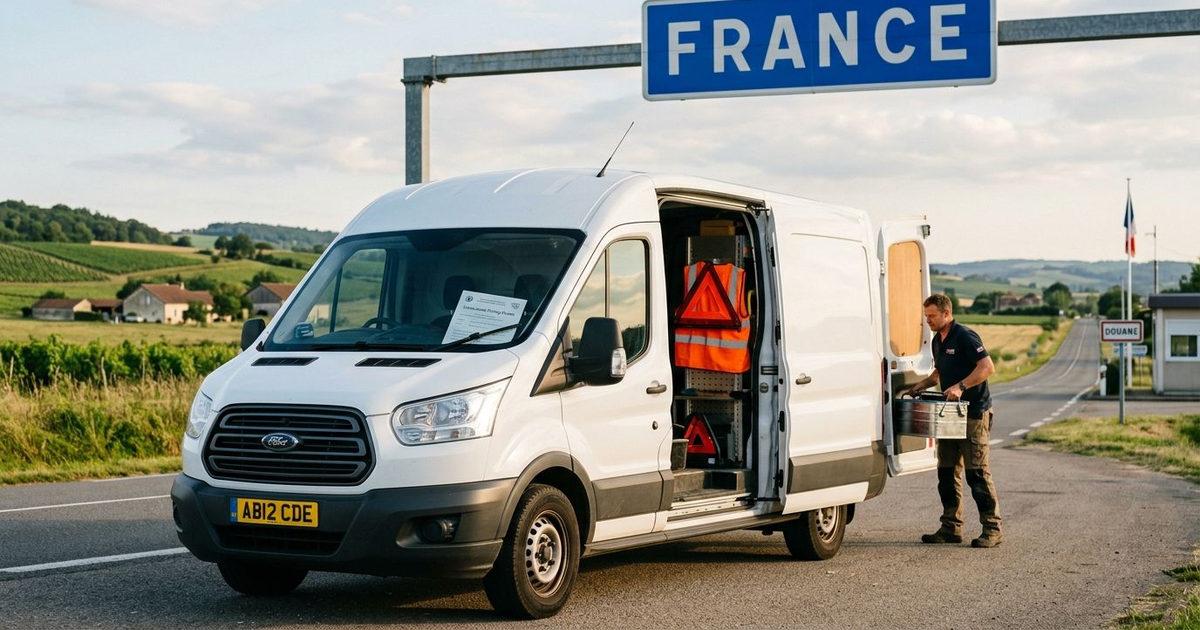
A lot of UK motor traders only think about France when the ferry is booked, the collection note is printed, and a driver is due at the port before dawn. That's usually when the avoidable problems start. A missing document, the wrong plate identifier, a jacket buried in the boot, or a junior driver who is perfectly legal in the UK but not operating to the same threshold in France can turn a routine trip into a compliance issue that costs time, margin, and credibility.
For the trade, driving in France isn't a leisure exercise. It's a business movement. You might be collecting stock, delivering a vehicle for demonstration, attending a trade event, or moving a car between sites and partners. In each case, the driver, the vehicle, and the in-car kit all need to stand up to roadside scrutiny.
The commercial risk is straightforward. If the driver isn't properly licensed, French enforcement can issue on-the-spot fines or even immobilise the trip by targeting the vehicle itself. If the car isn't carrying mandatory items, the penalties are immediate. If the paperwork is weak, you've handed an officer a reason to look more closely at everything else.
That's why the right approach is to treat French road compliance the same way you treat trade buying risk in the UK. Use a checklist. Verify the basics before departure. Don't rely on old forum advice. Don't assume a UK norm carries across the Channel unchanged.
Table of Contents
- Introduction Driving in France as a Business Risk
- Essential Driver and Licence Requirements
- Start with the person you are sending
- Experience affects risk, not just legality
- Mandatory Vehicle Documents and Insurance
- What should travel with the vehicle
- Paperwork standards matter
- Required Safety Equipment and Vehicle Kit
- The items that need to be in the car
- Outdated advice wastes money and attention
- Post-Brexit Rules UK Stickers and Crit'Air Zones
- The sticker rule that still catches traders
- Crit'Air needs operational planning
- Key French Traffic Laws and On-the-Spot Penalties
- The alcohol limit difference is not academic
- The road habits that need adjusting
- Beyond Road Rules The Trader's Vehicle Provenance Blind Spot
- Compliance on the road is only one layer
- Why provenance belongs in the same risk conversation
Introduction Driving in France as a Business Risk
A dealer sends a driver to northern France to collect stock from a counterpart. The car is mechanically fine. The route is simple. The paperwork looks “good enough”. That phrase causes more trouble in cross-border movements than most traders care to admit.
French roadside compliance is unforgiving when the basics are missing. It doesn't matter that the trip is short or that the vehicle will only be in France temporarily. The driver still needs to meet French legal standards, and the vehicle still needs the right supporting documents and mandatory equipment.
For UK businesses, the risk sits in three places:
- Driver risk. Age, licence status, and experience can affect whether the journey is lawful at all.
- Vehicle risk. Registration, insurance evidence, and supporting paperwork need to be defensible.
- Operational risk. In-car safety items, plate identifiers, and urban access rules can create immediate fines and delays.
Practical rule: Treat every Channel crossing as a compliance event, not a transport admin task.
That mindset changes behaviour. Instead of asking whether the car can physically make the trip, ask whether a French roadside check would be satisfied in under two minutes. If the answer is uncertain, there's work to do before departure.
The wider point matters for the motor trade. Businesses that are casual with road compliance are often casual elsewhere too. A weak process around travel documents, identity of the vehicle, and mandatory equipment usually sits alongside weak acquisition controls, shallow dealer vehicle checks, and overreliance on basic records. That's why driving in France requirements should sit inside a broader risk process, not outside it.
Essential Driver and Licence Requirements
Start with the person you are sending
A common failure point is simple. The vehicle is ready, the ferry is booked, and the wrong employee is handed the keys.
For France, the first compliance check is always the driver. UK drivers must be at least 18 years old to legally drive in France, and failure to possess a full, valid UK driving licence can lead to immediate enforcement action, according to Brittany Ferries guidance on driving in France. For a motor trader, that rules out any assumption that UK insurance availability or internal convenience is enough. If the licence position is weak, the trip is weak.
A provisional licence holder should not be sent. Neither should a staff member whose entitlement is unclear because nobody checked the card, categories, or current validity before departure. In practice, this is a dispatch-control issue as much as a legal one. If your transport desk treats driver allocation casually, roadside risk rises fast.
If the driver holds a current UK photocard licence, that is usually the cleanest position for French travel. Older paper licences need closer review because an International Driving Permit may be required. That adds admin, creates another document that can be forgotten, and introduces avoidable delay if the trip is time-sensitive.
For operators reviewing mixed nationality or mixed-history driver files, this guide to exchanging an EU driving licence to a UK licence is a useful reference for internal compliance checks.
Experience affects risk, not just legality
Age is only one filter. Licence tenure also changes the compliance profile of the trip.
Drivers with less than three years of experience face a stricter alcohol limit in France than more experienced drivers, as noted earlier. Operationally, this is significant because many dealer groups and independents use junior staff for auction runs, vehicle collection, and short-notice cross-border movements. A legally employable UK driver can still be the higher-risk choice for a French trip.
That has a commercial angle. One roadside issue can wipe out the margin on a collection, delay handover to a buyer, or leave a stock vehicle stranded while the business sorts out recovery and rescheduling. Sending the cheapest available driver is not always the cheapest decision.
Use a pre-departure driver screen that is strict enough to stand up under scrutiny:
- Confirm the licence is full and valid. Do not rely on verbal assurance.
- Confirm the driver is at least 18.
- Check how long the licence has been held. Newer drivers carry a different risk profile in France.
- Check the document format. A photocard is usually simpler. Older paper licences need extra review.
- Match the driver to the job. High-value stock, tight delivery windows, and unfamiliar routes justify your lowest-risk driver.
A French roadside stop will test the decision you made in the yard, not the excuse you make afterwards.
Well-run traders build this into allocation, not just HR records. The question is not whether someone can drive. The question is whether they are the right person to put in front of French enforcement with your stock, your timetable, and your margin at stake.
Mandatory Vehicle Documents and Insurance
What should travel with the vehicle
Once the driver is cleared, the file for the vehicle needs to be just as disciplined. Traders often move cars they don't personally own in the everyday sense, and that can create a credibility problem if the paperwork is incomplete or inconsistent.
The safest position is to carry the original Vehicle Registration Certificate (V5C) or the strongest available registration evidence supporting the vehicle's legal identity. If the car is being transported or driven for trade purposes, make sure whoever is behind the wheel can explain why they have possession of it and what the movement is for. Photocopies and vague explanations invite unnecessary scrutiny.
If your team needs a refresher on what the UK registration certificate proves and how to handle it correctly in stock processes, this registration certificate guide is worth keeping in your internal procedure notes.
Insurance is the second pillar. The practical question isn't whether the vehicle is insured somewhere in your portfolio. It's whether the specific trip, jurisdiction, driver, and use case are covered. That means checking cross-border use, demonstration use if relevant, temporary vehicle substitution, and who is named or permitted to drive.
Paperwork standards matter
A clean trade process usually includes a departure pack with these items:
- Registration proof. Carry the original V5C where possible, not an informal copy.
- Insurance evidence. Confirm that France is covered under the relevant policy and that the intended driver is validly insured.
- Driver identity support. Keep passport and licence details consistent with the booking and trip file.
- Trade movement rationale. Collection note, sale invoice, purchase confirmation, or event paperwork should be easy to produce if questioned.
This isn't about over-documenting a simple trip. It's about reducing doubt. Border and roadside issues often escalate because a file looks improvised.
A practical rule for traders is to avoid relying on “we can email that over if needed”. If the answer to a roadside request depends on someone back in the office being at their desk, the process is weak. Carry what is needed in the vehicle, keep it organised, and make sure the driver knows exactly what each document is for.
The best paperwork pack is the one a driver can present confidently without ringing the sales office.
That confidence matters. French enforcement is more likely to move on quickly when the driver looks prepared, the documents are coherent, and the vehicle's legal status is clear.
Required Safety Equipment and Vehicle Kit
The items that need to be in the car
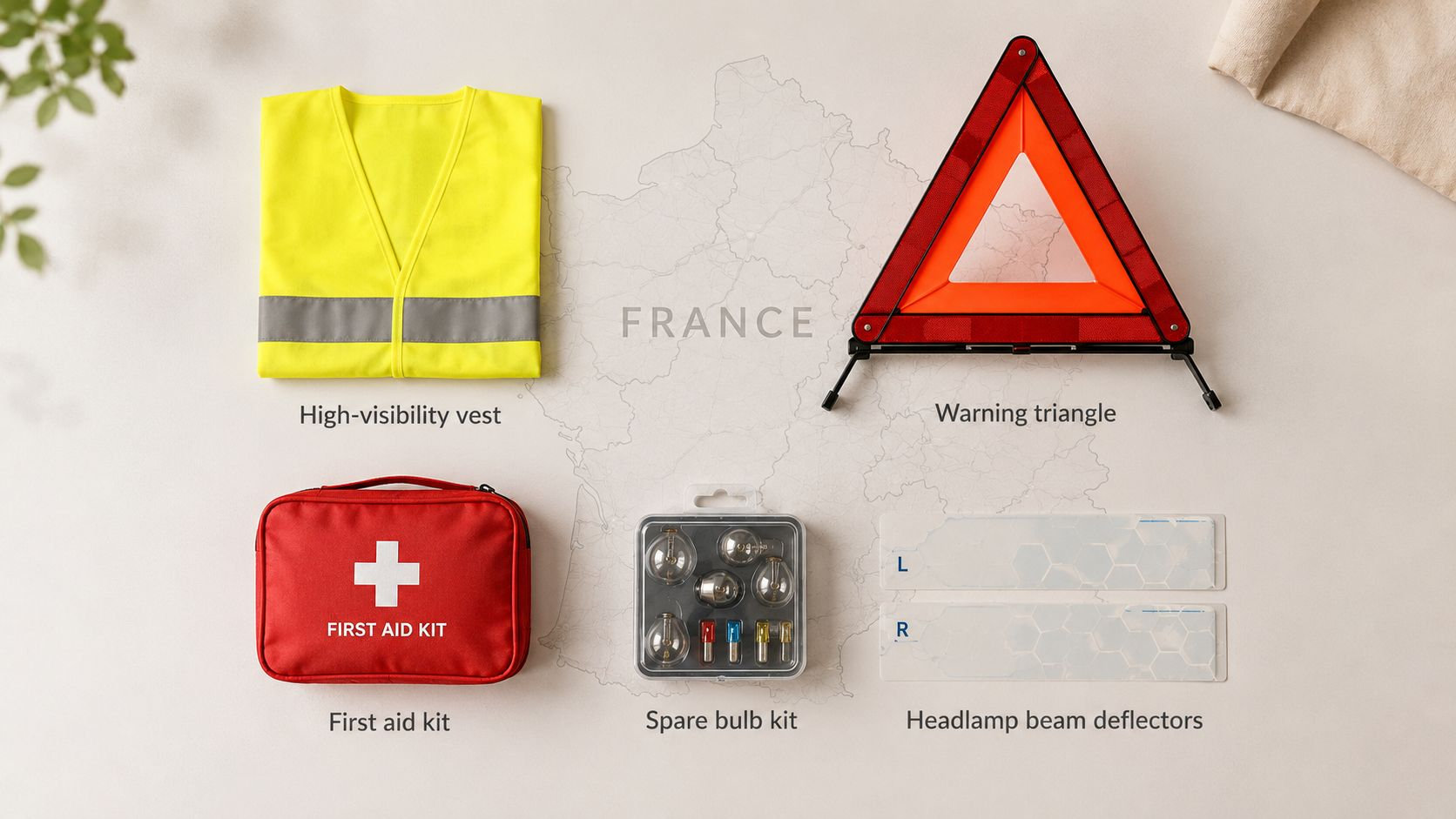
Failure to comply with specific regulations often leads to unnecessary financial losses for many otherwise organised operators. The law mandates the physical carriage of a warning triangle and a reflective high-visibility jacket stowed within the passenger compartment, not the boot; failure to present these specific items upon police inspection incurs a fixed penalty of €135 per missing item. It also necessitates the use of headlamp beam deflectors to adjust for right-hand traffic, as set out in LeShuttle's France driving guide.
Two details matter more than most checklists admit.
First, the high-vis jacket has to be reachable from inside the vehicle. If it's under stock mats, boxed with auction paperwork, or buried in the boot under display plates, you've missed the point. Second, beam deflectors are not cosmetic. They are part of making a UK vehicle safe and compliant for driving on the right.
Use a physical audit, not a verbal one:
- Warning triangle. Confirm it's present, usable, and not broken.
- High-visibility jacket. Put it in the passenger compartment, not the luggage area.
- Headlamp beam deflectors. Fit them before departure, not at the terminal queue.
- Condition check. Don't assume a previous driver replaced kit after the last trip.
For EV transporters or businesses moving electrified stock, it also makes sense to review emergency preparedness around battery incidents. Trade teams handling modern inventory may find Knight Tek's thermal runaway solutions a useful specialist resource when setting workshop and transport safety procedures.
A broader pre-trip audit should sit alongside your standard car safety checks for UK used cars, particularly where vehicles are leaving stock and being moved by different drivers.
Outdated advice wastes money and attention
A significant problem with French kit compliance isn't just missing equipment. It's distraction caused by outdated advice. Traders waste time chasing items that no longer matter, while overlooking the items that still attract enforcement.
That's why I'd separate your pre-France checklist into two categories:
Compliance area What works What doesn't Mandatory kit Physical triangle, accessible jacket, fitted beam deflectors Assuming “it's probably in the car somewhere” Process control Signed vehicle check before departure Relying on the last driver's memory Risk handling One standard cross-border kit in every travel vehicle Building an ad hoc kit each time If you send multiple vehicles over the Channel each year, standardise the kit. One sealed pack per vehicle. One sign-off sheet. One person accountable for replenishment. That's the easiest way to stop small roadside penalties from becoming a repeated operating cost.
Post-Brexit Rules UK Stickers and Crit'Air Zones
The sticker rule that still catches traders
The most persistent bad advice in this area is usually recycled from old travel forums and stale checklist pages. One part is harmless but irritating. The other part can cost you money.
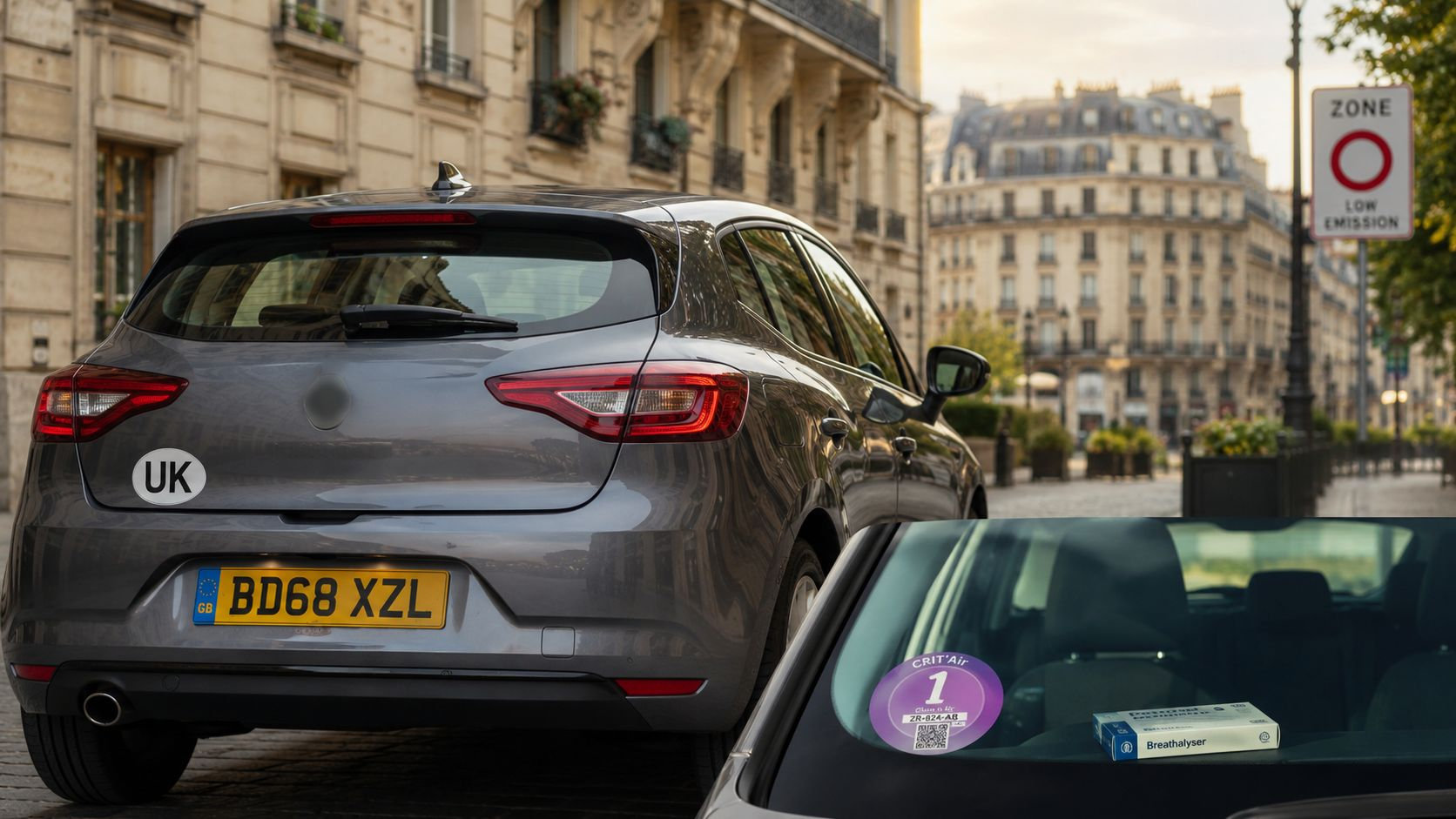
The requirement for drivers to carry a breathalyser was suspended indefinitely in 2020, while the transition from 'GB' to 'UK' stickers is a strict rule. Displaying an old 'GB' sticker is now illegal and can result in fines up to €135, as highlighted in this discussion of common first-time France driving pitfalls.
That creates an obvious trade-off. Buying an unnecessary breathalyser kit wastes cost and attention. Leaving an obsolete GB identifier on the vehicle creates real exposure.
Don't let legacy advice crowd out current compliance. The sticker on the back of the vehicle matters more than the gadget in the glovebox.
For traders moving demo units, auction purchases, or recently prepared stock, plate presentation needs a final check before loading or departure. If the rear identifier is wrong, correct it in the yard. Don't assume the driver will sort it at the services.
Crit'Air needs operational planning
Urban France adds another layer. Crit'Air is the emissions sticker used for access control in clean air zones. For the trade, the practical issue isn't theory. It's route planning. If a car is heading into a city, around a city, or to an event venue in an urban area, check whether the route interacts with a low-emission zone and whether the vehicle needs the correct badge.
This is especially relevant for:
- Demonstration movements into major urban areas
- Press or event vehicles attending city-based launches
- Dealer-to-dealer transfers that use urban ring roads or controlled zones
- Commercial vehicles working multi-stop routes
The discipline here is the same one many UK fleets already apply around local charging and emissions restrictions. If your teams are managing domestic route planning around similar policy shifts, this overview of the impact of clean air zones on UK drivers is a useful companion read.
A simple operating model works best. Build Crit'Air status into the trip planning stage. If a vehicle may need urban access, don't leave the question until arrival day. A collection or delivery can be perfectly road-legal in general terms and still run into local access restrictions if nobody reviewed the route properly.
That's the bigger post-Brexit lesson. Most problems aren't dramatic. They come from small assumptions carried over from old habits.
Key French Traffic Laws and On-the-Spot Penalties

The alcohol limit difference is not academic
For UK trade drivers, the alcohol rule is one of the easiest ways to become unintentionally non-compliant. France enforces a tiered blood alcohol concentration (BAC) limit: 0.05% for experienced drivers and a stricter 0.02% for those with less than three years' experience. This contrasts with the UK's uniform 0.08% limit, meaning a driver legal in the UK could face fines and vehicle confiscation in France, according to Green Flag's France driving guidance.
That isn't a technicality. It changes how a business should brief drivers. In UK operations, some staff still think in domestic terms and treat “under the UK limit” as a workable rule of thumb. In France, that approach is poor risk management.
The operational answer is simple. For work trips, the safest policy is no alcohol before driving. It removes the judgement call and avoids relying on whether the driver falls into the experienced or novice category.
The road habits that need adjusting
French compliance issues aren't limited to alcohol. UK drivers also get caught by unfamiliar traffic habits and assumptions. Tourist guides often frame these as quirks. For motor traders, they're cost risks.
Common examples include:
- Driving position and lane discipline. The shift to right-hand traffic increases the chance of poor lane placement, especially after fuel stops or fatigue breaks.
- Priority rules. Some junctions still rely on local priority conventions that can surprise drivers used to UK road layouts.
- Phone use and distraction. France takes a strict view of driver conduct. A casual approach that might already be risky in the UK becomes even harder to defend abroad.
- Roadside payment and toll stress. Confused drivers make rushed decisions, miss lane signage, or stop awkwardly at toll points.
A good trip brief should be short and memorable. Don't swamp drivers with generic travel notes. Focus on what changes their behaviour:
Risk area Driver briefing point Alcohol Don't drink before a work drive in France Junction approach Slow earlier and assume local rules may differ Restarts after stops Recheck road position every time you move off Urban driving Watch signage closely and avoid improvising routes A compliant trip usually looks boring. The driver is prepared, the route is clear, and nothing about the roadside interaction becomes memorable.
That's exactly what you want. The purpose of knowing French traffic law isn't to pass a quiz. It's to keep the vehicle moving, keep the driver out of trouble, and keep a routine commercial movement from turning into a margin leak.
Beyond Road Rules The Trader's Vehicle Provenance Blind Spot

Compliance on the road is only one layer
A trader can get every French travel rule right and still buy badly. That's the blind spot. Cross-border road compliance protects a single movement. It doesn't protect the stock decision itself.
The same businesses that build proper travel packs should apply the same discipline to acquisition. If a vehicle arrives with weak supporting history, awkward ownership context, or unexplained mileage patterns, the primary risk to the business is rarely the roadside fine. It's the capital tied up in a problematic unit and the dispute that follows after sale.
One of the clearest examples is mileage. Free UK MOT history checks cannot detect fraudulent mileage alterations made between annual tests, as they only record the mileage at the time of the test, leaving a 'black hole' for tampering that a detailed vehicle provenance report can help identify as an anomaly, as explained in this analysis of free car history check limitations.
That matters because many buyers still treat MOT history as if it were a complete answer. It isn't. It's a useful record, but it's not a full vehicle provenance picture.
Why provenance belongs in the same risk conversation
The traders who manage risk well tend to do three things consistently:
- They don't stop at basic records. A standard vehicle history check UK process is only the first screen.
- They look for context. Ownership pattern, timing, anomalies, and rapid movement all matter.
- They review point-of-decision risk. A used car history report is most valuable before capital is committed, not after.
That thinking applies across cars and heavier assets alike. Businesses with mixed fleets often take a similarly disciplined approach to workshop scheduling and operational reliability, which is why specialist resources on hgv maintenace can be useful for operators building joined-up transport controls.
In practical terms, trade vehicle intelligence proves its worth. Basic dealer vehicle checks tell you something. Better provenance work tells you whether the available story makes sense. For anyone buying stock regularly, that distinction affects valuation, negotiation stance, and whether the unit belongs in your pipeline at all.
Motor trade risk doesn't start and end at the border. The trip to France may expose poor compliance habits, but the deeper cost usually sits in stock acquisition. If you want fewer surprises, you need both disciplines. Sound road compliance for the journey, and stronger mileage check UK and vehicle provenance analysis before the purchase.
AutoProv supports UK dealers, wholesalers, and buying teams with deeper vehicle provenance reports built for point-of-decision risk assessment. If your current process relies on basic checks alone, AutoProv adds the context that helps you spot mileage anomalies, ownership concerns, and wider motor trade risk before you commit stock capital.
Frequently Asked Questions
AI-Generated Content Notice
This article was created with the assistance of artificial intelligence technology. While we strive for accuracy, the information provided should be considered for general informational purposes only and should not be relied upon as professional automotive, legal, or financial advice. We recommend verifying any information with qualified professionals or official sources before making important decisions. AutoProv accepts no liability for any consequences resulting from the use of this information.
From our AI insights
- Navigating DVLA Conviction Checks: Dealer Compliance
Understand DVLA conviction checks and lawful access for UK dealers.
- Streamlining Compliance: Automated Checks for Dealers
Discover how UK car dealers can automate compliance checks, reduce risk, and build trust with AutoProv.
- Avoiding Towing Missteps: Legal Checks for Dealers
Protect your dealership by ensuring vehicle weight and towing capacity compliance before listing stock.
Related Articles

Understanding the Consumer Rights Act 2015 in the UK Motor Trade
Explore the Consumer Rights Act 2015 and its impact on UK car buyers and sellers, offering essential protections and insights.

Understanding UK Automotive Regulations
Explore the complexities of automotive regulations in the UK, covering DVLA, FCA, MOT, and more.
What is a V5C Document: A Quick UK Log Book Guide
If you've ever bought or sold a car in the UK, you've definitely come across the V5C. It's often just called the 'log book', and it’s the official Vehicle Registration Certificate issued by the DVLA.
Published by AutoProv
Your trusted source for vehicle intelligence