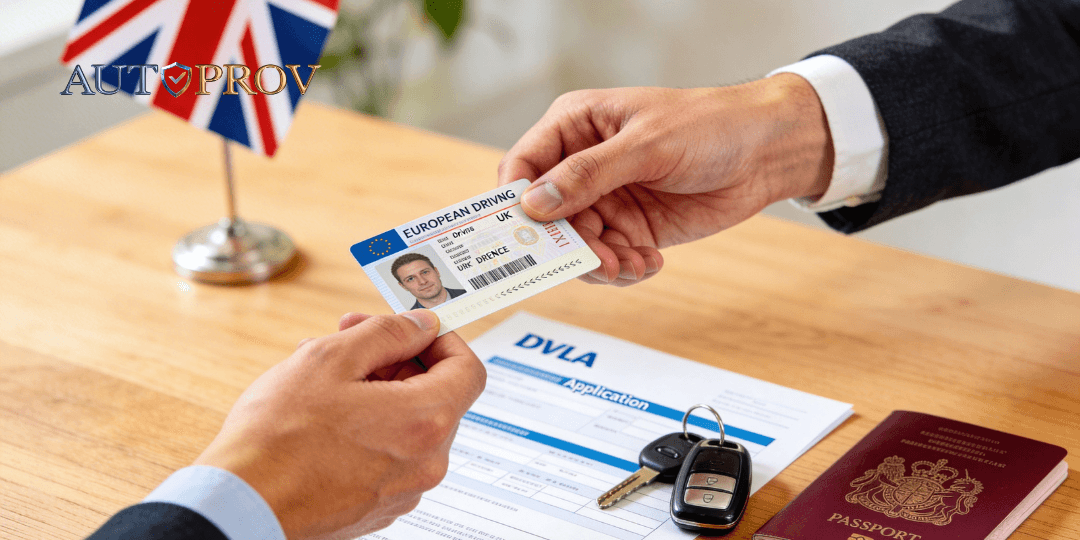
For a retail buyer, licence exchange is an admin task. For a motor trader, it can be a risk signal tied to identity, residency, timing, insurance, ownership patterns, and the broader question of whether the vehicle’s background is as straightforward as it first appears. A basic used car history report may confirm finance or write-off markers, but it won’t always explain why the ownership story feels incomplete.
A clean part-exchange lands on the forecourt. The paperwork looks mostly routine. Then you notice the seller is presenting an EU driving licence, not a UK one.
That detail changes the job.
For a retail buyer, licence exchange is an admin task. For a motor trader, it can be a risk signal tied to identity, residency, timing, insurance, ownership patterns, and the broader question of whether the vehicle’s background is as straightforward as it first appears. A basic used car history report may confirm finance or write-off markers, but it won’t always explain why the ownership story feels incomplete.
When dealers search for exchange eu driving licence to uk, most guides speak to private motorists. The trade problem is different. You need to know whether the licence status affects the credibility of the seller, the timing of a recent acquisition, and the confidence you can place in the vehicle provenance before you commit capital.
The Risk on Your Forecourt When a Car Has an EU Licence
A car arrives as a part-exchange. It’s desirable stock, sensible spec, clean enough at first glance. The seller has a V5C, some service paperwork, and an EU photocard licence.

That doesn’t make the deal suspect. It does mean the file needs more scrutiny than a standard domestic handover.
The first issue is identity continuity. A UK trader isn’t only checking who the customer is. You’re checking whether the paperwork, address history, and ownership timeline all line up. If the seller’s current ID is from another jurisdiction, you need to be satisfied that the vehicle’s recent life in the UK is properly evidenced, especially where registration timing and address changes don’t sit neatly together.
The second issue is provenance. An EU licence can be perfectly legitimate, but it can also sit alongside a vehicle history that needs more context. That might mean a recent arrival into the UK, a short holding period, or a transaction chain that’s harder to reconstruct from routine retail documents alone.
What experienced buyers look at first
A trader usually starts with the practical questions:
- Seller identity consistency: Does the name and address on the licence align with the V5C, invoices, finance settlement trail, and handover details?
- Residency clues: Does the overall file suggest settled UK residence, or a recent move that could affect how long the person has been entitled to drive here?
- Vehicle background: Is the car a normal UK-registered vehicle owned by an EU national, or does the licence hint at a wider non-standard history?
- Document quality: Are there gaps that make you work harder to prove lawful possession and credible ownership?
A V5C helps, but it isn’t proof of title on its own. Dealers already know that. What matters is how the licence fits the wider story, especially when you’re assessing whether the vehicle has changed hands quickly or carries avoidable post-sale dispute risk. That’s the same reason traders often look beyond the logbook itself and review context around what the V5C does and doesn’t prove in the UK buying process.
A foreign licence isn’t the problem. An unexplained paperwork pattern is.
Why basic checks can miss the point
A standard vehicle history check UK product can return a clean-looking result while the transaction still feels wrong. That happens because many tools focus on the vehicle record in isolation. Trade decisions usually require more than that.
When a seller presents an EU licence, the dealer should treat it as one more piece of transaction intelligence. Not a red flag by itself. A context signal. In the right deal, it means nothing. In the wrong deal, it’s the clue that prompts you to slow down, verify the story properly, and avoid buying a car that looks easier to retail than it really is.
Is the EU Licence Valid for UK Driving and Exchange
The mistake traders make is assuming every EU licence shown in the showroom is automatically valid for normal UK use without any time pressure. That’s too broad.
The practical rule starts with residence. EU driving licence holders who become residents of Great Britain can drive on their original EU licence until age 70 or until the licence expires. If the EU licence was obtained by exchanging a non-EU licence, it is valid in the UK for only 12 months from when the holder became resident. If the driver was aged 67 or over when becoming resident, validity is limited to three years, according to the RAC guidance on exchanging foreign licences in the UK.
That single exception matters more in the trade than many dealers realise.
The rule that changes the risk profile
If the seller’s EU licence was itself issued in exchange for a non-EU licence, you’re no longer dealing with the straightforward “EU national driving in the UK” assumption. You’re dealing with a chain of entitlement that may have a much shorter UK validity window.
For the dealer, that creates two immediate questions:
- Was the seller entitled to drive the vehicle in the UK at the relevant time?
- Does the licence history suggest the seller’s UK residence status is more recent or more complicated than the paperwork first indicates?
Neither point automatically kills a deal. Both points justify a deeper check.
A trader’s quick validation framework
Use a simple decision process on the spot.
Check What you’re looking for Why it matters Identity match Name and address consistency across licence, V5C and supporting paperwork Reduces dispute and impersonation risk Licence origin Whether the EU licence appears to be a direct EU entitlement or an exchange from a non-EU licence The 12-month rule can change legal use in the UK Residence clues Evidence the person is based in Great Britain Exchange and validity depend on GB residence Timing How the licence story aligns with acquisition and ownership dates Helps test whether the vehicle’s recent history makes sense What works and what doesn’t
What works is calm verification. Ask direct questions and compare answers with the paperwork trail.
What doesn’t work is relying on the fact that the licence “looks official”. A photocard can still sit inside a weak transaction file. Equally, a seller can present a licence that’s valid in one scenario and problematic in another because of how it was originally obtained.
Practical rule: If an EU licence appears in a deal with short ownership, sparse service evidence, or address inconsistencies, treat the licence as part of your provenance review, not just an ID check.
That’s where many dealers widen the lens and review surrounding DVLA-linked context, especially when the seller’s account of residence or keeper timing feels thin. A useful starting point is understanding how DVLA owner checks fit into a UK buyer’s verification process.
Why this matters for stock acquisition
The trade issue isn’t whether the seller can drive home legally. It’s whether the vehicle belongs in your stock profile at the price being discussed.
If the licence raises questions around residency timing, previous jurisdiction, or entitlement history, it may also point to missing context in the car’s own story. That affects appraisal confidence. It affects negotiation. In some cases, it affects whether you buy at all.
A Trader's Guide to the DVLA Exchange Process
Knowing the exchange process helps dealers in two ways. First, it lets you test whether a seller understands their own position. Second, it tells you where delays and admin friction can affect the handover, insurance practicalities, or post-sale confidence.
The DVLA exchange process requires a D1 form, the original EU licence, identity proof such as a passport, a photo, and a £43 fee. Applicants must be resident in Great Britain for at least 185 days a year. The process typically takes about three weeks, and exchanging within five years of residency avoids re-taking tests. Common errors such as signing outside the designated box or omitting documents can cause significant delays, as outlined in Acorn Insurance’s guide to exchanging an EU driving licence for a UK one.

The process in trade terms
For a consumer, this is paperwork. For a trader, it’s timeline management.
If a part-exchange customer says they’re “just waiting for the UK licence to come through”, that statement has to be tested against what the process requires. A person who hasn’t obtained the correct form, assembled originals, or prepared the fee probably isn’t near completion at all.
The core workflow is straightforward:
- Confirm eligibility The applicant must be resident in Great Britain and within the relevant exchange window.
- Obtain the D1 form This is usually collected from a Post Office offering DVLA services.
- Assemble original documents Originals matter. Copies don’t solve the problem.
- Submit to DVLA by post The application goes to the DVLA address shown on the form.
- Wait for issue of the UK licence Routine cases are typically processed within the stated timeframe.
Where applications go wrong
Most delays come from execution errors, not complex law.
A trader should pay attention when a seller describes any of these issues casually, because they often signal a file that will drag on:
- Incomplete form completion: Small mistakes can trigger rejection or rework.
- Missing originals: If the seller has sent copies or held documents back, the application may not progress.
- Poor postage practice: Untracked post creates unnecessary document risk.
- Translation gaps: If supporting material isn’t in English, the file may need extra work.
Those aren’t just consumer inconveniences. In the trade, they can affect whether a customer can complete a smooth onward transaction, whether there are delays in proving their position, and whether you’re comfortable with the broader deal quality.
Questions worth asking at appraisal
You don’t need to manage the application for the customer. You do need enough understanding to judge the credibility of what you’re being told.
Ask things such as:
- Have you submitted the D1 already, or are you still gathering documents?
- Did you send the original licence and ID documents?
- Was the application tracked?
- Has DVLA asked for anything further?
The answers often tell you whether the exchange is real, pending, or merely intended.
Dealers don’t need to become licensing clerks. They do need to know when a seller’s explanation doesn’t fit the process.
Why this matters beyond the person’s licence
A recent or unresolved exchange process can create drag around the vehicle transaction itself. It can complicate confidence in the seller’s administrative footprint and make the history file look thinner than it should for a supposedly settled UK owner.
This matters most when the car already carries other soft signals such as recent registration activity, patchy servicing, or mileage questions. That’s why dealers often pair identity and residence review with data-led context, including DVLA mileage analysis that helps test whether the ownership story is coherent.
What good practice looks like
Good practice is disciplined, not dramatic.
- Record the explanation clearly: Note what the seller says about residency, licence origin, and exchange status.
- Cross-check dates: Compare the narrative with keeper timing and supporting paperwork.
- Avoid assumptions: Don’t equate an EU licence with either compliance or non-compliance.
- Price for uncertainty where needed: If the provenance file remains thin, buy accordingly or walk away.
Traders who understand the mechanics of exchange eu driving licence to uk decisions don’t just avoid admin confusion. They make better stock calls because they can distinguish a routine migrant-owner vehicle from one that carries avoidable uncertainty.
Licence Exchange Nuances That Signal Deeper Vehicle Risk
Most consumer guides stop at the application form. The trade problem starts after that.
A recent licence exchange, a pending exchange, or an unusually delayed exchange can all add context to vehicle provenance. On their own, these details don’t prove wrongdoing. Combined with short-term ownership, weak paperwork continuity, or a rapid resale pattern, they can become the difference between an acceptable buy and an expensive argument later.

Delays create practical trade risk
One of the most overlooked issues is processing delay. A YouTube source states that some EU licence exchanges involving biometric permits can take up to 12 to 16 weeks, affecting 25% of those exchanges, and that this can leave buyers in a provisional status linked with 8% higher claims on used cars in the source’s account of the risk: discussion of EU exchange delays and trade implications.
Even allowing for the fact that this isn’t official DVLA guidance, the trade implication is straightforward. Delay changes behaviour around a vehicle. It can affect insurance confidence, handover planning, and how comfortable you feel with a deal that already has limited depth in its paperwork.
The licence story can expose the ownership story
When a seller says, “I’ve just moved, I’m exchanging the licence now,” that may be true. It may also explain why the car has a compressed UK paper trail.
That matters because compressed paper trails often overlap with the exact areas where dealers need stronger intelligence:
- Short-term keepership
- Fast re-sale after acquisition
- Unclear address history
- Mileage narratives that need corroboration
- Imported or non-standard background signals
A basic dealer vehicle check may confirm the car exists cleanly on the systems you’ve searched. It may not tell you whether the seller’s profile and the vehicle’s profile make sense together.
What to look for when the deal feels thin
Use the licence exchange detail as a prompt to widen your review.
Signal Why it matters in the trade Recent move to the UK Can explain admin gaps, but also short UK ownership evidence Pending exchange application Suggests timing uncertainty and possible document friction Biometric permit involvement May increase the chance of longer processing delay, based on the source above Recent acquisition then disposal Can indicate opportunistic flipping rather than settled use If a car’s history needs too many verbal explanations, the risk usually isn’t the explanation itself. It’s the lack of documentary depth behind it.
How this fits with broader motor trade risk
Professional buyers rarely make a decision on one data point. They stack signals.
A licence exchange detail becomes useful when it supports or contradicts what you’re already seeing in the rest of the file. If the car has stable mileage progression, consistent servicing, sensible ownership timing, and a clean handover story, the licence issue may be marginal. If the vehicle also shows rapid turnover or awkward ownership proof, the same licence detail carries more weight.
That’s why serious trade vehicle intelligence goes beyond single-source checks. Dealers need context around who held the car, for how long, and whether the supporting paperwork proves control and continuity. The same principle applies when reviewing what counts as proof of ownership of a car in the UK trade context.
The practical takeaway
Treat licence exchange status as a multiplier, not a verdict.
It can increase confidence when the story is coherent. It can also expose weak provenance that a standard used car history report leaves unexplained. That’s the point where disciplined buyers slow the transaction down, challenge assumptions, and protect margin.
Managing Expired Licences, Category Entitlements, and Delays
The awkward deals are the ones that cost time. Not the obvious ones.
An expired EU licence, unclear category mapping, or a customer who assumes all foreign entitlements transfer neatly into a UK licence can create appraisal errors. Dealers run into this more often on commercial stock, older drivers, and transactions where the customer talks confidently but the paperwork doesn’t back it up.

Expired or unclear licences need a different mindset
A common mistake is treating licence exchange as binary. Either it exchanges cleanly or it doesn’t. Real files aren’t that tidy.
If a seller presents an expired document, or can’t clearly show what categories they hold, don’t fill the gaps with assumptions. That’s especially important where the vehicle’s use case depends on entitlement, such as light commercial applications or older categories a buyer may expect to carry over.
In trade terms, the risk isn’t abstract. You can end up valuing a vehicle on the basis of capability the buyer later can’t lawfully use.
Category assumptions are expensive
The safest working approach is simple. Separate the car from the driver.
The vehicle may still be good stock. But if your appraisal or retail discussion relies on assumed licence categories, you’re creating avoidable exposure. Experienced traders keep the wording tight and document what has and hasn’t been verified.
A practical checklist helps:
- Check current validity: Don’t assume an older EU photocard still supports current driving entitlement.
- Avoid category guesswork: If category mapping matters to the sale, verify it before relying on it.
- Keep commercial valuation disciplined: Don’t build price on assumptions about vocational use.
- Record any uncertainty: A clear internal note protects the deal team later.
The more specialised the vehicle use, the less room there is for licence assumptions.
Why UK-side verification matters so much
Post-Brexit, the rules for UK drivers living in EU states aren’t harmonised. Government guidance says UK licence holders living in Germany and Spain must exchange within 6 months of residency, while in Slovakia the deadline is 60 days after completing 185 days of residence. The GOV.UK guidance for UK licence holders living in the EU shows how fragmented the position is.
That matters because it explains why UK-side checking needs to be precise. There isn’t one simple reciprocal pattern across Europe. There are multiple national timelines and rules, which means a licence presented in the UK may carry a more complicated administrative history than the customer realises.
Practical handling when delays drag on
If a customer says the exchange is delayed, keep the response commercial and evidence-led.
Some delays are genuine. Some are incomplete applications described as backlog. The answer isn’t to argue. It’s to request the paperwork trail that supports the account.
Use a short decision filter:
Situation Sensible trade response Expired licence with weak supporting paperwork Slow the deal down or step away Category needed for vehicle use but not verified Value the vehicle without relying on that entitlement Claimed delay with no evidence of submission Treat the exchange as unproven Coherent file with documented application progress Continue, but keep notes and price with discipline This is the difference between routine due diligence and costly optimism. Dealers who handle edge cases well don’t necessarily reject more stock. They stop overpaying for uncertainty.
Turning Licence Checks into a Competitive Advantage
Most traders won’t win more deals by talking more about licences. They’ll win by making better buying decisions when licence details reveal something the rest of the market has missed.
That’s the value of understanding exchange eu driving licence to uk issues. It sharpens your read on seller credibility, ownership timing, vehicle provenance, and whether the paperwork in front of you supports the price being asked. It also reduces the chance of treating a weak file as a normal one because the vehicle itself presents well.
The commercial edge comes from using licence status as one signal inside a wider motor trade risk process. Not in isolation. Alongside mileage progression, keepership patterns, registration context, and supporting documents. That’s how experienced buyers separate an honest non-UK paperwork trail from a vehicle with gaps that should affect appetite and valuation.
If your current workflow relies on a basic used car history report alone, you’ll catch the obvious issues. You may still miss the contextual ones. That’s where richer vehicle history check UK and trade vehicle intelligence processes make the difference, especially when buying against the clock.
For dealers reviewing their current approach, it helps to assess what a stronger best car check website should provide beyond pass or fail markers. The useful tools are the ones that surface context, not just data.
A disciplined licence check won’t transform a poor buy into a good one. It will do something more valuable. It will stop you pretending uncertainty isn’t there.
AutoProv helps UK dealers, motor traders and wholesalers go beyond a basic vehicle history check UK result by adding context around vehicle provenance, ownership patterns, mileage signals and hidden risk indicators. If you want sharper dealer vehicle checks, stronger used car history report analysis and better point-of-decision trade vehicle intelligence, explore AutoProv.
Frequently Asked Questions
AI-Generated Content Notice
This article was created with the assistance of artificial intelligence technology. While we strive for accuracy, the information provided should be considered for general informational purposes only and should not be relied upon as professional automotive, legal, or financial advice. We recommend verifying any information with qualified professionals or official sources before making important decisions. AutoProv accepts no liability for any consequences resulting from the use of this information.
From our AI insights
- Navigating Hidden Finance Claims: CRA 2015 Insights
Discover how hidden finance claims affect UK car dealers under CRA 2015 and strategies to manage them.
- Navigating CCR 2013: Niche Insights for UK Motor Traders
Explore niche insights on CCR 2013 for UK motor traders, focusing on compliance and cancellation rights.
- Decoding CRA 2015: Dealer's Guide to 30-Day Rejections
Explore CRA 2015's 30-day rejection rights from a dealer's perspective, highlighting key compliance strategies.
Related Articles

Understanding the Consumer Rights Act 2015 in the UK Motor Trade
Explore the Consumer Rights Act 2015 and its impact on UK car buyers and sellers, offering essential protections and insights.

Understanding UK Automotive Regulations
Explore the complexities of automotive regulations in the UK, covering DVLA, FCA, MOT, and more.
What is a V5C Document: A Quick UK Log Book Guide
If you've ever bought or sold a car in the UK, you've definitely come across the V5C. It's often just called the 'log book', and it’s the official Vehicle Registration Certificate issued by the DVLA.
Published by AutoProv
Your trusted source for vehicle intelligence