
The car looks right on the auction stand. The dashboard mileage is sensible, the body presents well and the latest MOT shows a pass. A quick MOT history check on a car appears to confirm the purchase, so the bidding moves on. That approach can leave a dealer paying retail preparation costs for wholesale stock with an unclear past. An MOT record is more useful when read as a timeline, not a certificate. It can show changing mileage, repeated defects, test-location movements and patterns of use that affect valuation, inspection time and resale risk.
For the UK motor trade, the practical question isn't whether the vehicle passed its latest test. It's whether the available evidence supports the vehicle's stated condition, provenance and expected margin.
Table of Contents
- Why Basic MOT Checks Fail Trade Buyers
- What the timeline can reveal
- Accessing and Navigating Official DVSA Records
- Build a consistent evidence file
- Reading Advisory Trends and Failure Rates
- Use the national picture as a benchmark
- Common Advisory Progressions and Trade Implications
- Identifying Mileage Anomalies and Clocked Vehicles
- Score the pattern, then corroborate it
- Moving Beyond Raw Data with Provenance Intelligence
- Context makes the signal usable
- Next Steps When Red Flags Emerge
- Apply a clear buying response
Why Basic MOT Checks Fail Trade Buyers
A pass result answers a narrow question. It confirms that the vehicle met the relevant MOT standards at the time and place of that test. It doesn't confirm that the engine, clutch or gearbox is sound, that previous repairs were carried out properly, or that the vehicle's history is commercially straightforward.
That distinction matters at auction and during part-exchange appraisal. A car may have passed recently while carrying advisories that point to deferred work. A previous failure may have been repaired properly, or it may sit within a wider pattern of recurring brakes, suspension, corrosion or lighting issues. Treating both vehicles as identical because the latest result says “pass” removes the context a buyer needs.
The official service has been available on GOV.UK since 3 November 2015 and lets users check pass or fail results, recorded mileage, advisories, defects, certificates and test locations through the registration number, with the V5C number required for some functions. The records form a chronological evidence base rather than a single roadworthiness label. The GOV.UK MOT history service is the correct starting point for a vehicle history check UK workflow.
What the timeline can reveal
A trade buyer should read the record for relationships between entries:
- Mileage movement: Does the recorded figure rise consistently, remain plausible for the vehicle's use, or fall between tests?
- Recurring defects: Does the same advisory appear repeatedly, suggesting delayed maintenance or an unresolved underlying fault?
- Testing gaps: Is there a reasonable explanation for a period without an MOT record?
- Location changes: Do test centres and geography fit the ownership and usage story?
- Repair outcomes: Did a serious failure disappear after a later test, and is supporting paperwork available?
A consumer may only need to know whether the car can be driven today. A dealer needs to estimate what the vehicle will cost to acquire, inspect, repair, describe and stand behind. That makes the MOT record one input into motor trade risk, not a substitute for a mechanical inspection or broader vehicle provenance review.
For a quick preliminary check, traders can use this guide to checking MOT and tax for free, then escalate vehicles with unusual patterns before committing buying time or capital.
Practical rule: A clean latest result is a starting point for valuation, not evidence that the stock is clean.
Accessing and Navigating Official DVSA Records
A wholesale car can look straightforward until its paperwork, identity and test history fail to line up. Start with the registration exactly as shown on the vehicle and its documents. Search the live record, confirm the returned make and model, then read from the newest test backwards. Seller screenshots are useful clues, not evidence to rely on when the current record is available.
The registration number opens the basic search. The record can show pass or fail outcomes, mileage at each test, advisories and defects, downloadable current and previous MOT certificates, and the test location. Some functions, including test-location information in Great Britain, also require the V5C number. Use the V5C during a fuller appraisal, while treating it as unnecessary for the first history search.
Build a consistent evidence file
Wholesale decisions improve when every vehicle is assessed against the same fields. Record:
- Identity: Match the registration, vehicle, VIN and V5C details.
- Latest test: Capture the date, result, mileage and every advisory or defect.
- Earlier tests: Work backwards through failures, passes, mileage readings and repeated wording.
- Certificates: Download current and previous certificates where available, particularly when a repair explanation depends on a specific failure.
- Test locations: Compare centres with the known ownership, operating area or supplying source.
- Open questions: Separate recorded facts from claims that still need invoices, service records or physical inspection.
For cars, motorcycles and vans in Great Britain, the underlying MOT data reaches back to 2005. Northern Ireland coverage was added from 2017, so the evidence window depends on location and the vehicle record. Those coverage dates are set out in DVSA's MOT inspection guidance, while the available record still does not establish a complete ownership narrative.
Test locations need context. A distant centre may reflect transport, relocation or a dealer's preferred garage rather than concealment. It becomes more useful when combined with a mileage discrepancy, an ownership change or another unexplained break in the vehicle's story. Assess the signals together before reducing a bid.
Preserve the raw record before making an offer. Keep certificates, note missing explanations and tie each concern to a required inspection or document request. A buyer processing several vehicles should extract the same six fields every time. At volume, consistency is the constraint, and a batch process or MOT history API can earn its cost by reducing manual transcription. Automated results still require identity checks, source preservation and experienced judgement.
Reading Advisory Trends and Failure Rates
Advisories are where the latest pass often loses its apparent simplicity. They identify items that didn't necessarily prevent a pass but may still affect preparation cost, safety assessment or the vehicle's near-term retail appeal. One advisory is a prompt for inspection. The same issue appearing over successive tests is a pattern.
Read the wording across time, not just the colour or status attached to one entry. A tyre, suspension component, corrosion point or brake-related item may remain manageable at first, then become a major repair after repeated deferral. Conversely, an advisory that disappears may indicate that the work was completed, although the MOT record alone won't prove who carried it out or what parts were fitted.
Use the national picture as a benchmark
DVSA results for Quarter 1 of 2026–2027 recorded 7,808,594 tests for Class 3 and 4 vehicles, including cars, vans and passenger vehicles with up to 12 seats. There were 1,696,269 failures, an initial fail rate of 26.75%, and a final fail rate of 21.72% after vehicles that passed once minor defects were rectified at the test station were excluded from the final calculation. 566,187 tests failed with at least one dangerous item, equal to 7.25% of tests in that class. These figures are published in the DVSA MOT test results data.
The comparison is useful, but it isn't a valuation formula. A vehicle with a previous failure isn't automatically poor stock, and a vehicle with a pass history isn't automatically low risk. The figures establish that failures and dangerous items occur at meaningful scale, so buyers should treat repeated defects as commercial evidence rather than dismissing them as isolated bad luck.
Common Advisory Progressions and Trade Implications
Advisory Note Year 1 to Year 2 Progression Trade Action Required Tyre wear or damage The same issue remains, becomes more specific or appears on additional wheels Inspect tread, sidewalls, alignment and replacement cost before bidding Suspension component An advisory is followed by another note or a failure involving the same area Arrange a lift inspection and obtain a repair estimate Brake condition The note persists, broadens or appears alongside a later brake failure Check discs, pads, callipers and brake performance independently Corrosion The wording moves from a general observation to a structural or safety-related concern Inspect affected areas closely and price the risk of hidden remedial work Lighting or visibility item A repeat entry suggests routine neglect rather than an isolated fault Check all lamps, wipers and glass during appraisal A neglected ex-fleet or lease vehicle may show regular testing but still carry a trail of deferred wear. Regular testing tells you that the vehicle entered the system, not that every advisory was resolved promptly. A buyer should price the physical condition in front of them and use the history to direct inspection, not to manufacture certainty.
For a more systematic review of repeated entries, use a historical trend analysis of MOT records and keep the outcome tied to an inspection estimate. The margin is protected when the buyer converts an advisory pattern into a costed decision before purchase.
Identifying Mileage Anomalies and Clocked Vehicles
A falling MOT mileage deserves attention, but it doesn't prove deliberate clocking by itself. Recording errors, data-entry mistakes and legitimate component changes can create an apparent reversal. The buyer's job is to assess the whole progression and obtain evidence that either supports or contradicts the vehicle's stated mileage.
A large analysis of 62.7 million UK vehicles found 3.42 million vehicles, or 5.45%, roughly 1 in 18, showed a reduction in mileage between MOTs after obvious anomalies were removed. The same analysis estimated that clocked vehicles had their mileage reduced by an average of 46,089 miles. The analysis of UK MOT records provides the supporting methodology and context. Other industry data is higher: HPI reported that one in 11 vehicles undergoing its checks had a mileage discrepancy in 2019, with 836,214 confirmed discrepancies and an 8.99% hit rate.
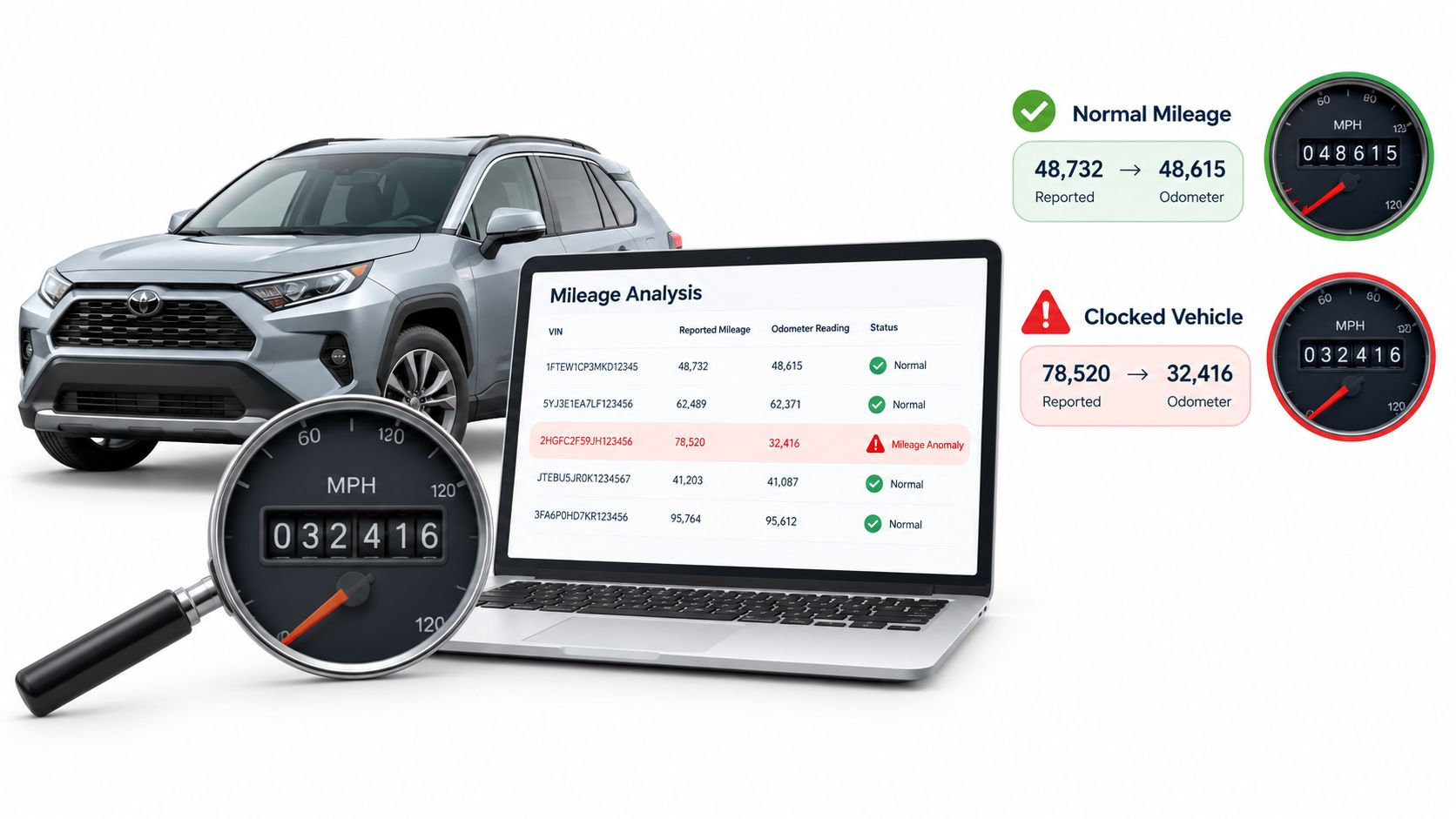
Those figures justify screening, not automatic rejection. A single lower reading may be a transcription issue. A lower reading followed by an implausibly small increase, a short ownership period and missing service invoices is a different proposition.
Score the pattern, then corroborate it
Flag vehicles showing any of these characteristics:
- Non-linear mileage: A reading falls or rises in a way that doesn't fit the elapsed time or later readings.
- Unusually low annual usage: The stated mileage conflicts with the vehicle's condition, service intervals or operating history.
- Sudden drops: A later MOT records materially less mileage than an earlier test.
- Conflicting documents: Service invoices, auction entries or dashboard readings don't agree with the MOT sequence.
- Incomplete explanation: The seller offers a verbal answer but no dated paperwork or consistent evidence.
The correct response is to increase scrutiny. Compare the dashboard with MOT entries, service stamps, invoices, tyre wear, interior condition and any available auction or maintenance records. Ask the supplying party to explain the discrepancy in writing and decide whether the explanation is strong enough for your own compliance file.
A useful check car mileage history can help organise the evidence, but no mileage check UK workflow should treat one database event as conclusive. The pattern carries more weight than the isolated reading.
For a focused explanation of how to interpret these reversals, refer to understanding mileage anomalies in MOT records. If the evidence remains unresolved, value the vehicle on the lower-confidence assumption or decline it. Margin disappears quickly when a dealer sells a car with an undocumented mileage story.
Moving Beyond Raw Data with Provenance Intelligence
The official MOT record is a strong foundation, but it isn't a complete vehicle provenance file. It records tests and their outcomes. It doesn't, by itself, explain every change of keeper, insurance event, auction movement, repair decision or reason for a rapid resale.
That gap matters most when buying at volume. A buyer can manually inspect a certificate, but manual review becomes inconsistent when several vehicles arrive together and each has different ownership, mileage and defect patterns. Raw records also require interpretation. A short ownership period may be normal for a company vehicle, or it may warrant questions when paired with a mileage inconsistency and an abrupt change in selling channel.
Context makes the signal usable
A trade-focused used car history report should bring related evidence into one decision view:
- MOT chronology: Test dates, results, mileage, advisories and failures.
- Ownership timeline: Changes in keeper history and unusually short periods of possession.
- Insurance-related events: Recorded incidents that may affect condition or resale disclosure.
- Mileage analysis: Progression across available records, with anomalies separated from ordinary variation.
- Risk indicators: Combinations of signals that warrant inspection, documentation or a lower offer.
This isn't about replacing the official source. It is about reducing the chance that a buyer overlooks a connection between separate entries. Vehicle provenance becomes useful when it answers practical trade questions: what happened, when did it happen, how credible is the explanation and what should the vehicle be worth given the remaining uncertainty?
AutoProv provides UK-focused vehicle history, provenance and risk intelligence for dealers, wholesalers and other motor-trade buyers. Its vehicle provenance report combines MOT history with mileage patterns, ownership timelines, insurance-related events and other risk indicators to support stock acquisition, valuation and point-of-decision review.
The output still needs a human decision. A report can highlight an anomaly, but the buyer must inspect the vehicle, request evidence and decide whether the risk is measurable. The operational benefit is a more organised workflow, with the reason for a hold, negotiation or rejection recorded rather than left in a buyer's memory.
Next Steps When Red Flags Emerge
Finding a red flag isn't the decision. It is the point at which the buyer chooses a controlled response. The right outcome may be a walk-away, a revised offer or a purchase subject to evidence and inspection.
Start by separating known cost from unquantifiable risk. A worn tyre with a clear replacement price is different from a mileage history that cannot be reconciled. A previous MOT failure with documented repair work is different from recurring structural corrosion with no invoices. Dealers protect margins by refusing to price uncertainty as though it were a routine repair.
Apply a clear buying response
- Pause the purchase. Save the MOT history, certificates, screenshots or report output, then identify the exact entry that changed the risk assessment.
- Request corroboration. Ask for service invoices, repair records, auction documentation and an explanation from the supplying party. Keep the request specific.
- Inspect the relevant area. Use a competent independent inspection for mileage-related condition, corrosion, brakes, suspension or signs of repair. Don't let a fresh pass replace a physical assessment.
- Recalculate the offer. Include confirmed repair costs, inspection fees, preparation time and a reasonable allowance for unresolved evidence.
- Walk away when the risk can't be bounded. An attractive hammer price doesn't compensate for a history that could create post-sale disputes, disclosure problems or an unprofitable repair programme.
Buying discipline: If you can't explain the vehicle's history to the next buyer using evidence in your file, you haven't finished the appraisal.
A previous failure alone shouldn't trigger an automatic rejection. Neither should a single mileage reversal. The decisive factor is whether the surrounding evidence produces a credible account and whether the remaining exposure fits your buying policy.
Use a documented go or no-go decision framework so different buyers apply the same standard. Record why the vehicle was accepted, repriced or declined, including which facts remain unresolved. That creates a stronger internal process and helps stock controllers review decisions after purchase.
The most reliable trade workflow combines an official MOT history check on a car with service evidence, physical inspection and broader provenance analysis. It doesn't promise certainty. It gives the buyer a defensible basis for deciding how much risk the margin can carry.
AutoProv helps UK dealers, wholesalers and motor-trade buyers combine MOT records with mileage analysis, ownership timelines, insurance-related events and vehicle risk indicators in one provenance workflow. Review the available vehicle intelligence before committing capital by visiting AutoProv.
Frequently Asked Questions
AI-Generated Content Notice
This article was created with the assistance of artificial intelligence technology. While we strive for accuracy, the information provided should be considered for general informational purposes only and should not be relied upon as professional automotive, legal, or financial advice. We recommend verifying any information with qualified professionals or official sources before making important decisions. AutoProv accepts no liability for any consequences resulting from the use of this information.
From our AI insights
- MOT History: Understanding Seasonal Trends
Explore how seasonal trends impact MOT history and what it means for vehicle checks in 2026.
- MOT History: Navigating Recent Regulatory Changes for Traders
Explore the impact of recent MOT regulatory changes on UK traders and learn how to adapt effectively.
- Leveraging MOT History APIs: Dealer Insights 2026
Explore how MOT history APIs can enhance vehicle checks for UK dealers in 2026.
Related Articles

Understanding the MOT History: A Comprehensive Guide
Explore everything you need to know about MOT history, including its significance, how to check it, and what to look out for.
Understanding MOT History: A Key to Smart Used Car Purchases
Discover how MOT history can guide your used car buying decisions and ensure you make an informed choice.

How to View MOT History and Make Smarter Buying Decisions
For anyone in the UK motor trade, a vehicle's Ministry of Transport (MOT) history is much more than a simple pass or fail certificate. It's the car's diary, a detailed logbook of its life on the road. Glancing only at the latest MOT is a rookie mistake, and a costly one at that. To really get under the bonnet of a vehicle's past, you need to view MOT history in its entirety—it’s the only way to see the true timeline of maintenance versus neglect.
Published by AutoProv
Your trusted source for vehicle intelligence