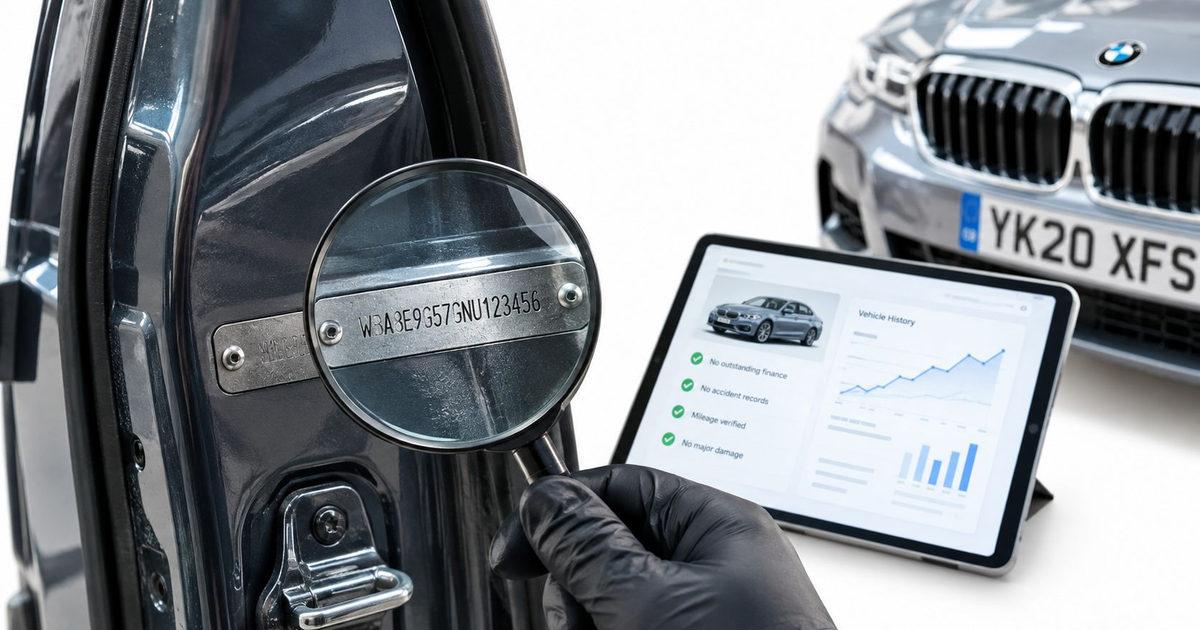
A used car can look tidy and still carry hidden history, mileage issues, or identity problems.
The RAC says 1 in 3 cars checked have a hidden history, 1 in 11 show inaccurate mileage, and 1 in 5 have had at least one plate change (RAC car data check). For anyone buying stock in the UK motor trade, that's a reminder that a vehicle history check UK process can't stop at a quick glance at the plate.
The key question is whether the VIN tells a consistent story across the car, the documents, and the record trail. A proper used car history by VIN workflow treats identity first, then mileage, then ownership and provenance context, because that's how you separate a clean-looking unit from one that's carrying risk you can price, challenge, or walk away from.
Table of Contents
- Why VIN Checks Matter for UK Motor Traders
- The VIN is the stable identifier
- Authoritative Sources for Vehicle History Checks
- DVLA and MOT data answer different questions
- What the sources can't tell you on their own
- How to Check a Used Car's History by VIN
- Build the mileage line before you buy
- Reading Risk Signals in the VIN and Identity Trail
- Different VIN failures point to different risks
- Interpreting Mileage and Ownership Anomalies in Context
- Clean-looking records can still hide risk
- What to challenge before you price the car
- Building VIN Checks Into Your Buying Workflow
- Use risk signals, not single checks, to decide
- What a defensible buying decision looks like
- Making Provenance Intelligence Standard Practice
Why VIN Checks Matter for UK Motor Traders
The market backdrop is simple. There's enough hidden risk in the UK used-car market that a VIN check isn't a box-tick, it's a buying control. The RAC's hidden-history figures show why dealers and wholesalers can't rely on presentation alone, especially when plate changes are common enough to affect 1 in 5 checked cars (RAC car data check).
The VIN is the stable identifier
Registration numbers can change. A VIN should not. That's why the VIN is the anchor for any vehicle provenance review, because it ties the car back to the same underlying identity across DVLA records, MOT history, ownership history, and administrative events. If the registration plate has changed, the VIN is what lets you tell whether the car's physical identity still matches its paper trail.
For trade buyers, that distinction matters more than it does for consumers. A tidy advert, a fresh plate, or a plausible story from the seller doesn't prove continuity. The VIN does the heavy lifting because it's the vehicle's permanent identity, and the rest of the check is about confirming that the story around it still makes sense.
Practical rule: if the plate is doing more work than the VIN, the car needs a closer look.
A proper dealer vehicle checks workflow also has commercial consequences. If identity is wrong, mileage is inconsistent, or the vehicle has a hidden provenance problem, you're not just taking a retail complaint risk. You're taking margin risk, arbitration risk, and reputation risk on the next handover.
What a VIN tells you in practice sits at the centre of that control point. Once you treat the VIN as the baseline identity record, the rest of the process becomes a structured comparison instead of a hopeful trust exercise.
Authoritative Sources for Vehicle History Checks
A strong used car history report starts with the sources that control the underlying records. In the UK, the DVLA and MOT systems give you the core factual baseline, while trade-focused provenance tools help interpret what those records mean in context. None of them should be treated as a magic pass or fail.
DVLA and MOT data answer different questions
The DVLA's public vehicle information service verifies core identity details, including the date first registered and when the V5C was last issued. It also relies on the fact that every registered vehicle has a unique stamped-in VIN, with the VIN usually visible on the windscreen, door frame, chassis, or V5C (DVLA vehicle information service). That makes it the first source for checking whether the physical car and the official record are describing the same vehicle.
The MOT history service answers a different set of questions. It exposes the exact mileage recorded at each test, pass or fail status, and the date the next MOT is due, which makes it a baseline source for mileage check UK workflows rather than a complete provenance view (MOT history service). If the MOT timeline is clean, that's useful. If it's broken, inconsistent, or sparse, that's also useful because it tells you where the record trail needs more scrutiny.
What the sources can't tell you on their own
A single lookup won't tell you whether a vehicle has been cloned, cosmetically refreshed, or re-registered after a complicated past. It won't tell you whether short ownership intervals were routine turnover or a sign of rapid resale after a problem. And it won't tell you whether a mileage run is believable without the surrounding context.
That's where trade-focused data source mapping matters. In practice, the best results come from joining identity data, MOT history, mileage pattern analysis, and ownership timing into one buying view rather than reading each record in isolation.
Trade takeaway: a clean DVLA result and a clean MOT line don't prove a clean vehicle, they prove that two important baselines haven't yet contradicted each other.
For a dealer, that's enough to move from generic vehicle history check UK thinking to a more disciplined trade vehicle intelligence workflow. The goal isn't to collect more data for its own sake. It's to know which source answers which question, and where the gaps still leave you exposed.
How to Check a Used Car's History by VIN
Start with the car itself, not the website. The VIN should be physically located on the vehicle and then matched against the V5C, because the whole process falls apart if you begin with the paperwork and never confirm the stamped identity. That physical cross-check is the difference between looking at a record and verifying a vehicle.
The next move is to compare the VIN with the DVLA identity record. If the first registration date, V5C issue history, tax status, and MOT status line up sensibly, you've established a baseline. If they don't, the question isn't whether the car is automatically bad, it's what changed and why.
Build the mileage line before you buy
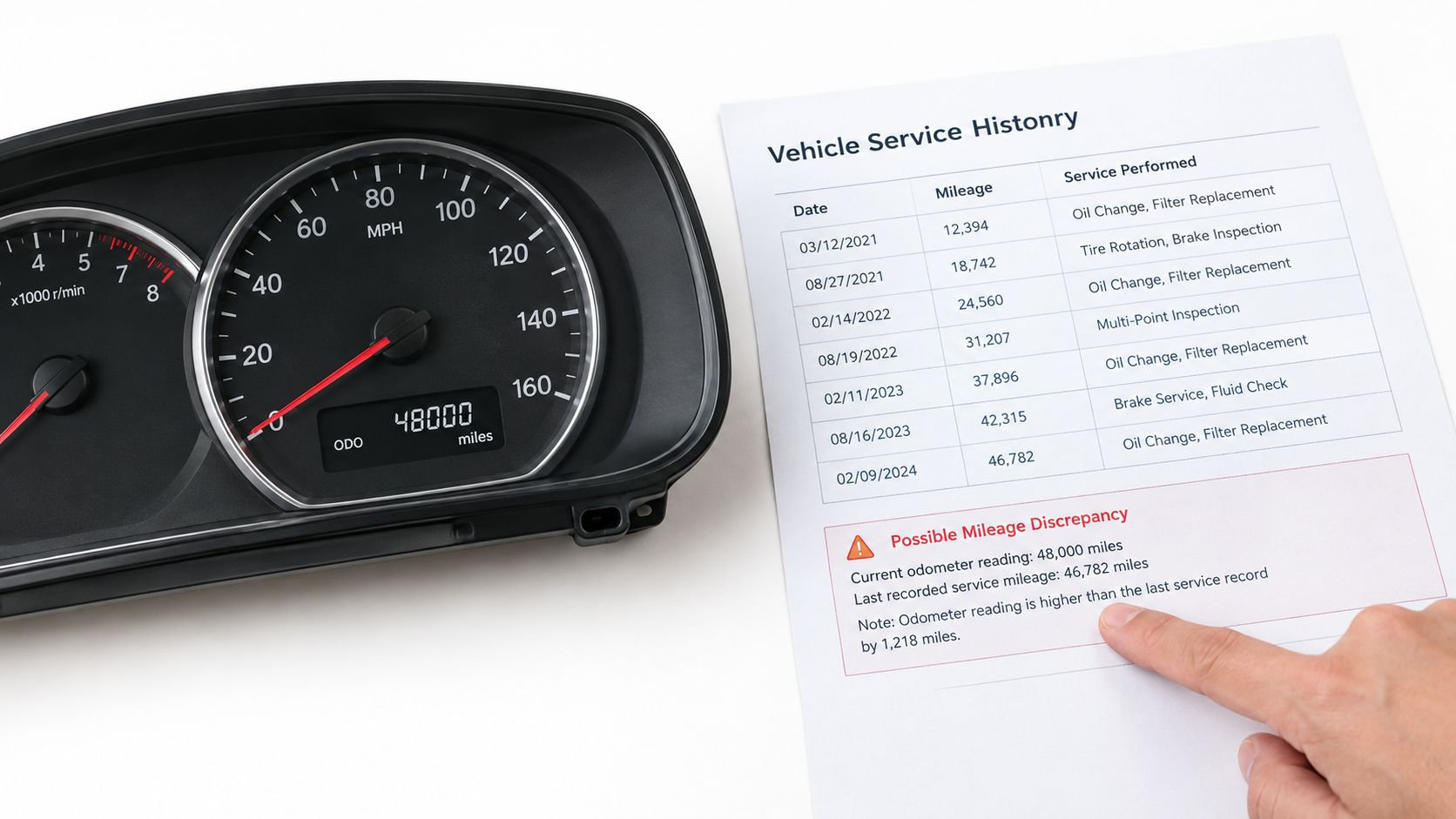
The MOT timeline is where many trade buyers find the first serious inconsistency. The official MOT record shows the mileage at each test, so you can reconstruct whether the odometer has risen in a believable pattern or whether there are negative jumps, plateaus, or strange gaps that don't fit the car's stated use (MOT history service).
Then look at the ownership story. If the V5C issue history suggests repeated reissues, that doesn't prove a problem on its own, but it does tell you to read the rest of the file more carefully. The value of the workflow is that it pushes you from instinct to evidence before you commit capital.
Source What It Verifies Key Limitation DVLA public vehicle information service Core identity details, first registration date, V5C issue history, tax and MOT status It is a record snapshot, not a full provenance judgement MOT history service Mileage at each test, pass or fail status, next MOT due date It shows test history, not every mileage event or ownership change Physical VIN inspection Whether the stamped identity on the car matches the documents It cannot explain why a mismatch exists Trade risk report Pattern-based risk signals across identity, mileage, and ownership It still depends on the quality of the underlying records In fast-moving buying environments, the routine stays the same even if the clock is tighter. At auction, on a trade-in, or in wholesale sourcing, the question is always the same, does the VIN-based story stay coherent when you compare the body, the document trail, and the mileage chronology?
VIN and chassis verification guidance belongs in that routine because chassis identity is part of the same physical-vs-record comparison. Once those basics are aligned, you can move on to whether the pattern itself makes commercial sense.
Reading Risk Signals in the VIN and Identity Trail
A matching VIN doesn't mean a clean car. It means the first identity test passed. The useful work starts when you ask what kind of VIN problem you're looking at, because not all failures mean the same thing.

Different VIN failures point to different risks
A legible VIN that still matches the paperwork is one thing. An illegible VIN can mean poor preservation, damage, or tampering. A mismatched VIN suggests the body, plate, or document trail doesn't line up. A missing VIN raises a different set of questions about identity integrity. A falsified or incomplete VIN is the most serious of the group because it points directly to deliberate interference or a broken chain of identity.
That distinction matters in trade buying because the response isn't the same for each case. One issue may need a physical reinspection and a document query. Another may mean walking away immediately. The point is to treat the failure mode as evidence, not just the word “mismatch” as a generic warning.
A 2025 analysis cited by a UK motoring outlet reported 449 VIN irregularities in that year, including 138 illegible VINs, 137 mismatched VINs, 104 missing VINs, and 70 falsified or incomplete VINs (Manchester Evening News coverage). The useful part of that figure isn't the headline, it's the spread of failure types. Different irregularities imply different problems, from accidental damage to cloning and identity laundering.
Trade takeaway: don't ask only whether the VIN matches, ask what kind of identity issue you're actually seeing.
That's where the document trail matters as much as the metal stamping. Plate changes, V5C reissues, imports, and repairs can all create confusing but explainable patterns. The job is to separate those from signs that the car's identity has been altered to hide its past.
Cloning risk and dealer response belongs in that judgement. A good buyer doesn't reject every irregularity, but they do document why a car was cleared, challenged, or removed from the file.
Interpreting Mileage and Ownership Anomalies in Context
Mileage checks fail when they're treated as a binary clocking test. In practice, the more useful question is whether the mileage pattern fits the vehicle's age, ownership pattern, and record history. That's where a mileage check UK becomes a valuation tool instead of a simple warning light.
Clean-looking records can still hide risk
HPI-reported UK motor-fraud figures recorded 836,214 confirmed mileage discrepancies in 2019, an 8.99% hit rate, after 607,981 cases in 2018 at 7.35%. Industry estimates also put about 160,000 buyers per year at risk of fraudulent mileage, with clocking costing Britain over £750 million annually (motor-fraud figures). Those figures are a reminder that a tidy history printout doesn't automatically mean a trustworthy car.
The practical job is to read non-linear patterns properly. A short ownership interval followed by quick resale can be benign, or it can be part of a story that needs checking. A long gap in MOT history can be the result of storage, export, SORN, or import timing, but it can also hide the place where a mileage record ought to have been visible and wasn't.
What to challenge before you price the car
- Abrupt mileage drops: treat any negative change as a reason to inspect the full timeline, not just the last certificate.
- Odd annual mileage bands: if the use pattern jumps in ways that don't fit the segment or the seller's story, ask for corroboration.
- Very short ownership periods: check whether the turnover reflects trade movement, a repair cycle, or something less comfortable.
- Missing record windows: don't confuse absence of evidence with evidence of absence.
The point is not to assume tampering every time a pattern looks uneven. Some vehicles have perfectly valid explanations. The point is to stop treating a clean sequence as proof of low risk when the rest of the file still looks thin.
How to read mileage history properly fits this part of the buying process because mileage only becomes meaningful when you compare it with the VIN, the MOT trail, and the ownership rhythm. A discrepancy may not kill the deal, but it should always change the price, the questions, or the decision.
Building VIN Checks Into Your Buying Workflow
The buying teams that stay out of trouble usually do the same thing every time. They verify the identity first, read the mileage next, then decide whether the vehicle's history supports the price. That sequence protects margin because it stops bad stock from being rationalised after the fact.
Use risk signals, not single checks, to decide
A vehicle that clears the VIN match but shows a weak MOT trail still needs scrutiny. A car with a believable mileage curve but odd identity history may still be risky. A stock unit with one soft warning might be worth renegotiating if the rest of the file is strong, but two or three aligned issues usually justify walking away.
That's where point-of-decision vehicle intelligence helps. AutoProv is one option that combines VIN validation, DVLA data, MOT history, mileage patterns, and ownership context into a trade-oriented risk view at the point of purchase. Used properly, that kind of tool doesn't replace judgement, it makes the judgement faster and easier to document.
What a defensible buying decision looks like
Keep the file notes tight. Record the VIN, the DVLA identity result, the MOT mileage trail, and any anomaly you found. If you renegotiate, record why. If you walk away, keep the reason short and factual so the next buyer or manager can see the logic.
Practical rule: if you can't explain the decision in one paragraph, the check probably wasn't specific enough.
That discipline matters because vehicle data is always a point-in-time snapshot. The market moves, records get updated, and sellers don't always tell the whole story. A consistent workflow protects the team from overconfidence and makes post-sale dispute handling much easier.
Making Provenance Intelligence Standard Practice
VIN-based provenance checks should sit inside the buying process, not around it. Identity verification comes first, mileage and ownership context follow, and the final decision is made on risk weight rather than on a single green or red result. That's the mindset that keeps vehicle provenance checks useful in a working dealership.
The wider reason is commercial, not abstract. Hidden history, mileage anomalies, and identity problems all create pressure on margin, time, and reputation. If your team checks differently from one vehicle to the next, you'll miss patterns that a standardised workflow would have caught early.
The right habit is simple. Make the VIN routine part of every acquisition, document every lookup, and use trade-focused dealer vehicle checks where manual baselines stop short. That gives you a defensible buying file, a clearer negotiation position, and fewer surprises after the car is on site.
If you want a more structured way to assess used car history by VIN in live buying decisions, visit AutoProv for trade-focused vehicle provenance and risk intelligence. It's built to help motor traders combine VIN, DVLA, MOT, mileage, and ownership signals at the point of purchase. That gives you a clearer basis for pricing, negotiation, and stock selection before you commit capital.
Frequently Asked Questions
AI-Generated Content Notice
This article was created with the assistance of artificial intelligence technology. While we strive for accuracy, the information provided should be considered for general informational purposes only and should not be relied upon as professional automotive, legal, or financial advice. We recommend verifying any information with qualified professionals or official sources before making important decisions. AutoProv accepts no liability for any consequences resulting from the use of this information.
From our AI insights
- Navigating UK Grey Imports: A Trader's Guide
Understand the complexities and opportunities of UK grey imports for savvy motor traders.
- Navigating VIN Checks Post-Brexit: What UK Traders Need to Know
Discover how Brexit impacts VIN checks for UK traders and the crucial data to review.
- Navigating Low-Cost Vehicle Checks in the UK
Learn how to safely conduct low-cost vehicle checks and avoid pitfalls.
Related Articles

Essential Vehicle Checks Before Buying a Used Car
Learn essential checks to ensure your used car purchase is safe and sound in the UK market.

Why a Provenance Check is Essential for Used Car Buyers
Ensure your used car is a smart investment by understanding the importance of a provenance check and how AutoProv can help.
A Guide to Vehicle Check with VIN Number
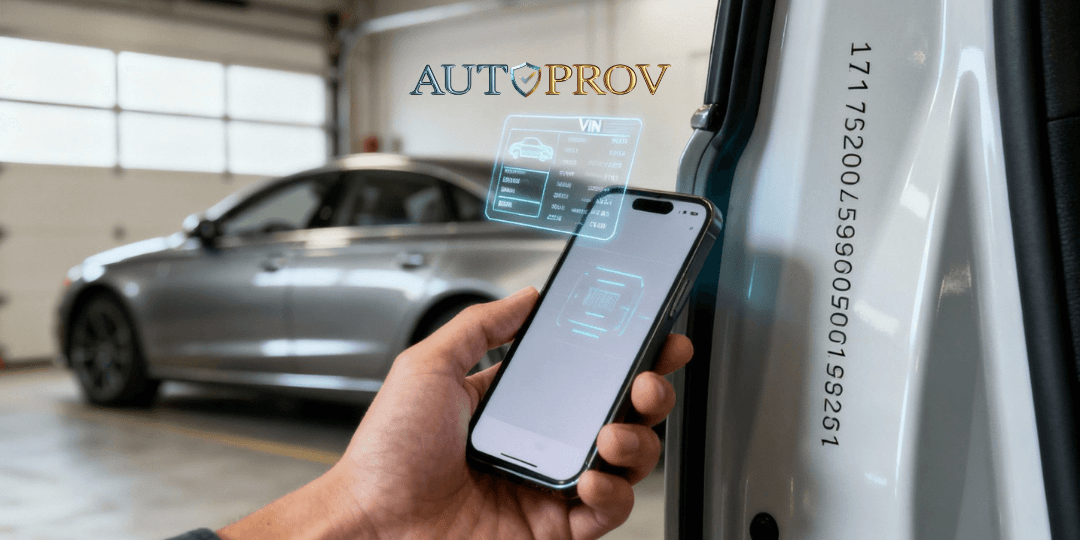
A vehicle check with vin number is easily the most important thing you can do before buying a used car. Think of it as your first line of defence—a quick, simple step that pulls back the curtain on a vehicle's past, protecting you from expensive mistakes, legal headaches, and downright dangerous cars.
Published by AutoProv
Your trusted source for vehicle intelligence